Role of Subcontractors in Custom Home Building

Most luxury custom homes in South Georgian Bay rely on a skilled network of subcontractors, yet over 80 percent of Canadian high-end builds involve five or more specialized trades. For homeowners investing in new construction or major renovations, knowing who actually completes each stage is essential to protect their investment. This article delivers clear guidance about the critical roles subcontractors play, helping you demand the highest standards for your Canadian dream home.
Table of Contents
- What Are Subcontractors in Construction?
- Major Types of Construction Subcontractors
- How Subcontractors Are Chosen and Managed
- Legal Agreements and Regulatory Compliance
- Risks, Costs, and Common Homeowner Mistakes
Key Takeaways
| Point | Details |
|---|---|
| Understanding Subcontractors | Subcontractors are specialised professionals hired by general contractors to perform specific tasks, ensuring high-quality construction outcomes. |
| Importance of Evaluation | Selecting subcontractors involves assessing their technical competence, licensing, and safety records to ensure project success. |
| Legal Agreements | Subcontractor agreements must clearly define responsibilities, performance standards, and comply with local regulations to protect all parties involved. |
| Homeowner Vigilance | Homeowners should conduct thorough research, use written contracts, and maintain detailed documentation to mitigate risks during construction. |
What Are Subcontractors in Construction?
In custom home building, subcontractors are specialised professionals who perform specific tasks within a larger construction project. A subcontractor is an independent company or individual hired by a general contractor to complete a defined portion of work under an existing contract. Unlike direct employees, subcontractors operate as separate business entities with unique expertise in specific construction disciplines.
Subcontractors typically focus on particular trades or skills essential to completing a home construction project. Common examples include electricians, plumbers, carpenters, roofers, and foundation specialists. These professionals bring targeted technical knowledge that ensures each aspect of home construction meets professional standards. Their specialisation allows general contractors to assemble project teams with precise skills matching specific project requirements.
The relationship between general contractors and subcontractors is governed by formal purchase orders and subcontract agreements that clearly define work scope, responsibilities, timelines, and payment terms. These legal documents protect both parties by establishing clear expectations and performance standards. Subcontractors are responsible for delivering high-quality work within agreed parameters, while general contractors coordinate overall project management and ensure seamless integration of various specialised services.
Pro tip: When selecting a custom home builder, always inquire about their network of subcontractors and how they manage and quality-control specialised work throughout the construction process.
Major Types of Construction Subcontractors
Custom home building requires a diverse range of specialized construction subcontractors who bring unique expertise to different stages of the project. These professionals represent critical trades that collectively transform architectural designs into functional, high-quality homes. Each subcontractor operates with specific licensing and technical skills that ensure precise implementation of construction requirements.
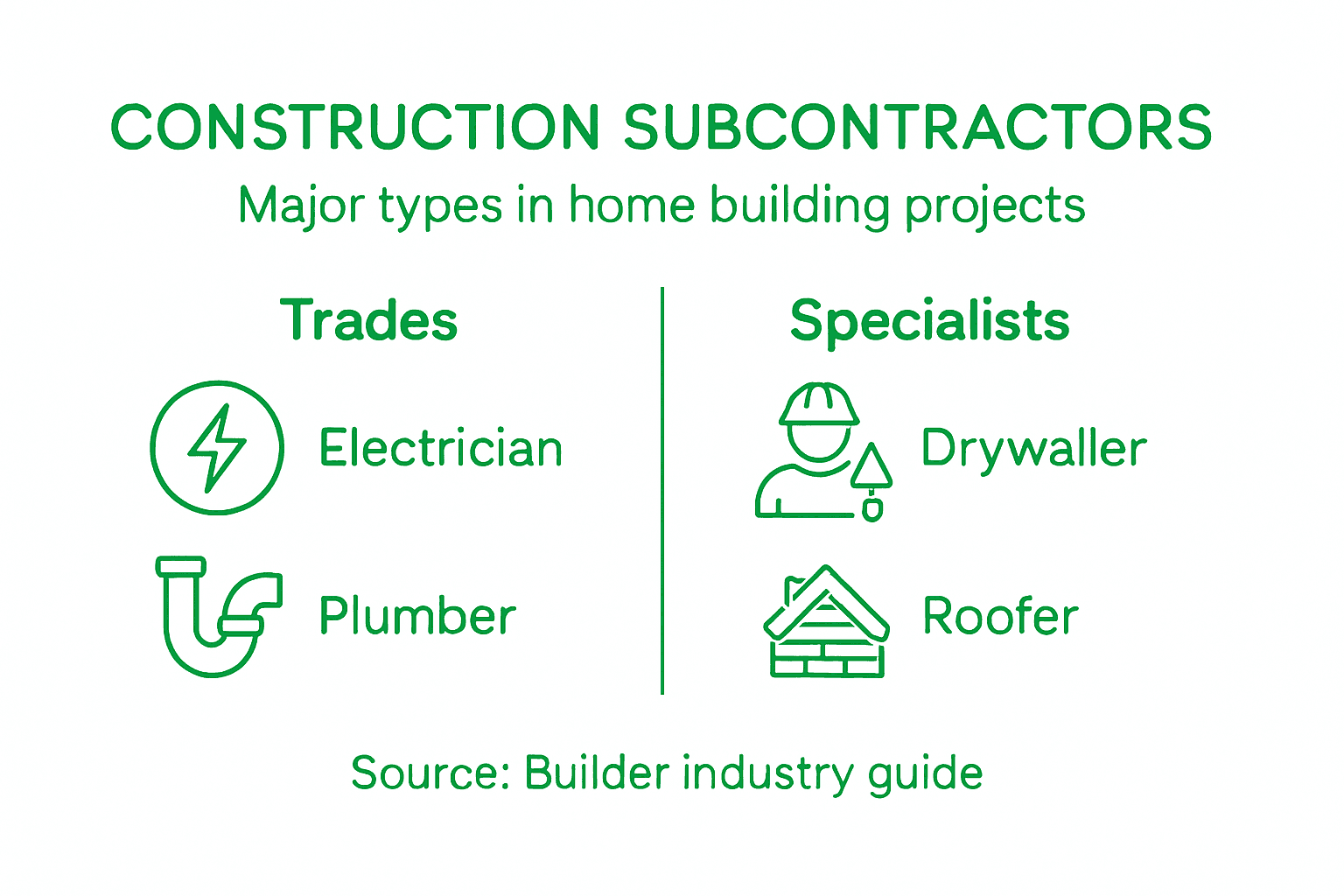
The most common types of construction subcontractors in residential building include:
- Electrical Subcontractors: Responsible for installing and maintaining electrical systems, wiring, panels, and ensuring safe power distribution throughout the home
- Plumbing Subcontractors: Handle water supply lines, drainage systems, fixture installations, and sewage connections
- Carpentry Subcontractors: Construct structural frameworks, install interior and exterior woodwork, build custom cabinetry, and manage framing
- Roofing Subcontractors: Specialise in roof installation, repairs, waterproofing, and selecting appropriate roofing materials
- Foundation Specialists: Prepare ground surfaces, pour concrete foundations, and ensure structural stability
Each subcontractor type brings specialized knowledge that contributes to different aspects of construction. Their collective expertise allows general contractors to manage complex projects by assembling teams with precise technical capabilities. A skilled general contractor understands how to coordinate these specialised professionals to ensure seamless project execution and consistently high-quality outcomes.
In practice, the strongest builders keep the same trades on the roster from build to build rather than re-tendering every job. On our projects across South Georgian Bay we bring in High Line Electric for electrical work, so service sizing, rough-in, low-voltage and lighting control, and ESA inspections are handled by a team that already knows our standards and our schedule.
Here is a summary of major subcontractor roles and their impact on home construction:
| Subcontractor Type | Core Responsibility | Impact on Project Quality |
|---|---|---|
| Electrical | Install and maintain all wiring | Ensures safe, reliable power |
| Plumbing | Manage water and drainage systems | Prevents leaks and water damage |
| Carpentry | Build structure and woodwork | Creates sturdy, durable framework |
| Roofing | Protect structure with roofing | Secures against weather elements |
| Foundation Specialist | Construct foundation base | Ensures lasting structural support |
Pro tip: When planning a custom home build, request detailed information about each subcontractor’s qualifications, licensing, and previous project experience to ensure comprehensive expertise.
How Subcontractors Are Chosen and Managed
Selecting and managing subcontractors is a critical process in custom home building that requires careful evaluation of contractor capabilities. General contractors develop comprehensive strategies to ensure they partner with the most qualified professionals who can deliver exceptional work across different construction disciplines. This selection process goes far beyond simply comparing price quotes and involves a thorough assessment of technical expertise, reliability, and past performance.
The subcontractor selection typically involves several key evaluation criteria:
- Technical Competence: Demonstrated expertise in specific construction trades
- Professional Licensing: Current and valid trade-specific certifications
- Previous Project References: Portfolio of completed similar projects
- Safety Record: Documented workplace safety practices
- Financial Stability: Ability to complete projects without financial interruption
Once selected, subcontractors are managed through rigorous oversight and performance tracking. General contractors establish clear contractual expectations that outline precise work parameters, quality standards, timelines, and payment schedules. Regular project meetings, detailed progress reports, and quality control inspections ensure that each subcontractor meets the agreed-upon standards and contributes effectively to the overall construction process.
Pro tip: Request comprehensive documentation from potential subcontractors, including their insurance certificates, worker’s compensation coverage, and detailed project completion records to validate their professional capabilities.
Legal Agreements and Regulatory Compliance
Custom home construction involves complex legal frameworks governing subcontractor relationships. These legal agreements establish clear boundaries, responsibilities, and expectations for all parties involved in the construction process. The primary objective is to create a comprehensive contract that protects the interests of the general contractor, subcontractors, and ultimately, the homeowner.
Key components of legal agreements for subcontractors typically include:
- Scope of Work: Detailed description of specific tasks and deliverables
- Performance Standards: Precise quality expectations and measurement criteria
- Payment Terms: Specific schedules, milestones, and payment conditions
- Insurance Requirements: Mandatory coverage levels and documentation
- Compliance Clauses: Adherence to local building codes and safety regulations
- Dispute Resolution: Predetermined mechanisms for addressing potential conflicts
Regulatory compliance extends beyond simple contractual obligations. Subcontractor agreements must address multiple regulatory dimensions, including workplace safety standards, environmental regulations, licensing requirements, and professional certification standards. General contractors bear ultimate responsibility for ensuring that all subcontractors meet provincial and national regulatory requirements, maintaining comprehensive documentation to demonstrate full compliance throughout the construction process.
Pro tip: Always engage a legal professional specializing in construction law to review subcontractor agreements, ensuring comprehensive protection and clear delineation of responsibilities.
Risks, Costs, and Common Homeowner Mistakes
Custom home construction involves significant financial investments and potential risks that homeowners must carefully navigate. Understanding common contractor scams is critical to protecting your investment and ensuring a successful building project. The complexity of working with subcontractors means homeowners must remain vigilant and informed throughout the construction process.
Common mistakes homeowners make when working with subcontractors include:
- Inadequate Research: Failing to thoroughly investigate contractor credentials and past performance
- Skipping Written Contracts: Proceeding without comprehensive, detailed written agreements
- Upfront Payment Errors: Making large advance payments before work begins
- Ignoring Insurance Verification: Not confirming subcontractors’ liability and worker’s compensation coverage
- Vague Scope Definitions: Not clearly specifying exact work requirements and expectations
- Pressure-Driven Decisions: Agreeing to services under high-pressure sales tactics
Financial risks in construction projects can be substantial, with potential cost overruns, unexpected complications, and quality issues threatening the entire project. Homeowners must establish clear communication channels, maintain detailed documentation, and understand their rights throughout the construction process. This includes maintaining a comprehensive record of all interactions, written agreements, and financial transactions to protect against potential disputes or unsatisfactory work.
The following table outlines common risks in subcontractor management and ways to reduce them:
| Homeowner Risk | Potential Outcome | Recommended Prevention Step |
|---|---|---|
| Poor subcontractor vetting | Delays, quality issues | Verify qualifications, check references |
| No written contracts | Disputes, unmet expectations | Use detailed legal agreements |
| Inadequate insurance | Legal/financial liability | Confirm all insurance certificates |
| Ambiguous work scope | Cost overruns, confusion | Define scope and deliverables clearly |
Pro tip: Create a dedicated project folder containing all contracts, communications, insurance documents, and progress records to maintain comprehensive oversight of your custom home construction project.
Ensure Your Custom Home Build Meets the Highest Standards with Expert Subcontractor Management
Building a custom home requires trustworthy subcontractors whose skills and reliability directly impact your project’s quality and timeline. At Mighton Construction Limited, we understand the critical importance of choosing and managing specialised subcontractors—from electricians and plumbers to carpenters and roofing experts—to deliver flawless craftsmanship throughout South Georgian Bay. With over 30 years of local expertise, our team coordinates every phase carefully to eliminate common risks and provide clear communication that keeps your dream home on track.

Discover how our premium custom home building services combine expert subcontractor oversight with a transparent, turn-key approach. Visit our custom homes service page to learn more about the precision and care we bring to each project. Ready to start your build confidently in Wasaga Beach or surrounding areas Explore our location hubs for detailed local insights. For comprehensive information and consultations, connect with us directly through Mighton Construction Limited and take the first step toward a home built exactly to your vision.
Frequently Asked Questions
What are the primary roles of subcontractors in custom home building?
Subcontractors in custom home building specialize in specific tasks such as electrical work, plumbing, carpentry, roofing, and foundation construction. They bring targeted expertise that ensures each aspect of the project is completed to professional standards.
How are subcontractors chosen for a construction project?
Subcontractors are typically selected based on their technical competence, professional licensing, previous project references, safety records, and financial stability. General contractors evaluate these criteria to ensure that the selected subcontractors can deliver high-quality work.
What legal agreements are involved in subcontractor relationships?
Legal agreements with subcontractors usually include the scope of work, performance standards, payment terms, insurance requirements, compliance clauses, and dispute resolution mechanisms. These contracts help protect the interests of all parties involved.
What are common mistakes homeowners make when working with subcontractors?
Common mistakes include inadequate research on subcontractors’ credentials, failure to use written contracts, making large upfront payments, and not clearly defining the scope of work. These errors can lead to disputes and unsatisfactory project outcomes.