
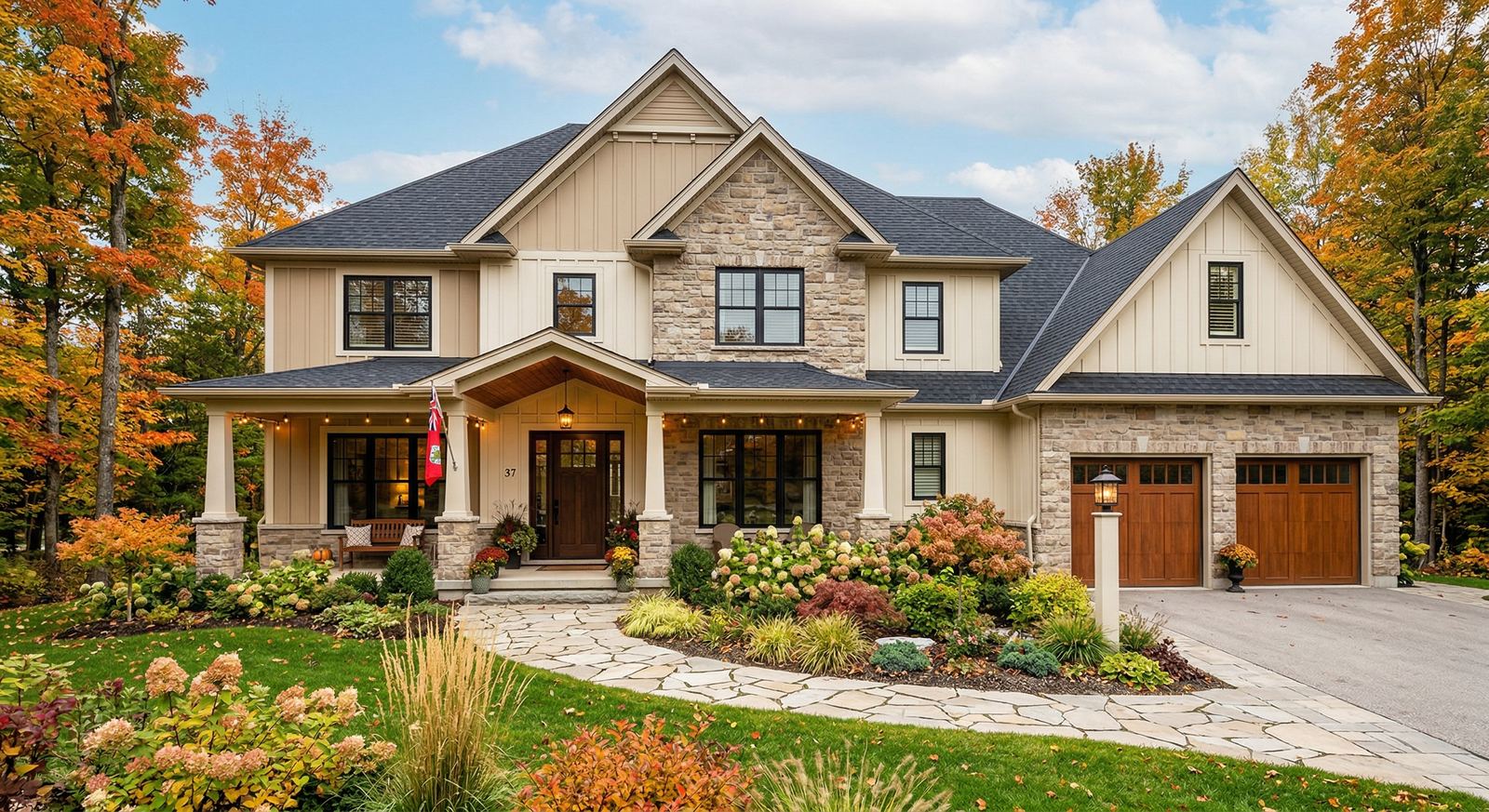
Custom Home Financing Guide (2026)
How construction mortgages, down payments, and budgets actually work when you build a custom home in South Georgian Bay — in plain language.
Financing a custom home works differently than buying a house that already exists. Because the home is built over many months, most people fund it with a construction mortgage that releases money in stages rather than all at once. Understanding how that works — and what lenders expect in 2026 — is one of the biggest things that separates a smooth build from a stressful one.
This guide explains the financing structures, down payment expectations, costs, and steps for building in Wasaga Beach, Collingwood, The Blue Mountains, and across Simcoe County. It pairs naturally with our custom home building service, where we provide open-book budgeting and detailed pre-construction estimates.
This is general educational information, not financial advice. Mortgage rules, rates, and rebates change frequently — confirm the current details with a licensed mortgage professional, your lawyer, and your accountant before making decisions.
The construction (progress-draw) mortgage
The most common way to finance a custom build is a progress-draw mortgage. Instead of one lump sum, the lender advances funds in draws as the home reaches defined stages. A typical schedule looks like this:
- 1.Foundation / excavation — first draw once the foundation is in.
- 2.Lock-up — framing, roof, windows, and exterior doors complete.
- 3.Drywall / mechanicals — insulation, wiring, plumbing, and drywall in.
- 4.Completion — finishes done and occupancy granted; the loan converts to a standard mortgage.
Before releasing each draw, the lender sends an appraiser to confirm the work is actually complete. During construction you usually make interest-only payments on the amount drawn so far, which keeps early payments manageable. In Ontario, a 10% holdback applies under the Construction Act to protect against trade and supplier liens, so plan your cash flow around money being held back at each stage.
Homes built with ICF constructionand other high-performance methods follow the same draw logic — the appraiser simply confirms each stage as it is reached.
Down payment, equity, and the 2026 rate picture
Construction financing is conventional lending, so budget for at least 20% equity — and be ready for many lenders to want 25–35% on a custom build, since an unfinished home carries more risk than an existing one. The good news: if you already own your lot, that land equity typically countstoward your down payment, which can dramatically reduce the cash you need up front.
On rates: after the elevated borrowing costs of 2023–2024, the Bank of Canada eased through 2025 and into 2026, but construction mortgages still generally price above a standard mortgage to reflect the added risk and administration. Rather than anchoring to a single number that changes monthly, get a current quote from a mortgage broker who handles construction lending — and budget a buffer in case rates move before your draws are complete.
For the build itself, our 2026 planning range in South Georgian Bay is roughly $400 to $700+ per square foot. Land, soft costs (permits, engineering, surveys, design), servicing (well, septic, or municipal connections), and a contingency of 10–15% all sit on top of the per-square-foot build cost. For deeper numbers, see our guides on the cost to build a custom home in Ontario, cost per square foot in Canada, and soft costs in Ontario home building.
HST and new-home rebates
A newly built home in Ontario is subject to 13% HST. When the home is your primary residence, the Ontario and federal New Housing Rebates can return a meaningful portion of that tax, and recent federal measures have targeted additional relief for first-time buyers on new builds. Because the rules and thresholds change, confirm your eligibility with your lawyer and accountant, and make sure your budget reflects the net HST you will actually carry — not just the sticker amount.
Steps to get financed
- 1. Talk to a construction-savvy mortgage broker early. Not every lender offers progress-draw mortgages; a broker who specializes in them will save you time.
- 2. Nail down your lot and budget. Lenders want to see a realistic, itemized budget — which is exactly what our pre-construction estimating provides.
- 3. Choose your builder and contract. A detailed fixed-price or open-book cost-plus contract with drawings strengthens your application.
- 4. Get approved and set the draw schedule. Align the lender's draw stages with your construction schedule so cash is available when trades need to be paid.
- 5. Build, draw, and convert. Draws release at each verified stage; at completion the loan becomes a standard mortgage. See how each stage runs in our custom home building process.
Custom home financing FAQs
How is financing a custom home different from a regular mortgage?
How much down payment do I need for a custom build in 2026?
What does it cost to build a custom home in South Georgian Bay right now?
Do I pay HST on a new custom home, and are there rebates?
When do I actually start paying, and how do the draws work?
Should I get financing approved before or after choosing a builder?
Planning a cottage instead? The same financing principles apply to a custom cottage or waterfront build. When you are ready to put real numbers to your project, request a consultationand we will help you build a budget a lender can work with.
Ready to put numbers to your custom home?
We provide open-book budgeting and detailed pre-construction estimates that lenders take seriously. Let's talk about your project, lot, and budget.