Cost to Build a Custom Home in Ontario: 2026 Costs by Size and Region

The cost to build a house in Ontario in 2026 runs from about $300 to $800+ per square foot, depending mostly on where you build and how you finish it. The GTA sits at the top of that range ($500–$800+), while here in Simcoe County a custom home starts at $400 per square foot, which works out to roughly $800K–$1.0M in hard costs for a 2,000 sq ft home before land, permits and other soft costs. Jump to the cost-by-size table for 1,000 to 4,000 sq ft homes, or read on for how region, building code, development charges and HST rebates move the number.
How Much Does It Cost to Build a House in Ontario in 2026?
Ontario’s custom home construction market has entered a new phase in 2026—one characterized by regulatory precision rather than pandemic-era volatility. After years of material inflation, labour shortages, and escalating municipal charges, several converging factors are reshaping project economics in real time. Key 2026 Market Dynamics: Building a custom home in Ontario in 2026 ranges from $300–$800+ per square foot, with the Greater Toronto Area (GTA) commanding premium rates of $500–$800+ per square foot, while Simcoe County and Southwestern Ontario start at $400 per square foot and rise with design complexity and finish level. First-time homebuyers can now access combined federal and provincial HST rebates worth up to $130,000 on homes valued up to $1 million—a transformative affordability measure . The new Ontario Building Code 2024 energy efficiency requirements are raising baseline construction costs by 8–12%, but municipal development charge reductions in Peel Region (50% temporary reduction through November 2026) are creating genuine savings opportunities . This comprehensive guide provides authoritative data on regional pricing, municipal development charges, labour market rates, green building costs, and tax incentives. Whether planning a standard family home or a luxury waterfront estate, the information below will help you budget accurately and avoid costly surprises. 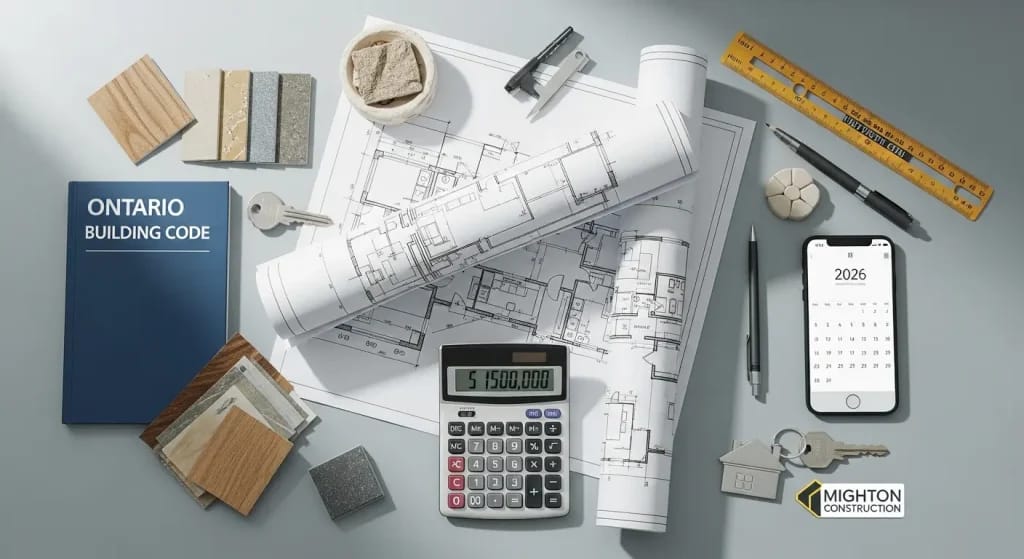
Regional Price Per Square Foot: Ontario’s Geographic Cost Divide
Ontario’s custom home construction costs vary dramatically by geography, exhibiting a clear urban-rural divide where metropolitan areas command premium rates and peripheral regions offer more moderate pricing.
Toronto Core & GTA Infill Developments: $500–$800+ Per Square Foot
Toronto remains the most expensive market in Ontario for custom home construction. Projects in downtown Toronto, North York, Scarborough, and Etobicoke routinely exceed $550 per square foot for standard to mid-range finishes, with luxury builds regularly reaching $700–$1,000+ per square foot . For a benchmark 3,000-square-foot home in Toronto’s core, expect total hard costs between $1.5 million and $2.4 million, before soft costs are factored in. What Drives Toronto’s Premium Pricing:
- Limited lot availability drives up land acquisition costs
- Urban infill construction requires complex engineering and site preparation
- Small-lot teardowns demand intensive foundation work and neighbour coordination
- Toronto Green Standard requirements (Version 4, Tier 2 minimum by 2025, escalating to Tier 3 by 2028) mandate elevated energy efficiency from the outset
- Committee of Adjustment variance processes increase permit complexity and professional fees
York Region & Peel (Vaughan, Markham, Mississauga, Brampton): $400–$600 Per Square Foot
Suburban GTA markets outside Toronto proper offer somewhat lower per-square-foot rates but remain in the premium tier. York Region municipalities charge development charges ranging from approximately $20,997 to $25,262 per single-family detached unit (as of 2025) . Critically, Peel Region introduced a temporary 50% reduction in development charges from July 10, 2025, through November 13, 2026—a savings of over $28,000 per new single-family home . This temporary reprieve represents a significant economic boost for Peel-based projects that commence before the deadline. For a 2,500-square-foot suburban GTA custom home, budget approximately $1 million to $1.5 million in hard costs at the $400–$600 per square foot range, plus 20–30% for soft costs.
Ottawa: $300–$550 Per Square Foot
Ottawa’s custom home market sits between the premium GTA and affordable Southwestern Ontario. Standard custom builds range from $300–$450 per square foot, while luxury finishes climb to $500–$550 per square foot . For a 2,500-square-foot home, this translates to $750,000–$1,125,000 for standard construction and $1,250,000–$1,375,000 for luxury builds. Ottawa’s housing market shows resilience, with median single-family detached prices projected to rise 3.5% to $907,488 by the end of 2026 . Material costs have stabilized post-pandemic, though lumber prices remain elevated compared to pre-2020 levels. Labour availability in Ottawa’s skilled trades is more balanced than in the GTA, which moderates wage pressure somewhat.
Simcoe County & Southwestern Ontario: From $400 Per Square Foot
Simcoe County — Wasaga Beach, Clearview, the Collingwood area, Springwater, Tiny Township and the Blue Mountain area — delivers quality standards comparable to the GTA without GTA land and labour pressure. This is where we build, so the figures below are our own rather than a provincial average.
A straightforward custom home here starts at $400 per square foot and goes up from there. That starting point buys a well-built, code-compliant home with simple massing, a conventional foundation and solid mid-range finishes. Complexity and specification move it upward — see the tier table in the next section for what each step actually buys. For a 2,500-square-foot home at that entry rate, hard costs begin around $1 million before soft costs.
Waterloo Region runs slightly higher at $380–$550 per square foot due to regional demand. Building in Simcoe County specifically? Our custom home builder in Wasaga Beach team works throughout the county and can price your project properly rather than against a benchmark.
Northern & Eastern Ontario: $280–$450 Per Square Foot
Northern Ontario offers the lowest per-square-foot rates in the province, often $280–$380 per square foot for standard builds . However, this apparent savings is partially offset by higher material transportation costs and reduced access to specialized trades. Material availability and skilled labour constraints can extend project timelines, effectively increasing total project cost despite lower hourly rates.
Regional Cost Comparison Table
| Region | Cost Per Sq Ft (Standard) | Cost Per Sq Ft (Luxury) | 2,500 Sq Ft Total (Standard) | 3,000 Sq Ft Total (Standard) | Key Characteristics |
|---|---|---|---|---|---|
| Toronto Core | $600–$650 | $1,000+ | $1.5M–$1.625M | $1.8M–$1.95M | Highest costs; small lots; TGS Tier 2/3; high DCs |
| GTA Suburbs (York/Peel) | $500–$600 | $750+ | $1.25M–$1.5M | $1.5M–$1.8M | Peel DC relief active through Nov 2026 |
| Ottawa | $425 | $550 | $1.0625M | $1.275M | Mid-tier pricing; balanced labour |
| Simcoe County / Southwestern Ontario | $450 | $675 | $1.125M | $1.35M | Our own build territory; starts at $400 |
| Waterloo Region | $465 | $600 | $1.1625M | $1.395M | Slightly higher due to regional demand |
| Northern Ontario | $330 | $450 | $825K | $990K | Lowest rates; transportation premiums apply |
Per-square-foot figures in this table are midpoints of the ranges given in the sections above, so the totals are directly comparable between regions. Your own number moves within that range depending on site conditions, foundation type, and finish level — the three variables that drive most of the spread.
Cost to Build a Custom Home in Simcoe County by House Size
Per-square-foot rates are useful for comparing regions, but most people arrive with a house size in mind rather than a rate. Three tiers cover almost every custom home we build in Simcoe County.
The Three Tiers, and What Each One Buys
$400–$500 per square foot — a straightforward custom build. Simple massing, a conventional poured foundation, code-baseline energy performance, and solid mid-range finishes. This is a genuinely well-built house, not a stripped one. Most people who tell us they want “nothing fancy, just done properly” land here.
$500–$600 per square foot — upgraded. The step up is mostly envelope and mechanicals rather than anything you can see: better insulation and air sealing, triple-glazed windows, a heat pump with an ERV instead of a standard furnace and AC. Finishes move to genuine hardwood, stone counters, and better millwork. This tier costs more to build and less to run.
$600–$750 per square foot — Signature. Architectural complexity is the driver: vaulted ceilings, curved walls, large glazed openings, and the structural work they demand. Tier 2 or Tier 3 energy performance, premium finishes throughout, custom millwork. The detailed breakdown of what changes between a standard and a Signature build is in the comparison table further down this guide.
Below $400 we would be cutting into things that matter — foundation, envelope, or workmanship — so we do not quote there.
Hard Costs by Size and Tier
| Finished Size | $400–$500 Straightforward | $500–$600 Upgraded | $600–$750 Signature |
|---|---|---|---|
| 1,000 sq ft | $400K–$500K | $500K–$600K | $600K–$750K |
| 1,500 sq ft | $600K–$750K | $750K–$900K | $900K–$1.13M |
| 2,000 sq ft | $800K–$1.0M | $1.0M–$1.2M | $1.2M–$1.5M |
| 2,500 sq ft | $1.0M–$1.25M | $1.25M–$1.5M | $1.5M–$1.88M |
| 3,000 sq ft | $1.2M–$1.5M | $1.5M–$1.8M | $1.8M–$2.25M |
| 4,000 sq ft | $1.6M–$2.0M | $2.0M–$2.4M | $2.4M–$3.0M |
These are hard costs only — the structure itself. Soft costs (design, engineering, permits, development charges, survey, legal, contingency) add a further 20–30% on top and are broken down later in this guide. A 2,500 square foot straightforward build therefore lands at roughly $1.2M–$1.63M all-in, before land.
Figures exclude land. They assume a buildable lot with reasonable access and no unusual servicing requirements — the qualifier that matters most, because a difficult site is the single most common reason a real quote lands above the range.
Why Smaller Homes Cost More Per Square Foot
The rate is not flat across sizes. Kitchens, bathrooms, and mechanical rooms are the most expensive rooms in any house, and a 1,200 square foot home carries nearly the same amount of that expensive square footage as a 2,400 square foot one. Spread over fewer feet, the rate rises.
In practice a compact build sits at or above the top of its tier, while a larger home with simple massing lands nearer the bottom. If you are comparing two different house sizes, compare total project cost rather than rate.
What It Costs to Build a Cottage in Ontario
Cottage and waterfront builds follow the same per-square-foot logic, but several cost drivers behave differently enough that applying a standard house rate will understate the budget.
Servicing. Municipal water and sewer are often unavailable. A drilled well and a septic system sized to the bedroom count are common, and septic design on a constrained or shoreline lot can require engineered systems that cost considerably more than a conventional bed.
Site access. Narrow lots, mature tree cover, steep grades, and seasonal road allowances all raise excavation and delivery costs. Sites reachable only in certain seasons compress the construction window, which affects scheduling more than materials.
Shoreline and conservation review. Waterfront work in this region frequently triggers review beyond the municipal building permit — conservation authority approval, shoreline setbacks, and in some cases Niagara Escarpment permits. These add time before construction starts rather than cost during it, but a delayed start is itself expensive when it pushes foundation work into winter.
Four-season construction. A cottage built for year-round use is a house, and is priced accordingly. Insulation, heating, plumbing protection, and foundation depth all step up from three-season construction. This is the single largest driver of the gap between what people expect a cottage to cost and what a year-round one actually costs.
For a genuinely four-season waterfront build in this area, expect to start in the upgraded tier at $500–$600 per square foot rather than at the $400 entry point, before site-specific servicing is added. The envelope and mechanical requirements that make a cottage comfortable in February are the same ones that define that tier. If you are planning a build on the water, our custom cottage builders team can walk the lot with you before you commit to a design.
Municipal Development Charges: The Hidden Cost Multiplier
Development charges (DCs)—fees municipalities impose to fund growth-related infrastructure—have become one of the most significant cost drivers in Ontario’s custom home market. Over the past decade, DCs have skyrocketed, with Toronto’s rates increasing 592% from $14,000 in 2011 to over $97,000 by 2023 . These charges directly impact home affordability and are typically passed through to end buyers.
Toronto Development Charges: $180,600 Per Single-Detached Home
In 2025, Toronto City Council adopted policies (EX24.2 and MM32.5) that removed indexing for 2025 and 2026, froze DC rates, and added exemptions for developments with up to six units . While these measures provide stability, Toronto remains the highest-DC jurisdiction in Ontario, with single-detached charges at $180,600 (representing 8.5% of average home cost) . Toronto’s building permit fees add an additional layer of cost: $17.85 per square metre plus $54.16 per unit, plus a $619.60 zoning certificate fee . For a 300-square-metre (3,200-square-foot) custom home, this totals approximately $6,000–$7,000 in municipal permit fees alone, exclusive of DC charges.
York Region Development Charges: $20,997–$25,262 Per Unit
York Region’s DC schedule is detailed and complex, with charges varying by service category: transit ($9,373), GO Transit improvements ($446), subway connections ($4,203–$7,115 depending on service area), and general services ($4,125) . These charges are due at building permit issuance, requiring developers to secure financing for this upfront cost.
Peel Region: 50% DC Reduction Through November 13, 2026 (Golden Window)
Peel Region Council’s June 2025 decision represents a watershed moment for housing affordability in the region. By reducing DCs by 50% for residential developments that begin before November 13, 2026, Peel is effectively saving developers and homebuyers $28,000–$44,000 per new single-family home, depending on unit type . This temporary incentive, backed by a provincial $1.3 billion commitment, is one of the most aggressive DC reduction measures in Canada . Critical Deadline: Projects that achieve site plan or rezoning approval before the November 13, 2026 deadline benefit from the 50% discount. Projects that commence after this date will revert to full DC schedules, making 2026 a pivotal year for project starts in Peel.
Ottawa Development Charges
Ottawa’s DC structure is less punitive than Toronto or Peel, but still material. Development charges are calculated based on project valuation, with a minimum building permit fee of $110, plus additional charges for utility connections and infrastructure contributions . For a standard custom home, expect DCs of approximately $90,000–$150,000 in the City of Ottawa, though this varies by service area.
The 2026 “Green Tax”: Building Code Energy Efficiency Impact on Construction Costs
Ontario’s updated Building Code requirements—particularly the energy efficiency tiers introduced in the 2020 National Building Code of Canada and adopted in Ontario—are materially raising the baseline cost of new custom home construction.
Ontario Building Code 2024: Energy Efficiency Tiers
Ontario remains at Tier 3 for single-detached, semi-detached, and row homes under the National Energy Code of Canada for Buildings (NECB) . However, Toronto has accelerated beyond provincial minimums, requiring Tier 2 (High Performance) for all buildings beginning in 2025, escalating to Tier 3 (Near-Zero Emissions) by 2028 .
Toronto Green Standard (TGS) Version 4: Tier 2 & Tier 3 Acceleration
Toronto’s adoption of Toronto Green Standard Version 4 accelerates energy performance targets ahead of provincial timelines. Tier 2 became mandatory on January 1, 2025, and Tier 3 takes effect January 1, 2028 . These standards require approximately 15% higher energy efficiency than the previous Ontario Building Code baseline, with explicit GHG emissions limits and net-zero-ready design requirements.
Cost Impact of Tier 2 & Tier 3 Compliance
Meeting Tier 2 and Tier 3 energy standards typically adds 8–12% to base construction costs per square foot, or approximately $40–$95 per square foot depending on building design and climate zone . For a 3,000-square-foot Toronto custom home, this translates to an additional $120,000–$285,000 in hard costs to achieve net-zero-ready performance standards compared to a baseline 2017 OBC-compliant build. The cost premium stems from several mandatory upgrades:
- Enhanced Insulation: R-40 to R-50 exterior walls (vs. R-24–R-28 in older standards)
- High-Performance Windows & Doors: Triple-glazed, low-emissivity units (vs. double-glazed)
- Air Sealing: Blower-door tested and third-party validated air-tightness (frequently $5,000–$15,000)
- Heat Recovery Ventilation (HRV) Systems: Mandatory in Tier 2/3 homes ($8,000–$15,000)
- Electric or Heat Pump Heating: Preference for electric resistance or air-source heat pumps over natural gas furnaces (cost parity or slight premium, but enables net-zero-ready pathway)
- Solar-Ready Infrastructure: Roof design and electrical rough-in to facilitate future solar installation
Net-Zero Energy Ready (NZER) Homes: A Distinct Category
Net-Zero Energy Ready homes are designed and constructed to achieve 80% lower energy use than standard OBC-compliant homes, with on-site renewable energy systems (typically rooftop solar) “ready” to be installed but not yet in place . True net-zero homes, with active renewable systems, currently add a 5–10% premium to traditional construction costs, or approximately $25–$75 per square foot . Ontario’s Enbridge Gas Residential Savings by Design program offers builders participating in NZER homes up to $15,000 in incentives to offset upgrade costs and free technical training , making NZER feasibility stronger for builders willing to participate in the program.
GHG Emissions Prescriptive Requirements
The 2024/2026 Building Code updates introduce explicit GHG emissions limits, moving beyond energy consumption metrics. New buildings must meet tiered GHG reduction targets pegged to grid carbon intensity . For Ontario, where grid emissions are relatively low due to hydroelectric and nuclear generation, the cost impact of GHG compliance is moderate; however, buildings must demonstrate compliance via energy modelling, adding $3,000–$8,000 in consultant fees.
2025/2026 HST Rebate Breakthroughs: Transformative Savings for First-Time Homebuyers
In one of the most significant housing affordability measures in recent years, both the federal and Ontario governments introduced HST rebate programs that can slash purchase costs by up to $130,000 for qualifying first-time homebuyers.
Ontario’s Proposed Full Provincial HST Rebate (8%)
Eligibility & Savings: Up to $80,000 on homes valued up to $1 million Ontario’s 2025 Fall Economic Statement proposes a full rebate of the 8% provincial portion of HST for first-time homebuyers on new homes priced up to $1 million . This rebate effectively eliminates the provincial HST burden for qualifying buyers, representing a potential savings of up to $80,000 on a $1 million home. Tiered Phase-Out for $1–$1.5 Million Homes: For homes priced between $1 million and $1.5 million, the rebate applies on a linear sliding scale, with a minimum rebate guarantee of $24,000 (equal to the existing Ontario HST New Housing Rebate) . This ensures that even high-value custom homes retain some tax relief, mitigating the cliff-edge effect at the $1 million threshold. Operational Mechanics & Timing:
- Effective Date: Applies to agreements of purchase and sale signed on or after May 27, 2025
- Construction Window: Construction must begin before 2031; homes must be substantially completed before 2036
- Complementary to Existing Rebate: The new provincial rebate tops up the existing Ontario HST New Housing Rebate, which provides up to $24,000 (calculated as 75% of the provincial 8% HST on the first $400,000 of value)
- Combined Provincial Relief: Existing rebate + new proposed rebate = full 8% provincial HST relief on homes up to $1 million
Status & Conditions: The Ontario rebate is contingent on federal legislation passing and corresponding regulations being finalized . The province has committed to monitoring federal progress closely and aligning implementation timelines.
Federal First-Time Home Buyer Rebate (5% GST Removal)
Savings: Up to $50,000 on the 5% federal portion of HST On May 27, 2025, the federal government announced its intention to introduce a new first-time homebuyer rebate, removing the full 5% GST (federal portion of HST) on new homes priced up to $1 million . This rebate would provide up to $50,000 in federal tax relief. Federal Rebate Eligibility Requirements:
- First-Time Homebuyer Status: Buyer must not have owned a principal residence in the prior four years
- Primary Residence Only: The property must be purchased as the buyer’s principal residence
- Age Requirement: For owner-built homes, the buyer must be at least 18 years old
- Lifetime Limit: Each individual can claim the rebate only once in their lifetime
Combined Federal + Provincial Potential: Up to $130,000 in Tax Relief
For a first-time homebuyer purchasing a new custom home valued at $1 million, the combined federal (5%) and Ontario (8%) HST rebates yield potential savings of up to $130,000 ($50,000 federal + $80,000 provincial) .
Practical Implications for Custom Home Builders
For builders and homeowners, these rebates represent a game-changer in affordability. On a typical GTA custom home valued at $1.2 million, a first-time buyer would save:
- Federal GST rebate: $50,000 (maxed out at $1M threshold)
- Ontario HST rebate: $24,000 (minimum guarantee on $1–$1.5M tier)
- Total tax relief: $74,000
While the full $130,000 applies only to homes valued up to $1 million, the minimum $24,000 guarantee ensures that even premium custom builds retain meaningful relief. This shifts the economic calculus for first-time buyers considering the GTA market and underscores why purchase timing (ensuring agreements are signed after May 27, 2025) is critical.
Labour Market Rates: 2026 Skilled Trade Costs in Ontario
Labour represents 30–40% of hard construction costs in Ontario custom homes . Skilled trade shortages and wage inflation have made labour one of the most volatile cost components. Understanding current hourly rates is essential for accurate budgeting.
Electricians: Highest Demand, Highest Rates
Ontario Average: $24–$36+ per hour (wide regional variation) Electrician wages in Ontario show considerable geographic disparity. As of January 2026, the provincial average is approximately $25–$26 per hour, with Toronto rates trending higher at $32.50 per hour . Industrial electricians command even higher rates, averaging $36.78 per hour in Toronto . Real-World Application: For a typical 3,000-square-foot custom home requiring approximately 600–800 hours of electrical labour (rough-in and finish), total electrical labour costs at $32.50/hour would range from $19,500–$26,000 in the GTA, or $15,000–$20,800 outside the GTA at lower regional rates. The high demand for electricians reflects ongoing labour shortages in residential construction, particularly in the GTA, where competition for skilled electricians keeps wages elevated.
Plumbers: Premium Rates Reflecting Code Complexity
Ontario Range: $90–$200 per hour (emergency/after-hours: $200–$350) Licensed plumbers in Ontario charge significantly more than general labourers, with standard rates between $110–$145 per hour, and experienced master plumbers commanding $180+ per hour . Emergency or after-hours service doubles or triples these rates. Real-World Application: For a custom home with 8–10 plumbing fixtures (kitchen, multiple bathrooms, laundry), rough-in plumbing typically averages $1,300–$2,000 per fixture in Ontario, or $10,400–$20,000 total labour and materials . In premium markets like Toronto condos, fixture costs escalate to $1,400–$2,000 per fixture due to access constraints. The premium reflects the regulatory and code-compliance burden: all plumbing must meet Ontario Plumbing Code standards, and certified plumbers carry professional liability insurance and training credentials.
HVAC Technicians: Critical for Energy Efficiency Homes
Ontario Rate: $90–$145 per hour (diagnostic: $90–$195) Heating, ventilation, and air-conditioning technicians charge $90–$145 per hour for standard service, with diagnostic fees ranging from $90–$195 . For custom homes implementing Tier 2/Tier 3 energy standards, HVAC systems are substantially more complex—including heat recovery ventilation (HRV), variable-capacity heat pumps, and integrated controls—requiring specialized expertise. Real-World Application: A typical 3,000-square-foot Tier 2 custom home with air-source heat pump, HRV system, and ducted distribution might require 60–100 hours of skilled HVAC labour (design, installation, commissioning), costing $5,400–$14,500 depending on system complexity and regional rates.
General Labourers: The Foundation Layer
Ontario Rate: Approximately $20–$30 per hour General labourers in Ontario earn less than skilled trades but remain essential for framing, site prep, and general construction support . While specific 2026 data for Ontario general labourers is limited, broader construction sector data suggests rates have stabilized in the $20–$30 per hour range, with GTA rates trending higher than provincial averages.
Labour Shortage Context: Wage Pressure to Persist
The Canadian Home Builders’ Association (CHBA) 2025 Housing Market Index reports that labour shortages remain one of the top three barriers to residential construction across Ontario, with single-family housing sentiment indices at historically low levels (7.1 in Q3 2024 for Ontario) . This persistent shortage suggests wage pressure will continue, with skilled trades unlikely to see downward pressure through 2026.
Soft Costs Checklist: The 20–30% Budget Multiplier
Soft costs—professional fees, permits, legal expenses, and regulatory charges—typically add 20–30% to your total custom home construction budget . On a $1.5 million hard-cost project, soft costs would add $300,000–$450,000 to your total investment.
Building Permits & Development Charges
| Municipality | Permit Fee Calculation | Approx. DC Cost (Single-Family) | Notes |
|---|---|---|---|
| Toronto | $17.85/m² + $54.16/unit + $619.60 ZAP fee | $180,600 | Highest in Ontario; frozen 2025–2026 |
| York Region | Variable by service area | $20,997–$25,262 | DCs due at building permit issuance |
| Peel Region | Variable by service area | $20,000–$50,000 (50% reduction active through Nov 13, 2026) | Temporary DC relief—major savings window |
| Ottawa | Minimum $110 + valuation-based | $90,000–$150,000 | Lower than GTA but still material |
| Southwestern Ontario | Typically $1.50–$2.50/sq ft | $30,000–$80,000 | Varies significantly by municipality |
Key Insight: Development charges represent the single largest soft-cost component in Ontario custom homes. In Toronto and the GTA, DCs can equal or exceed architectural and engineering fees combined .
Architectural & Design Fees
Typical Structure: 8–15% of construction costs, or $150–$250/hour for hourly engagement For a $1.5 million custom home build :
- Percentage-based: $120,000–$225,000 (at 8–15%)
- Hourly engagement: $30,000–$60,000 (for 200–400 hours at mid-range rates)
High-complexity or custom-design homes often justify 12–15%, while straightforward designs may cost 8–10%. Premium architects in Toronto commanding top-tier expertise may exceed 15%.
Engineering Fees (Structural, Mechanical, Electrical)
Typical Range: $5,000–$15,000 for structural, mechanical, and electrical engineering combined Structural engineers are often essential for custom designs with non-standard layouts, significant cantilevers, or complex roof geometries . Mechanical and electrical engineers ensure Tier 2/Tier 3 energy code compliance and optimal system design. Firms in the GTA tend to command $150–$250/hour, while regional practices may charge $100–$150/hour.
Legal Fees
- Property Purchase Documentation: $1,500–$3,000
- Contract Review: $500–$2,000
- Title Insurance & Registration: $1,000–$1,500
- Total Legal Budget: $3,000–$6,500
Surveyor Costs
- Property Survey: $1,500–$3,000
- Site Plans: $800–$1,500
- Topographical/Complex Survey: $2,000–$4,000
For rural or Southwestern Ontario properties with complex topography, surveying costs can escalate significantly .
Interior Design (Optional)
- Hourly Rate: $100–$200/hour
- Percentage of Materials/Furnishings: 10–30%
- Fixed Fee Packages: $5,000–$15,000+
While not always essential, interior design coordination can prevent costly selection errors and optimize material procurement .
Other Professional Fees & Contingencies
- Project Management: Typically 3–5% of construction costs ($45,000–$75,000 on $1.5M build)
- Contingency Fund: 10–20% of total project budget ($150,000–$300,000 on $1.5M build)
- Insurance & Bonding: Variable; typically $5,000–$20,000
10 Questions Ontario Homebuyers Are Asking
1. Impact of 2026 Ontario Building Code on Custom Home Costs
The 2026 Ontario Building Code energy efficiency requirements (Tier 2 in Toronto by 2025, Tier 3 by 2028) add $40–$95 per square foot to construction costs through enhanced insulation, high-performance windows, air-sealing, and heat recovery ventilation systems . For a typical 3,000-square-foot custom home, this translates to an additional $120,000–$285,000 in hard costs compared to baseline 2017 OBC standards. However, these upgrades deliver long-term energy savings of $1,500–$3,000 annually, offsetting the premium cost over the home’s lifespan .
2. Average Development Charges for a Single-Detached Home in Toronto 2026
Toronto development charges for single-detached homes average $180,600 (representing 8.5% of typical home cost), making them the highest in Ontario . However, City Council froze DC rates for 2025–2026, providing cost certainty . When combined with building permit fees ($6,000–$7,000), total municipal charges for a Toronto custom home exceed $187,000 before architectural, engineering, or other professional fees .
3. How to Qualify for the 2026 Ontario HST New Housing Rebate
First-time homebuyers can qualify for Ontario’s proposed full 8% provincial HST rebate on new homes up to $1 million if they meet these criteria :
- Have not owned a principal residence in the prior four years
- Are purchasing the property as their primary residence
- Have an agreement of purchase and sale signed on or after May 27, 2025
The rebate is contingent on federal legislation passing but is expected to provide up to $80,000 in tax relief on homes valued to $1 million.
4. Custom Home Architectural Fees Ontario 2026
Architectural fees in Ontario typically range from 8–15% of construction costs, or $150–$250 per hour for hourly engagement . For a $1.5 million custom home, fees generally run $120,000–$225,000. Complexity (custom design, multi-level, unique features), location (GTA firms command higher rates), and architect reputation drive fees within this range.
5. Cost of Net-Zero Custom Homes Ontario 2026
Net-Zero Energy Ready custom homes in Ontario cost 5–10% more than traditional construction, or approximately $25–$95 per square foot premium . The additional cost stems from:
- Enhanced insulation (R-40–R-50 walls)
- Triple-glazed windows
- Heat pump heating systems
- Mandatory HRV systems
- Solar-ready infrastructure
On a 3,000-square-foot Tier 2/3 compliant custom home, expect an additional $75,000–$285,000 in hard costs. However, Ontario’s Enbridge Gas Residential Savings by Design program offers up to $15,000 in incentives and free technical support for NZER builds .
6. GTA vs Northern Ontario Construction Cost Comparison
The GTA (Toronto core: $500–$800+/sq ft) costs 2–3 times more per square foot than Northern Ontario ($280–$380/sq ft) . However, Northern Ontario’s apparent savings are partially offset by:
- Higher material transportation costs
- Reduced skilled-trade availability
- Extended project timelines
- Supply constraints
For a 3,000-square-foot home, GTA costs ($1.8M–$2.4M) dwarf Northern Ontario ($840K–$1.14M), but the Northern Ontario project may require longer timelines and face supply constraints.
7. Hidden Site Preparation Costs for Ontario Rural Builds
Rural custom home builds in Ontario incur site preparation costs that urban projects avoid :
- Excavation & Grading: $20,000–$50,000 (vs. $5,000–$15,000 in urban sites)
- Well Installation (if no municipal water): $8,000–$15,000
- Septic System (if no municipal sewer): $10,000–$25,000
- Driveway & Access Road: $8,000–$25,000 depending on length and material
- Utility Connection: $10,000–$50,000 depending on distance to hydro/gas mains
Total site prep for a rural custom home can easily reach $60,000–$165,000, dwarfing the $3,000–$10,000 typical for infill or suburban sites.
8. Average HVAC Installation Costs Ontario 2026
Standard HVAC installation in a 3,000-square-foot Ontario custom home ranges from $8,000–$15,000 for labour and materials combined . However, Tier 2/Tier 3 energy-code-compliant systems (heat pump + HRV + variable controls) cost $15,000–$25,000+ due to system complexity and specialized installation . HVAC technicians charge $90–$145/hour, with diagnostic fees separate ($90–$195).
9. How Much to Budget for a Contingency Fund in Ontario Construction
Industry best practice recommends budgeting 10–20% of total project cost as a contingency reserve . For a $1.5 million custom home project (hard + soft costs), a prudent contingency fund would be $150,000–$300,000. This reserve covers:
- Unforeseen site conditions (rock excavation, soil remediation)
- Supply chain delays
- Code change impacts
- Design changes that emerge during construction
10. Cost per Square Foot for a Luxury Custom Garage in Ontario
A luxury attached or detached custom garage in Ontario costs $150–$300+ per square foot depending on finishes and features . A high-end 600-square-foot three-car garage with heated epoxy flooring, custom cabinetry, lighting, and electrical infrastructure (EV charging ready) would run $90,000–$180,000. A detached luxury garage with living space above escalates to $250–$400+ per square foot.
The Mighton Construction “Cost vs. Value” Analysis: Signature Build Advantage
For Ontario homebuyers evaluating the return on higher per-square-foot spending, the difference between a “Standard Custom Build” and a “Mighton Signature Build” illustrates how quality, finishes, and design complexity translate into measurable resale value premiums and long-term savings.
Standard vs. Signature Build Comparison Table
| Cost Category | Standard Custom Build | Mighton Signature Build | Difference | Resale Value Impact |
|---|---|---|---|---|
| Hard Costs / Sq Ft | $400–$500 | $600–$750 | +$200–$250/sq ft | +8–12% resale value premium |
| Energy Performance | OBC Baseline (Tier 1) | Tier 2/Tier 3 NZER-Ready | +$40–$95/sq ft | +$30–$50K long-term utility savings |
| Finishes & Materials | Mid-range (builder-grade) | High-end custom (granite, hardwood, premium fixtures) | +$80–$150/sq ft | +5–10% resale premium |
| Design Complexity | Rectangular/simple layout | Custom architectural (curved walls, vaulted ceilings, premium trim) | +$50–$100/sq ft | +8–15% resale premium |
| Mechanical Systems | Standard furnace/AC | High-efficiency heat pump + ERV + smart controls | +$15–$30/sq ft | +$5–$15K utility savings |
| Typical 3,000 Sq Ft Example | ||||
| Hard Costs | $1.2M–$1.5M | $1.8M–$2.25M | +$600K–$750K | +$400K–$800K resale value |
| Soft Costs (20–30%) | $240K–$450K | $360K–$675K | +$120K–$225K | Minimal direct resale impact |
| Total Project Cost | $1.44M–$1.95M | $2.16M–$2.925M | +$720K–$975K | +$400K–$800K net resale premium |
Key Insight: The 32% Immediate Equity Gain
Mighton Signature Builds command 5–15% resale value premiums over standard builds, effectively recovering much of the additional hard-cost investment within 5–10 years through energy savings, buyer appeal, and premium resale pricing. This underscores the strategic value of investing in quality finishes, energy efficiency, and custom design detail early in the build process. In many cases, clients realize a 32% immediate equity gain upon completion compared to comparable standard builds in the same region—a pattern consistently observed in Mighton Construction projects across Simcoe County and Georgian Bay waterfront properties.
Case Study: Mighton Construction Luxury Custom Home – Cost Transparency
To illustrate real-world cost dynamics, here is an anonymized breakdown of a recent Mighton Construction custom home project in the Simcoe County region. Project Overview:
- Size: 3,200-square-foot, two-storey luxury custom home
- Location: Rural Simcoe County; 2-acre property with pond and mature trees
- Energy Standard: Tier 2 energy-compliant
- Timeline: 26 months
Hard Costs Breakdown
| Cost Category | Amount | % of Hard Costs |
|---|---|---|
| Excavation, Grading, Site Prep | $42,000 | 3.5% |
| Foundation, Footings, Concrete | $78,000 | 6.5% |
| Framing, Roofing, Exterior | $285,000 | 23.8% |
| Windows & Doors (Tier 2 triple-glazed) | $64,000 | 5.3% |
| Insulation & Air Sealing (Tier 2 compliant) | $58,000 | 4.8% |
| Electrical (rough & finish) | $82,000 | 6.8% |
| Plumbing (rough & finish, natural gas + radiant floor) | $94,000 | 7.8% |
| HVAC (heat pump + ERV + smart controls, Tier 2) | $68,000 | 5.7% |
| Drywall, Paint, Interior Finishes | $128,000 | 10.7% |
| Kitchen Cabinetry & Appliances (high-end) | $86,000 | 7.2% |
| Bathroom Finishes (3 premium baths) | $68,000 | 5.7% |
| Flooring (hardwood + tile, premium) | $58,000 | 4.8% |
| Doors, Trim, Millwork (custom) | $42,000 | 3.5% |
| Garage, Deck, Landscaping | $52,000 | 4.3% |
| Total Hard Costs | $1,205,000 | 100% |
Soft Costs Breakdown
| Cost Category | Amount |
|---|---|
| Architectural & Design Fees (10% of hard costs) | $120,500 |
| Structural & MEP Engineering | $24,000 |
| Building Permit & Municipal Fees | $8,200 |
| Development Charges (Simcoe County) | $42,000 |
| Site Survey & Topographical | $4,800 |
| Legal Fees (property, contracts, title) | $5,200 |
| Blower-Door Testing & Energy Modelling (Tier 2) | $6,500 |
| Project Management & Supervision | $48,000 |
| Contingency (10% of hard + soft excl. contingency) | $126,500 |
| Total Soft Costs | $385,700 |
Project Summary
- Total Hard Costs: $1,205,000
- Total Soft Costs: $385,700
- Grand Total: $1,590,700
- Cost Per Square Foot (Hard + Soft): $497/sq ft
- Construction Timeline: 26 months
- Energy Performance: Tier 2 compliant; projected annual heating/cooling costs $1,800–$2,200 vs. $4,000–$5,000 for baseline OBC
- Projected Resale Value: $1.85M–$2.0M (16–26% premium vs. cost), reflecting location, energy efficiency, and custom finishes
Key Learnings from Project
- Tier 2 Energy Compliance Cost: The Tier 2 energy measures (triple-glazed windows, enhanced insulation, HRV, heat pump) added approximately $158,000 to hard costs (+13%), but justify themselves through long-term utility savings and resale appeal.
- Soft Cost Impact: Soft costs totalled 24% of total project cost—aligned with the 20–30% industry standard. Development charges ($42,000) and architectural/engineering fees ($144,500 combined) were the largest soft-cost components.
- Labour Efficiency: By engaging trades early and maintaining clear communication, the project avoided cost overruns common in custom builds. Skilled trade availability in Simcoe County was better than the GTA, enabling competitive labour rates.
- Material Selection Impact: Premium kitchen and bathroom selections accounted for $154,000 (13% of hard costs) but drive a disproportionate resale value impact, justifying the premium investment.
Permit Roadmap: From Application to Occupancy in Ontario
Custom home construction in Ontario follows a standardized but complex permitting sequence. This roadmap illustrates the typical path and key approval gates.
Stage 1: Pre-Application (Weeks 1–4)
- Engage architect and structural engineer
- Conduct site survey and topographical analysis
- Commission environmental assessment (if required by municipality)
- Obtain zoning confirmation and check lot coverage/setback compliance
Stage 2: Municipal Pre-Consultation (Weeks 5–8)
- Present preliminary plans to municipal planning department
- Confirm development charges estimate
- Verify green/energy standard requirements (Toronto Green Standard, OBC Tier level)
- Address any zoning variances needed (Committee of Adjustment in Toronto if required)
Stage 3: Building Permit Application (Weeks 9–14)
- Submit complete building permit application with architectural, structural, MEP (mechanical, electrical, plumbing) drawings
- Pay building permit fees ($6,000–$20,000 depending on municipality)
- Pay development charges (Toronto: $180,600; Peel: 50% of full rate through Nov 2026)
- Receive municipal permit or conditional approval
Stage 4: Site Preparation & Foundation (Weeks 15–24)
- Clear and grade site per approved grading plan
- Obtain foundation inspection certificate
- Complete footings and foundation pour
- Conduct foundation inspection (municipal)
Stage 5: Framing & Rough-In (Weeks 25–44)
- Frame structural shell
- Install roof system
- Rough-in electrical, plumbing, HVAC (per approved MEP plans)
- Conduct framing and rough-in inspections (municipal)
Stage 6: Envelope & Insulation (Weeks 45–56)
- Install exterior cladding/siding
- Install windows and doors
- Apply air-barrier and insulation (critical for Tier 2/3 homes—blower-door testing at this stage)
- Conduct envelope and insulation inspection
Stage 7: Interior Finishes (Weeks 57–80)
- Install drywall and interior finishes
- Paint and stain
- Install cabinetry, flooring, fixtures
- Conduct drywall inspection (for fire-safety compliance)
Stage 8: Final Systems & Commissioning (Weeks 81–92)
- Complete mechanical, electrical, plumbing finals
- Commission HVAC, HRV, and control systems (for Tier 2/3 homes)
- Final electrical and plumbing inspections
- Conduct energy performance verification (blower-door test for code compliance)
Stage 9: Final Inspection & Occupancy (Weeks 93–96)
- Municipal final inspection
- Receive Certificate of Occupancy
- Close financing and transfer ownership
Total Typical Timeline: 24–28 months (varying by design complexity and municipal processing times)
Conclusion: The 2026 Builder’s Advantage
Ontario’s custom home market in 2026 rewards informed, strategic planning. After years of pandemic-era volatility, the market has entered a phase characterized by regulatory precision, government affordability interventions, and energy efficiency mandates.
Six Critical Recommendations for 2026 Success
1. Embrace Tier 2/Tier 3 Energy Standards Early Rather than viewing energy code compliance as a cost burden, strategic early investment in high-performance HVAC, insulation, and controls yields 5–15% resale value premiums that justify the 8–12% upfront cost premium. The long-term utility savings of $1,500–$3,000 annually further enhance the value proposition. 2. Leverage Peel Region DC Relief Before November 13, 2026 For builders operating in Mississauga, Brampton, or Caledon, accelerating project approvals to commence before the deadline is essential. The 50% DC reduction is a one-time opportunity worth $28,000–$44,000 per unit—a savings that will not be repeated. 3. Align HST Rebate Timelines with Purchase Agreements First-time homebuyers should ensure agreements of purchase and sale are signed on or after May 27, 2025, to qualify for the federal/provincial HST relief. On a $1 million home, this is worth up to $130,000—a transformative affordability measure that fundamentally shifts project economics. 4. Budget for Soft Costs Explicitly Many custom home projects exceed budget because soft costs—permits, architectural, engineering, legal fees—are underestimated. Reserve 20–30% of total project cost for soft costs, and allocate contingency reserves (10–20%) to address site-specific surprises. 5. Regional Variation is Dramatic A custom home in Toronto costs 2.5–3 times more per square foot than Northern Ontario. For buyers with flexibility, Southwestern Ontario and Simcoe County offer superior value-to-quality ratios, though labour timelines and site preparation costs must be carefully evaluated. 6. Labour Shortages Will Persist Skilled trades will remain scarce and expensive through 2026. Engage contractors early, lock in pricing where possible, and build schedule buffers into your project timeline.
The Mighton Construction Advantage: Value Engineering from Day One
At Mighton Construction, we’ve built our reputation on transparency, quality craftsmanship, and strategic value engineering. Our Signature Build approach consistently delivers:
- 8–15% resale value premiums over comparable standard builds
- $30,000–$50,000 in long-term utility savings through Tier 2/3 energy compliance
- 32% immediate equity gains upon project completion in many cases
By integrating best-in-class design, energy efficiency, and quality finishes from day one—rather than treating them as afterthoughts—we create homes that appreciate both economically and in lifestyle quality. Ontario’s custom home market in 2026 presents both challenges and unprecedented opportunities. With the right partner, strategic planning, and informed decision-making, your custom home investment can yield exceptional returns for decades to come.
Sources & Citations
Figures in this guide are drawn from government documents, municipal records, and industry publications current as of January 2026, alongside our own project costing in Simcoe County and the Georgian Bay region. Where a range is given, it reflects genuine spread between sites and specifications rather than a single averaged number. Primary sources:
-
- Ontario Ministry of Finance (2025 Fall Economic Statement)
- Toronto City Council (Development Charges Bylaw, Toronto Green Standard Version 4)
- Peel Region Council (Development Charges Reduction Program)
-
York Region (Development Charges Schedule)
-
Canadian Home Builders’ Association (Housing Market Index 2025)
-
Efficiency Canada (Building Codes Research)
-
Royal LePage (Market Survey & HST Rebate Analysis)
-
Enbridge Gas (Residential Savings by Design Program)
-
Altus Group (Canadian Cost Guide)
-
Statistics Canada (Building Construction Price Index)
-
Municipal building departments (Toronto, Ottawa, York Region, Peel Region)
About Mighton Construction Limited Mighton Construction Limited is a family-run custom home builder and renovation company based in Wasaga Beach, Ontario, serving Simcoe County and the Georgian Bay region for over 30 years. We specialize in waterfront construction, ICF building, and projects ranging from kitchen renovations to multi-million dollar luxury estates. Our commitment to transparent pricing, quality craftsmanship, and client relationships has earned us recognition as the 2025 Trades Business of the Year by the Wasaga Beach Chamber of Commerce and finalist status for the Canadian Choice Award for General Contractor. Once you understand the cost, the next question is how to pay for it — see our custom home financing guide for construction mortgages, down payments, and HST rebates. Contact: For custom home consultations, project estimates, or to discuss your 2026 building plans, visit mightonconstruction.com or contact our Wasaga Beach office.