
Why energy efficiency matters for luxury custom homes
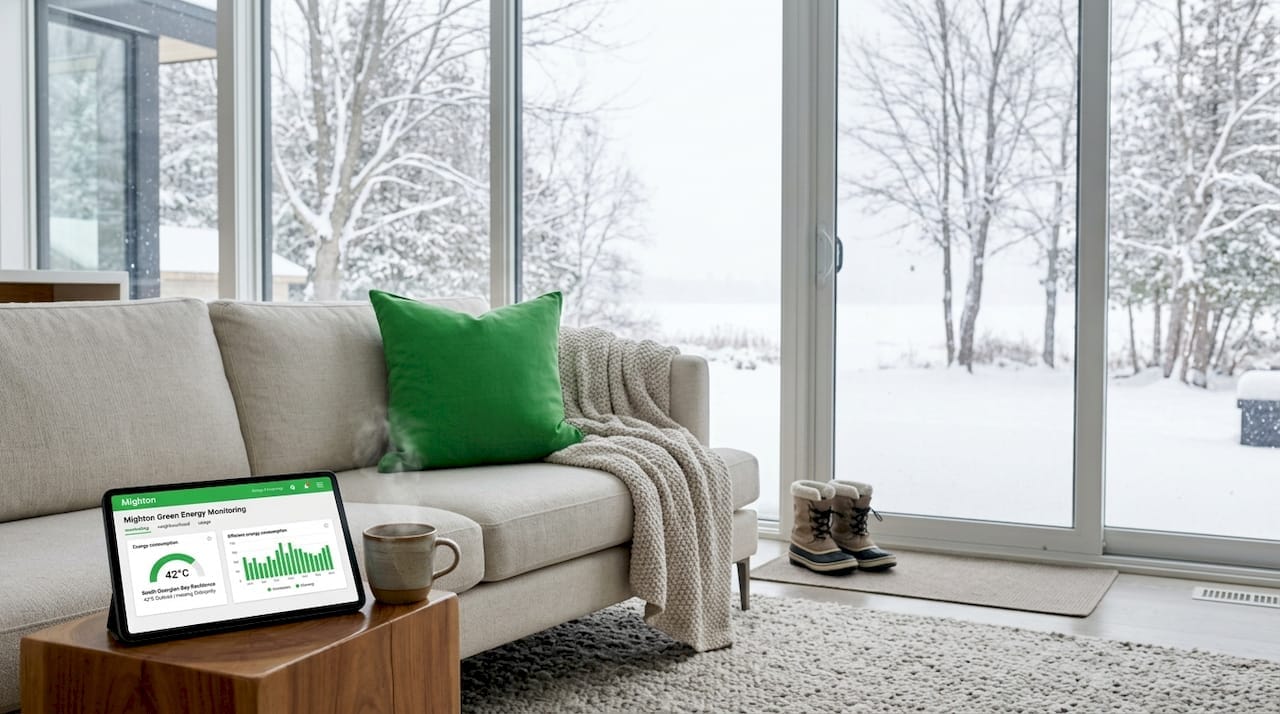
TL;DR:
- Energy efficiency in South Georgian Bay homes influences comfort, resale value, and environmental responsibility beyond mere cost savings. Implementing strategic envelope improvements, adhering to Ontario’s SB-10 standards, and sequencing upgrades from weatherisation to mechanical systems optimize long-term performance and savings. Ongoing maintenance and data-driven decision-making are essential for sustaining efficiency, making thorough planning and real evidence crucial for luxury property success.
Energy efficiency is widely misunderstood as simply a cost-saving measure, but for homeowners and property developers in South Georgian Bay, it represents something far more significant. It shapes everyday comfort, future resale value, environmental responsibility, and your home’s long-term resilience against Ontario’s harsh heating seasons. Reducing home energy demand lowers energy bills while decarbonising buildings, and the financial and lifestyle returns on a well-executed efficiency strategy consistently outperform those of superficial upgrades. This article walks you through the real impacts, the regulatory requirements, and the practical steps that make efficiency work for luxury builds and renovations in the South Georgian Bay region.
Table of Contents
- The true impact of energy efficiency in Canadian homes
- Understanding Ontario’s energy efficiency requirements
- Making upgrades count: Practical steps for energy efficiency
- ROI and incentives: The financial case for energy efficiency
- Beyond new builds: Maintenance, tech, and the ‘efficiency gap’
- Why the smartest efficiency strategies start with real evidence
- Ready to make your home more efficient?
- Frequently asked questions
Key Takeaways
Point
Details
Lower costs, higher comfort
Smart energy upgrades significantly reduce utility bills and improve home comfort for homeowners and developers in luxury markets.
Mandatory and strategic
Ontario’s building codes require energy efficiency, but the right approach enhances value far beyond minimum compliance.
Proper sequencing pays off
Investing in insulation and air sealing first delivers better comfort and maximised financial returns compared to system swaps alone.
Incentives boost ROI
Available incentives and rebates can reduce payback periods and make efficiency investments more attractive.
Don’t overlook operations
Regular maintenance and digital optimisation close the efficiency gap in both new and existing luxury homes.
The true impact of energy efficiency in Canadian homes
Most people assume energy efficiency is about paying slightly less on a monthly utility bill. The actual story is far broader and, frankly, more compelling. When you build or renovate with efficiency as a guiding principle, you are making a decision that affects indoor air quality, thermal comfort on a minus-twenty January morning, the appraised value of your property, and your home’s contribution to Canada’s climate targets.
Buildings are Canada’s third-largest source of greenhouse gas emissions, and over 96% of direct building emissions come from space and water heating. That single statistic should reframe how you think about every insulation, window, and mechanical decision in a luxury build. You are not just choosing a comfortable home; you are choosing whether your home sits on the right side of Canada’s energy transition.
“The most expensive energy is the energy you waste. For luxury homes, waste often hides inside oversized mechanical systems, under-insulated envelopes, and uncontrolled air leakage.”
For South Georgian Bay properties, heating load is the dominant energy demand driver. Cold winters, proximity to Georgian Bay and its lake-effect weather patterns, and the prevalence of large-footprint luxury homes all amplify energy costs. A well-insulated envelope is not a luxury feature; it is a foundational requirement. Research into passive house energy savings consistently shows that homes built to aggressive efficiency standards require 60 to 90 per cent less heating energy than code-minimum builds.
Key energy efficiency benefits at a glance
Benefit
What it means for your home
Lower utility bills
Hundreds to thousands in annual savings depending on home size
Higher property value
Efficient homes command premium resale prices
Improved comfort
Consistent temperatures, fewer draughts, better air quality
Reduced emissions
Aligns with Ontario and federal climate targets
Code compliance
Meets OBC and future-proofing standards from day one
Lower maintenance costs
Durable, well-sealed envelopes reduce moisture and decay
The comfort argument deserves particular emphasis for luxury homeowners. Cold walls, uneven room temperatures, and poor indoor air quality are symptoms of an inefficient envelope, and no amount of high-end finishes will correct them. Prioritising ICF benefits and robust insulation strategies from the design stage creates the thermal stability that truly defines a premium living experience.
Key areas where efficiency directly affects homeowners include:
- Heating and cooling loads reduced through better envelope performance
- Indoor air quality improved through controlled ventilation rather than uncontrolled leakage
- Resale and appraisal values elevated by energy ratings and certifications
- Insurance and financing increasingly influenced by energy performance scores
Investing in maximising home insulation from the very beginning of a project costs far less than retrofitting it later, a reality that often surprises homeowners who view insulation as a commodity rather than a performance system.
Understanding Ontario’s energy efficiency requirements
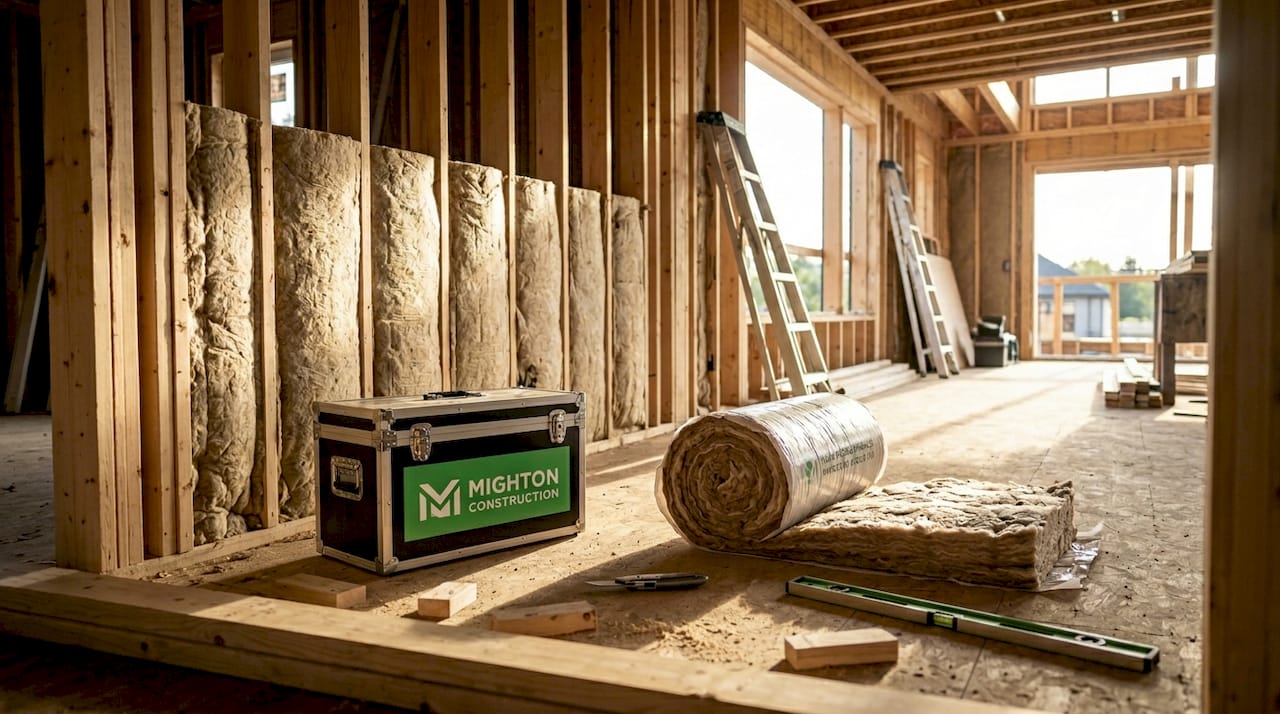
Energy efficiency in Ontario is not optional for most new builds and major renovations. The Ontario Building Code’s Supplementary Standard SB-10 sets the framework, and it applies directly to the custom home and major renovation projects that define much of South Georgian Bay’s premium construction market.
(https://www.oaa.on.ca/OAA/Assets/Documents/Practice Advisory/Knowledge Base/PT.36.2_V03.3_OBC-SB10_EnergyEfficReqt.pdf) for custom and major renovation projects, enforced via prescriptive or performance paths. Understanding the difference between these two compliance routes is essential before you commit to a design.
Prescriptive vs. performance compliance
Compliance path
How it works
Best suited for
Prescriptive
Follow a component checklist (insulation R-values, window U-factors, etc.)
Straightforward builds with standard configurations
Performance modelling
Model the whole home’s energy use; must meet a defined target
Custom layouts, complex designs, ICF construction
The prescriptive path is simpler on paper but inflexible. If your luxury home features large south-facing glazing, an ICF envelope, or a non-standard mechanical system, prescriptive compliance may actually undervalue what your home achieves. Performance modelling, by contrast, rewards genuine design excellence.
Here is a practical sequence for navigating SB-10 on a luxury build or major renovation:
- Engage an energy modeller early. Bring an energy consultant into the design process before drawings are finalised. Changes made at the sketch stage cost a fraction of what they cost in the field.
- Establish your target pathway. Decide with your builder whether prescriptive or performance modelling suits your project’s complexity and ambition.
- Document everything. SB-10 compliance requires verified documentation; sloppy record-keeping creates enforcement problems at occupancy.
- Validate assumptions against site conditions. Air leakage targets only hold when trades execute airtight detailing with care.
- Plan for a blower door test. This real-world pressure test verifies actual airtightness and is the single best quality check for envelope performance.
Pro Tip: Avoid the “pass the model, fail in reality” trap. An energy model is only as accurate as its inputs. If your modeller uses optimistic air leakage assumptions that your trades cannot actually achieve on site, the compliance paperwork looks fine but the home performs poorly. Insist on realistic assumptions, then verify them with a blower door test at rough-in and at completion.
Understanding cost to build in Ontario in relation to efficiency investments is equally important. Spending an additional two to four per cent of construction cost on envelope upgrades at the build stage typically saves far more over a ten-year horizon, particularly for homes in South Georgian Bay’s climate zone.
Making upgrades count: Practical steps for energy efficiency
Knowing that energy efficiency matters is one thing. Knowing how to sequence upgrades so every dollar works harder is what separates well-performing luxury homes from expensive ones. The most common and costly mistake is jumping straight to shiny mechanical upgrades without first addressing the envelope.
Sequencing upgrades properly, starting with weatherisation and air sealing before heating system upgrades, produces material improvements in both comfort and cost outcomes. Here is why: a heat pump or high-efficiency furnace installed in a leaky, under-insulated house is simply moving conditioned air out into the cold. You are paying for premium equipment to compensate for a flawed envelope. Fix the envelope first, and your heating and cooling equipment can be right-sized, which further reduces capital cost.
The upgrade sequence that delivers results
- Step 1: Air sealing. Address all penetrations, electrical boxes, rim joists, and top plates. This alone can reduce heating loads by 15 to 25 per cent.
- Step 2: Insulation upgrades. Attic, walls, and basement assemblies in that order of cost-effectiveness for most Ontario homes.
- Step 3: Window and door improvements. Triple-glazed units with thermally broken frames make a meaningful difference in South Georgian Bay’s climate.
- Step 4: Controlled ventilation. Install a heat recovery ventilator (HRV) after sealing the house to maintain indoor air quality without uncontrolled leakage.
- Step 5: Mechanical systems. Now, right-size your heat pump, boiler, or hybrid system to the actual load of your improved envelope.
Real-world data backs this up. Projects that followed this sequence consistently reported approximately $50 per month in lower energy bills and avoided an estimated $7,500 in over-sized mechanical equipment costs compared to projects that skipped straight to HVAC replacement. For a luxury home where mechanical systems are already premium, that avoided cost is even more significant.
Pro Tip: Bundle upgrades within a single renovation phase wherever possible. Incentive programmes often require multiple measures to be completed together to qualify for maximum rebates. Bundling also means opening walls and ceilings only once, which reduces disruption and labour cost dramatically.
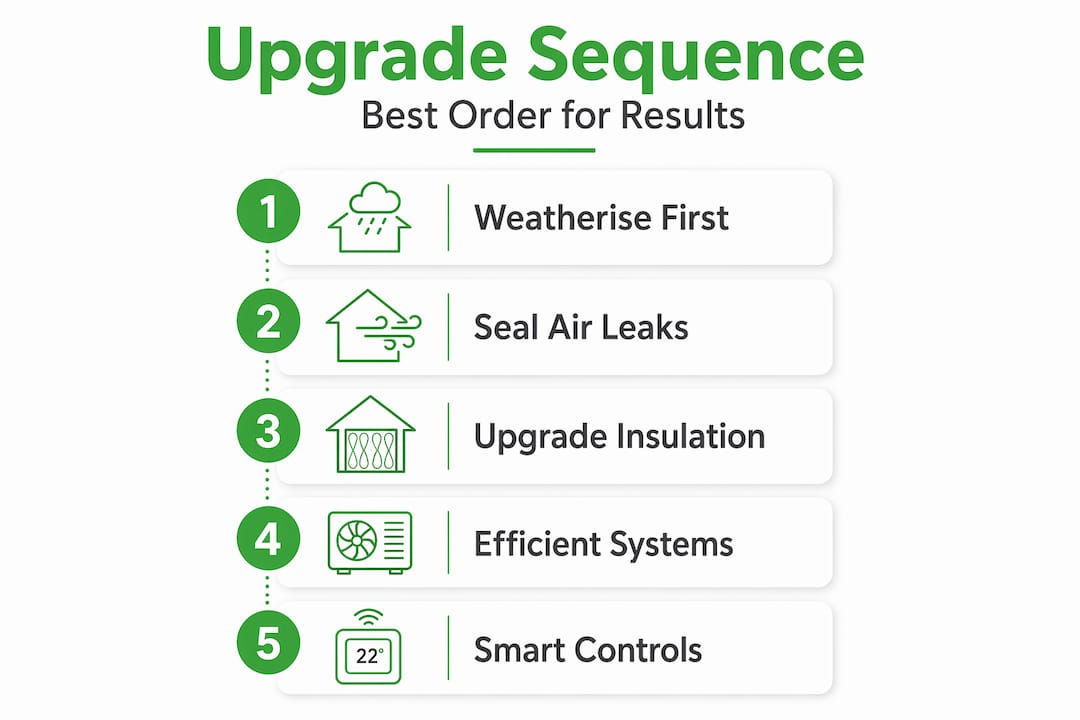
A well-structured renovations workflow maps every upgrade in the right order so no scope is duplicated and no efficiency gain is accidentally undermined by a later trade. This is exactly where working with an experienced builder pays dividends. The value from strategic renovations is highest when every upgrade is sequenced, documented, and executed with the whole house in mind.
ROI and incentives: The financial case for energy efficiency
Efficiency upgrades are investments, not expenses, and they should be modelled accordingly. When you calculate the return on an energy upgrade, you need to account for annual energy savings, avoided maintenance costs, increased property value, and any applicable incentives or rebates.
Consider a straightforward example. A $9,000 heat pump might save $600 annually in Ontario, giving a simple payback of 15 years before incentives. That sounds modest until you factor in the Greener Homes Affordability Programme rebates and provincial incentives that can reduce your net cost by $2,000 to $5,000.
“Incentives can take years off your payback calculation. A project that looks marginal at list price often becomes compelling once grants are applied.”
Incentives and grants can dramatically shorten payback periods, making upgrades even more attractive. Real retrofit data shows payback periods dropping from 7.1 years to 4.9 years once incentives are applied. For luxury homeowners making $30,000 to $80,000 in comprehensive efficiency upgrades, that difference is financially material.
Payback comparison: Heat pump with and without incentives
Scenario
Installed cost
Annual savings
Simple payback
No incentives
$9,000
$600
15.0 years
With $3,000 rebate
$6,000
$600
10.0 years
With $4,500 rebate
$4,500
$600
7.5 years
How to build your own efficiency investment model:
- Obtain a current energy audit or model to establish your baseline energy use.
- Price each upgrade measure individually with your contractor.
- Research applicable federal and provincial rebates for each measure.
- Calculate net cost, annual savings, and simple payback for each measure.
- Rank measures by payback period and bundle those with complementary rebate requirements.
- Factor in property value uplift, particularly relevant for luxury renovation returns in competitive South Georgian Bay markets.
The market in areas like Blue Mountain, Collingwood, and Wasaga Beach is increasingly rewarding energy performance. Buyers in the premium segment are aware of heating costs and comfort quality, and homes with documented efficiency credentials command attention.
Beyond new builds: Maintenance, tech, and the ‘efficiency gap’
Even the best-built home loses performance over time if it is not maintained and monitored. This is the concept of the “efficiency gap,” the widening difference between a home’s designed performance and its actual operating performance. It is a real and costly problem.
Failing to monitor and optimise existing assets creates an efficiency gap that compounds over time. Globally, deferred maintenance represents a $3 trillion problem, and residential properties are a significant contributor. Caulking degrades, HRV filters clog, dampers stick, and mechanical systems drift out of calibration. Each small failure erodes efficiency and comfort incrementally.
Practical steps to close the efficiency gap in an existing home:
- Annual HRV/ERV cleaning and balancing to maintain ventilation efficiency
- Blower door retesting every five to seven years to identify new air leakage points
- Smart thermostat scheduling and monitoring to track energy use patterns and identify anomalies
- Infrared thermal scanning during cold weather to spot insulation gaps and moisture intrusion early
- Mechanical system commissioning after any renovation or addition to ensure systems are sized and calibrated correctly
“The most efficient home is the one that performs as designed, year after year. Maintenance is not optional; it is part of the efficiency strategy.”
Smart home technology plays a growing role here. Monitoring systems that track energy use in real time allow homeowners to spot problems early and respond before they become expensive. Paired with the inherent thermal mass advantages of ICF performance benefits, a well-maintained luxury home in South Georgian Bay can hold its performance standards for decades.
Why the smartest efficiency strategies start with real evidence
After working on luxury homes and renovations across South Georgian Bay for over 30 years, one pattern stands out clearly: the projects that deliver the best long-term results are not the ones that simply passed their energy models. They are the ones where the builder, homeowner, and designer treated efficiency as a design value from day one, grounded every decision in real data, and sequenced every upgrade with the end performance in mind.
Ontario’s regulatory minimums are a floor, not a ceiling. The most successful custom home clients we work with do not ask “what do we need to meet code?” They ask “what is the right performance target for this home and this site?” That shift in framing changes everything. It leads to better envelope decisions, right-sized mechanical systems, and homes that genuinely feel different to live in.
The other lesson that experience keeps reinforcing is this: cash-flow modelling matters more than sticker price. A homeowner who evaluates an efficiency upgrade solely on upfront cost will almost always underinvest. A homeowner who models ten-year cash flow, including energy savings, avoided maintenance, property value uplift, and available incentives, almost always makes a stronger choice.
Finally, do not neglect the operational side. A well-built home that is never balanced, maintained, or monitored will drift toward mediocrity. Treating efficiency as an ongoing discipline, not a one-time construction decision, is what separates truly high-performing homes from expensive ones. A disciplined renovation sequencing approach and commitment to long-term maintenance are what turn a great build into a lasting asset.
Ready to make your home more efficient?
Whether you are planning a new custom home or a significant renovation in South Georgian Bay, energy efficiency should be at the centre of every major decision. The financial returns, comfort improvements, and long-term property value gains are too significant to treat as afterthoughts.

Mighton Construction brings over 30 years of local expertise to custom home builds that prioritise performance, quality, and lasting value. Our ICF construction expertise delivers some of the most thermally robust homes available in Ontario, and our approach ensures efficiency is built in from the foundation up, not added on at the end. Browse our project gallery to see how premium design and energy performance come together in real South Georgian Bay homes, and reach out to start a conversation about your project.
Frequently asked questions
How much can energy efficiency upgrades save on utility bills?
Energy upgrades can save $600 per year or more depending on your home’s size, current systems, and how upgrades are sequenced. A well-executed heat pump installation, for example, can save $600 annually in Ontario before accounting for rebates.
Do incentives really reduce the payback period for energy renovations?
Yes, incentives can shorten payback periods by several years. Real retrofit data shows payback dropping from 7.1 to 4.9 years once grants are applied, which makes borderline upgrades financially compelling.
Is energy efficiency only for new homes or also for older properties?
Efficiency upgrades apply equally to existing homes, and not optimising existing assets creates a costly efficiency gap. Maintenance, air sealing, and smart monitoring can recover significant performance in older properties.
What’s the best order to do energy efficiency upgrades?
Weatherisation and air sealing before system changes consistently produces the best cost and comfort outcomes. Address the envelope first, then right-size your mechanical systems to the improved load.
Are there regulations I need to meet with luxury renovations in Ontario?
Yes, (https://www.oaa.on.ca/OAA/Assets/Documents/Practice Advisory/Knowledge Base/PT.36.2_V03.3_OBC-SB10_EnergyEfficReqt.pdf) for custom and major renovation projects in Ontario, enforceable via prescriptive or performance compliance paths, and documentation requirements apply throughout the construction process.