What is Energy Star certification for homes?

TL;DR:
- Energy Star certification verifies that homes and buildings use at least 20% less energy than standard code requirements through independent third-party verification. It requires annual renewal, with a score of 75 or higher on the EPA’s benchmarking scale, and offers significant financial, environmental, and health benefits. Proper timing, accurate data, and professional verification are essential for achieving and maintaining certification.
Energy Star certification is one of those labels many homeowners have seen on appliances and windows for years without fully understanding what it actually guarantees. That lack of clarity is costly. Whether you’re building a custom home in South Georgian Bay or renovating a waterfront cottage in Wasaga Beach, understanding what is Energy Star certification means understanding a programme that has helped consumers save over $500 billion in energy costs since 1992. This guide clears up the confusion and shows you exactly how certification works, what it’s worth, and how to pursue it.
Table of Contents
- Key takeaways
- What is Energy Star certification?
- The Energy Star certification process
- Benefits of Energy Star certification
- Energy Star certified homes vs. standard code buildings
- How to start the Energy Star certification process
- My take on Energy Star certification
- Build with Mighton Construction and meet your energy goals
- FAQ
Key takeaways
| Point | Details |
|---|---|
| Certification means verified performance | Energy Star homes are independently verified to use at least 20% less energy than standard code homes. |
| Annual renewal is required | Certification is valid for one year only and must be reapplied with fresh verification each cycle. |
| A score of 75+ is needed for buildings | Commercial and multi-unit buildings must score 75 or higher on the EPA’s national benchmarking scale. |
| Financial savings are real | Certified homeowners save roughly $400 per year on energy bills on average. |
| Market value improves with certification | Certification strengthens a property’s appeal and marketability, especially in competitive regions like Collingwood and Blue Mountain. |
What is Energy Star certification?
Energy Star is a voluntary energy efficiency programme jointly administered by the U.S. Environmental Protection Agency (EPA) and, for Canadian applications, Natural Resources Canada. It was launched in 1992 as a market-based approach to reducing energy consumption and greenhouse gas emissions, starting with personal computers before expanding to cover hundreds of product categories, new homes, and commercial buildings.
The label itself is a trusted stamp of approval that tells buyers, renters, and investors a product or building has met independently verified performance thresholds. This is not a self-reported claim. Third-party verification is baked into the programme, which is exactly what separates Energy Star from generic marketing language like “eco-friendly” or “green.”
There are three main categories of Energy Star certification:
- Products: Appliances, windows, heating and cooling equipment, lighting, and electronics. These must meet specific efficiency thresholds set by the EPA before manufacturers can display the label.
- Homes: New residential construction must be built to meet the Energy Star specification requirements for the version in effect at the time of application, including envelope, mechanical systems, and lighting.
- Buildings: Existing commercial, institutional, and multi-family residential buildings are benchmarked using Portfolio Manager and must score in the top 25% of performers nationally.
For Canadian homeowners, the programme is cross-border relevant because many building products, appliances, and construction systems sold in Canada carry Energy Star ratings based on EPA standards. The energy efficiency certification carries the same weight whether your property is in Springwater, Ontario, or across the border.
Pro Tip: When comparing windows or HVAC systems for a renovation, look for the Energy Star “Most Efficient” designation, which sits above the standard label and represents the top performers in any given product category.
The Energy Star certification process
Many homeowners picture the certification process as filling out a form and receiving a sticker. The reality is more rigorous than that, which is also what makes the certification meaningful.
Here is how the process works for existing buildings and multi-unit residential properties:
-
Benchmark your building in Portfolio Manager. This is the EPA’s free online tool where you enter whole-building energy consumption data, physical characteristics, and occupancy information. The tool then generates a 1-to-100 score based on how your building compares to similar buildings nationally.
-
Reach a score of 75 or higher. Only buildings in the top 25% of energy performance are eligible to apply. A score of 74 means you’re close but not there yet. This threshold motivates genuine improvement rather than paperwork compliance.
-
Engage a Licensed Professional. A Professional Engineer (PE) or Registered Architect (RA) must conduct an on-site verification visit to confirm that the data entered in Portfolio Manager accurately reflects the building’s actual conditions. This step catches errors in energy accounting and occupancy reporting that could otherwise inflate scores.
-
Submit the application. Once the Licensed Professional signs off, the application goes to the EPA for review and issuance of the certificate and plaques.
-
Renew annually. Energy Star certification is valid for one year only. Each subsequent year requires fresh energy data, a new benchmarking score, and a new verification process. Buildings that slip below a 75 lose eligibility until performance improves.
For new residential construction, the process differs. Builders work with a Certified Energy Rater during construction to verify that insulation, windows, mechanical systems, and air sealing meet the applicable Energy Star specification requirements before the certificate is issued.
Pro Tip: The most common reason buildings fail certification is inaccurate occupancy data entered in Portfolio Manager. If your square footage, operating hours, or number of occupants are off, your score will be too. Verify these inputs carefully before engaging a Licensed Professional.
Benefits of Energy Star certification
The benefits of Energy Star certification fall into three clear categories: financial, environmental, and health-related. And the numbers behind each one are more compelling than most homeowners expect.

On the financial side, certified homes save about $400 per year on energy bills on average compared to standard code homes. Over a 20-year mortgage, that is $8,000 in savings without accounting for rising energy costs. In communities like Collingwood and Wasaga Beach, where heating demands are significant for much of the year, the savings accumulate faster.
The environmental advantages are equally meaningful:
- Certified homes use at least 20% less energy than homes built to minimum code requirements.
- Reduced energy demand directly lowers the volume of fossil fuels burned to supply power grids, cutting greenhouse gas emissions.
- Lowering energy-related pollutants reduces community exposure to airborne toxins that trigger asthma and respiratory conditions. This is a public health benefit that goes well beyond your own property line.
“Energy Star stands as a trusted, science-backed market signal that encourages manufacturers and builders to design better, more efficient products and buildings.” — American Lung Association
The health benefits inside a certified home are also real. Tighter building envelopes with proper ventilation systems reduce drafts, control humidity, and limit the infiltration of outdoor allergens and pollutants. Homeowners in South Georgian Bay who build with ICF construction methods often report dramatically improved indoor comfort and air quality, qualities that align directly with Energy Star performance standards.
For property investors, certification adds marketability. Buyers increasingly ask about energy costs before making offers, and a certified home gives you a verified, credible answer.
Energy Star certified homes vs. standard code buildings
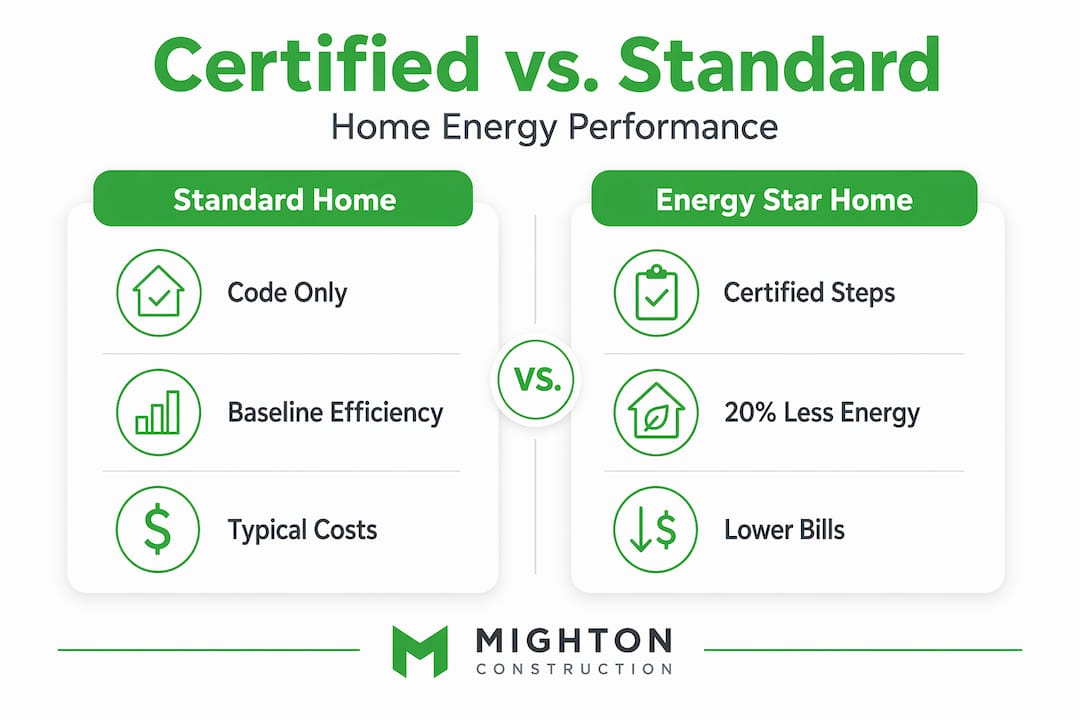
Most people assume that a home built to Ontario’s current building code is already efficient. It is not wrong to think that. Codes have improved significantly. But there is a measurable gap between code minimum and Energy Star performance, and that gap shows up every month on your utility bill.
| Feature | Standard code home | Energy Star certified home |
|---|---|---|
| Energy use compared to baseline | Meets minimum requirements | At least 20% below standard code |
| Annual energy savings | None above baseline | Approximately $400/year on average |
| Air sealing | Meets code minimum | Tested and verified by a certified rater |
| Insulation | Code minimum levels | Above-code levels, independently verified |
| HVAC efficiency | Code-compliant equipment | High-efficiency systems, properly sized |
| Indoor comfort | Variable | Consistent temperatures, controlled humidity |
| Ventilation | Minimum required | Balanced, fresh-air delivery systems |
| Third-party verification | None | Required before certification is issued |
Certified commercial buildings use 35% less energy than typical buildings of the same type nationwide. For residential properties in Collingwood, Blue Mountain, or Clearview Township where winters are long and heating loads are heavy, the comfort difference between a tightly sealed Energy Star home and a code-minimum build is something you feel every single day.
Pro Tip: Ask your builder to show you blower door test results for any Energy Star certified home you’re considering. This test measures actual air leakage, and a lower number directly predicts your heating and cooling costs. Builders who can’t produce these results should raise questions.
How to start the Energy Star certification process
Getting started is less daunting than the process description suggests, provided you approach it with the right sequence.
-
Decide whether you’re certifying a new build or existing property. New homes follow a different pathway involving a Certified Energy Rater during construction. Existing homes and buildings use Portfolio Manager and the benchmarking route. Know which track applies before taking any other step.
-
Gather your energy data. Pull 12 months of utility bills for electricity, natural gas, and any other fuel sources. Whole-building data is required. Missing even a few months will compromise your benchmarking score.
-
Set up and populate a Portfolio Manager account. The EPA’s Portfolio Manager tool is free and available online. Enter your property’s physical details, occupancy data, and energy consumption accurately. Treat this step with the same care you’d give a financial audit.
-
Review your score and identify improvement opportunities. If your score is below 75, use the benchmarking data to understand where your building underperforms. Common culprits in older South Georgian Bay homes include inadequate attic insulation, aging windows, and oversized or undersized HVAC equipment. Pairing certification goals with a sustainable renovation is often the most cost-effective path forward.
-
Engage a Licensed Professional once your score reaches 75. The PE or RA will verify your data on-site and sign off on your application. Budget for this professional fee as part of your certification costs.
-
Plan for annual renewal from the start. Set a calendar reminder 90 days before your certification anniversary. Gather the next year’s energy data, review whether your score holds, and initiate the renewal process with your Licensed Professional before the deadline.
For homeowners planning new custom builds in Wasaga Beach or the surrounding area, integrating green building certification targets into your design phase is far more efficient than trying to retrofit after construction. It also gives your builder clear performance targets to meet from the first nail.
My take on Energy Star certification
I’ve worked on custom home builds and renovation projects in South Georgian Bay long enough to see what separates the clients who treat Energy Star certification as a genuine investment from those who treat it as a marketing checkbox. The difference in long-term satisfaction is significant.
What I’ve found is that homeowners who engage with the certification process early, during the design phase rather than after framing, end up with homes that perform noticeably better. The certification becomes a byproduct of good decision-making rather than a goal pursued independently of it.
I’ve also seen the frustration when clients try to certify an existing building and discover their occupancy data is a mess, or that their mechanical systems are too old to support a competitive score. Those situations are fixable, but they take time and sometimes money to address before the real certification work can begin.
My honest opinion is that the annual renewal requirement puts some investors off, and I understand why. But prioritising energy efficiency certifications is a wise hedge against rising utility costs, especially in a region where heating seasons are long. A certified home in Collingwood or Clearview Township is a more defensible investment today than it was a decade ago, and that trajectory is not reversing.
The label removes uncertainty for buyers. That is genuinely valuable in a competitive market, and I’d rather see clients lean into it than treat it as optional.
— Adam
Build with Mighton Construction and meet your energy goals

At Mighton Construction, we have been building in South Georgian Bay for over 30 years, and energy-efficient construction is not an add-on for us. It is woven into how we design and build custom homes across Wasaga Beach, Collingwood, Springwater, Tiny Township, and beyond. Our team understands the specification requirements that support Energy Star certification and integrates them from the earliest stages of every project.
Whether you’re planning a luxury custom home, a waterfront cottage, a kitchen remodel, a basement finishing project, or a full addition, we bring the same commitment to performance and craftsmanship. If Energy Star certification is part of your goal, we know how to build to that standard. Visit our services page or contact us directly to discuss your project and find out how we can help you build something that performs as well as it looks.
FAQ
What does Energy Star certification mean for a home?
Energy Star certification means a home has been independently verified to use at least 20% less energy than a home built to standard code requirements. It is not a self-reported label. A certified rater confirms performance before the certificate is issued.
How long does Energy Star certification last?
Certification is valid for one year and must be renewed annually with updated energy data and a new verification process. Buildings that fall below a score of 75 during a renewal cycle lose eligibility until performance improves.
What score is required for Energy Star building certification?
Buildings must achieve a score of 75 or higher using the EPA’s Portfolio Manager benchmarking tool, meaning they perform better than at least 75% of similar buildings nationally.
Is Energy Star certification available in Canada?
Yes. The programme is jointly supported in Canada through Natural Resources Canada, and many Energy Star certified products and building standards apply directly to Canadian homes and buildings. Homeowners in Ontario can pursue certification for both new construction and existing properties.
How much can Energy Star certification save on energy bills?
On average, homeowners in Energy Star certified homes save roughly $400 per year compared to those in standard code homes. In regions with high heating demands like South Georgian Bay, annual savings can exceed that figure depending on the home’s size and systems.