Transparent pricing in custom home building: build with clarity


TL;DR:
- Transparent home building pricing involves ongoing cost visibility, detailed documentation, and clear scope management, not just a final quote. Different models, like fixed-price, cost-plus, or GMP, suit varying project stability and flexibility, with transparency measured by process discipline rather than documents alone. Success depends on trust, communication, and comprehensive management, ensuring homeowners stay informed and involved throughout construction.
Most homeowners assume that “transparent pricing” from a builder simply means getting a detailed quote with a clear bottom-line number. That assumption can lead to real frustration once a project is underway. True pricing transparency in custom home building is about something far more substantial: it’s the ongoing ability to see how every dollar is allocated, understand why costs shift, and trust the process from groundbreaking to final walkthrough. In South Georgian Bay, where luxury custom homes and waterfront cottages represent some of the most meaningful investments people make, understanding the difference between a number on a page and genuine financial clarity is essential before you sign anything.
Table of Contents
- What does transparent pricing really mean in construction?
- Comparing pricing models: cost-plus, fixed-price, and GMP
- How contract details and project scope influence pricing transparency
- Applying transparent pricing in your custom build or renovation
- Our perspective: why “transparency” alone isn’t enough in luxury home building
- Ready to build with clarity? Explore transparent pricing with Mighton Construction
- Frequently asked questions
Key Takeaways
| Point | Details |
|---|---|
| Transparency means clarity | True transparent pricing is about seeing every cost and understanding contract terms, not just a single figure. |
| Contract type shapes risk | Cost-plus, fixed-price, and GMP models each impact homeowner risk and transparency in different ways. |
| Details drive trust | Well-defined scope documents and clear change order rules are essential for genuine price clarity. |
| No system removes all risks | Transparent pricing helps you see cost risks but can’t eliminate market or scope change volatility. |
| Choosing the right process matters | Homeowners benefit most by joining transparency with strong builder partnerships and communication. |
What does transparent pricing really mean in construction?
Transparent pricing isn’t a single document or a software tool. It’s a philosophy that runs through every stage of how a builder manages your money. At its core, it means you receive line-by-line breakdowns of where your budget goes, including labour, materials, subcontractor fees, permits, overhead, and the builder’s margin.
To understand the concept properly, it helps to know a few construction key concepts that builders use every day:
- Open-book (cost-plus) contracts: You see every invoice, every receipt, and pay actual costs plus an agreed builder’s fee or percentage. High visibility, but cost outcomes can shift.
- Fixed-price contracts: You agree on a total price up front. The builder absorbs cost overruns but also pockets savings. Lower visibility into line items, higher cost predictability for you.
- Guaranteed maximum price (GMP): A cost-plus structure with an agreed ceiling. Costs are open, but there’s an upper limit protecting you from runaway expenses.
- Change orders: Formal, written amendments to the original contract when scope changes. The clearest sign of a transparent builder is a disciplined change order process.
One of the most common myths homeowners carry into their first builder meeting is that transparent pricing removes all financial risk. It doesn’t. As noted when comparing cost estimation explained in the context of luxury builds, scope changes, design revisions, and material price swings can still affect final costs regardless of model chosen. Transparent pricing should not be confused with “no risk” because cost-plus contracts can improve visibility but the homeowner can still bear cost volatility unless the contract includes a GMP cap and tight cost-control processes.
“Knowing where every dollar goes is not the same as knowing exactly how many dollars you’ll spend. That distinction matters enormously in custom home building.”
Pro Tip: Before you commit to any pricing model, ask your builder to walk you through a sample invoice or cost report from a previous project. If they can’t or won’t, that tells you something important about how they operate.
What genuine transparency looks like in practise is documentation at every turn: weekly cost reports, pre-approved allowances for finishes, clear subcontractor quotes, and a written record of every decision that carries a price tag.
Comparing pricing models: cost-plus, fixed-price, and GMP
Now that you understand the vocabulary, let’s look at how each pricing model actually performs in terms of transparency, risk, and decision-making power for homeowners.
| Pricing model | Cost visibility | Budget predictability | Best suited for | Risk bearer |
|---|---|---|---|---|
| Fixed-price | Low to moderate | High | Well-defined, stable scope | Builder |
| Cost-plus | High | Low to moderate | Evolving design, custom work | Homeowner |
| Cost-plus with GMP | High | Moderate to high | Complex, luxury, or long builds | Shared |
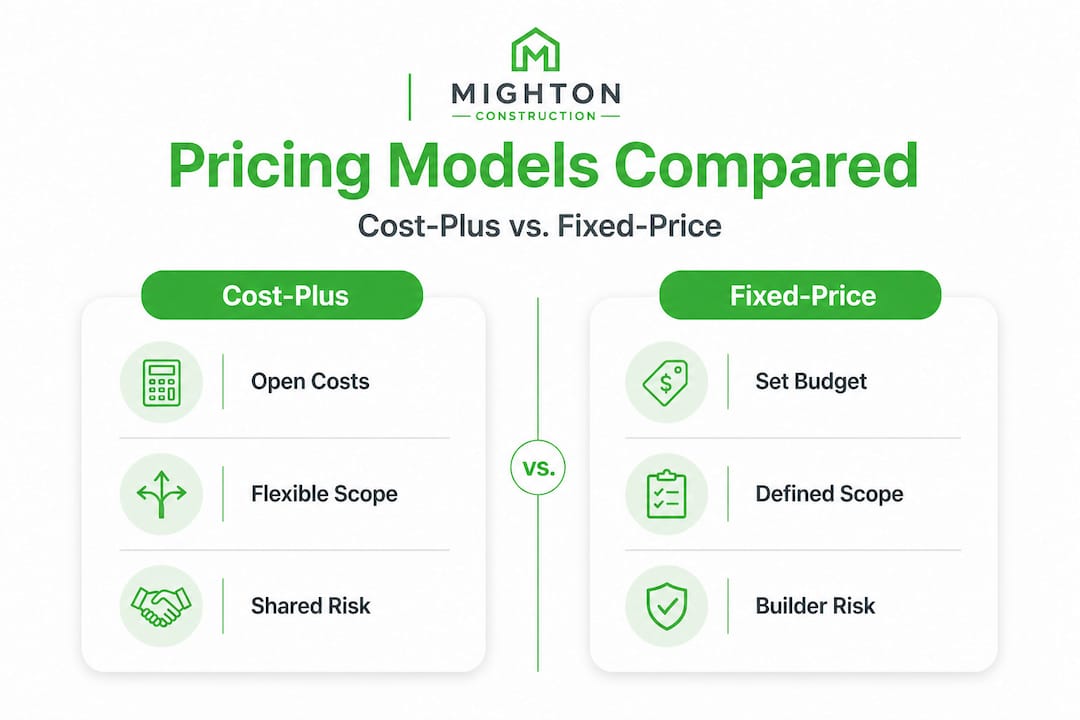
The table above reveals a fundamental trade-off: the more visibility you have into costs, the less certainty you typically have about the final number, unless a GMP is in place. Cost-plus can require more trust and may shift price risk to the client, while fixed-price can be lower on well-scoped projects, and cost-plus with GMP and open-book accounting is preferred when scope evolves and market volatility makes fixed bids unreliable.
Here is a numbered framework for choosing the right model for your situation:
- Define your scope stability first. If you know exactly what you want, from floor plan to fixtures, fixed-price gives you the cleanest number and predictable financing. Review our custom home FAQ for guidance on how to define scope early.
- Assess your design flexibility. If you’re planning a luxury waterfront cottage where design evolves as you see the site and materials in person, cost-plus with GMP protects you while keeping books open.
- Consider current material markets. In periods of supply chain volatility, fixed-price bids often include large contingency buffers that effectively make them more expensive. Cost-plus lets you benefit when prices drop.
- Factor in hidden building expenses. Soft costs like design fees, engineering, permits, and land transfer taxes exist outside any pricing model and must be accounted for separately.
- Match financing to model. Lenders in Canada often have preferences; some construction mortgages draw against fixed milestones, which aligns better with fixed-price contracts. Confirm with your lender before choosing.
Pro Tip: For renovations under $200,000 with a clearly defined scope, a fixed-price contract is usually the smarter financial choice. For luxury new builds over $750,000 in South Georgian Bay, a cost-plus GMP arrangement with open-book reporting gives you both visibility and a safety ceiling.
The honest reality is that neither model is universally superior. A builder who pushes one approach for every single project, regardless of your situation, is prioritising their own convenience over your best interests.
How contract details and project scope influence pricing transparency
Choosing the right pricing model is only half the equation. The other half is what lives inside the contract itself.

Consider this: two homeowners might both sign a “transparent” fixed-price contract for custom homes of similar size and complexity. One receives a crystal-clear experience with no financial surprises. The other is blindsided by costly change orders at every turn. The difference almost always comes down to how thoroughly the scope was documented before the ink dried.
A clear contract will define these elements in writing:
- Every material and finish, down to specific product lines or at minimum a clear dollar allowance
- Which items are included in the price and which are specifically excluded
- How change orders are triggered, documented, approved, and priced
- The builder’s markup or fee structure, stated plainly
- Payment schedules tied to measurable project milestones
- Who is responsible for permit fees, site preparation, utility connections, and landscaping
As noted in a guide on construction cost-plus versus fixed-price contracts, fixed-price contracts are most effective when the scope is clearly defined and stable, and transparency in that model typically comes from tightly defined inclusions and exclusions and robust change-order language rather than open-book invoice visibility.
| Contract element | Clear documentation | Unclear documentation |
|---|---|---|
| Material specifications | Named product lines or dollar allowances | “Standard finishes” |
| Change orders | Written, priced, signed before work starts | Verbal agreements, billed later |
| Builder’s fee | Stated as fixed fee or percentage | Implied in lump sum |
| Exclusions | Listed explicitly | Not addressed |
| Contingency | Defined amount and release conditions | Hidden or absent |
Understanding the design build process from the beginning is one of the most effective ways to ensure your scope is well defined before pricing conversations begin. When design and build are coordinated under one roof, the scope tightens naturally because the team that designs the home is the same team pricing the work.
“The most expensive sentence in a construction contract is ‘as required’ without a defined scope. Ambiguity is where cost overruns are born.”
It’s also worth understanding how subcontractor roles affect pricing transparency. In a truly transparent build, you should know which trades are being subcontracted, what each is being paid, and how the general contractor’s markup on subcontractor work is calculated. Some builders mark up subcontractor invoices significantly without disclosing this. Others pass through costs directly and charge a separate management fee. Both can be fair arrangements, but only if they’re disclosed clearly upfront.
Applying transparent pricing in your custom build or renovation
Knowing the theory is useful. Applying it when you’re sitting across from a builder who’s been in business for decades is where it gets real. Here is a step-by-step approach for vetting any builder’s commitment to genuine pricing transparency.
- Ask for a sample cost report. Request an anonymised example of how they report costs to current clients. Detailed, well-organised reports signal a mature process. Vague summaries are a warning.
- Ask specifically how change orders are handled. A transparent builder will tell you: written order issued, price agreed and signed before work begins, copy provided to you. Any deviation from that process is a red flag.
- Ask who approves extras. In a transparent operation, no extra cost over a defined threshold (say, $500) should proceed without your written approval. Confirm this in writing.
- Review their allowance methodology. Allowances are placeholder amounts for items not yet selected, like tile or plumbing fixtures. Overly low allowances are a tactic to present a lower bid, then collect more money when you select real products. Ask how their allowances were calculated and compare them to retail pricing on similar items.
- Request references from clients of similar project types. Ask those references specifically about financial surprises, change order management, and cost reporting.
Reviewing a thorough project workflow guide before your first builder meeting will also help you know which questions to ask at each stage of the process.
Signs of a truly transparent builder include proactive communication before costs change, detailed invoices with backup documentation, willingness to explain every line item, and a change order process that runs smoothly and without friction. Red flags include resistance to providing cost breakdowns, verbal agreements for extras, vague allowances, and reluctance to discuss their fee structure openly.
Cost-plus with GMP and open-book accounting is particularly well suited to situations where scope is still evolving and market conditions make fixed bids unreliable. In South Georgian Bay, where luxury waterfront properties often evolve as site conditions and client preferences develop, this model combined with rigorous documentation is frequently the right choice.
Pro Tip: Before your first builder consultation, write down your three biggest financial fears about the project. Bring them to the meeting and ask the builder directly how their process addresses each one. Their answer will reveal more than any brochure.
Our perspective: why “transparency” alone isn’t enough in luxury home building
Here is something most articles on this topic won’t tell you: transparency is necessary but not sufficient for a successful luxury build. We’ve seen projects where both parties had full access to every number, every invoice, and every cost report, and the experience was still deeply frustrating for the homeowner.
Why? Because numbers without context are just data. And data without trust, communication, and management discipline cannot build a home.
The best outcomes we see in luxury custom home projects in South Georgian Bay consistently come from three things: a builder who treats transparency as a living process rather than a one-time document, a client who stays engaged throughout construction rather than delegating entirely and hoping for the best, and a relationship where both parties communicate honestly when something changes.
Understanding what construction management truly involves makes it clear that the builder’s management capability is as important as their pricing model. A builder with mediocre management and a fully open-book contract will consistently deliver worse outcomes than a builder with excellent management and a well-structured fixed-price contract.
Transparency should be the foundation of your builder relationship, not the whole building. The walls, the roof, and the finishing details are trust, discipline, and collaborative communication. When you find a builder who actively educates you about costs, who brings problems to you before they become crises, and who demonstrates integrity in small decisions throughout a long project, that is where the real value of transparency lives.
Ready to build with clarity? Explore transparent pricing with Mighton Construction
At Mighton Construction, transparent pricing isn’t a sales phrase. It’s a practise built over more than 30 years of custom home and renovation projects across Wasaga Beach, Collingwood, Blue Mountain, and the wider South Georgian Bay region.
Whether you’re planning a luxury waterfront property as one of our custom cottage builders or exploring energy-efficient ICF custom homes for year-round comfort, our team is ready to walk you through our open, honest pricing process from your very first conversation. We believe that a homeowner who understands their costs is a homeowner who trusts their builder, and that trust is what turns a construction project into the home of your dreams. Contact us at mightonconstruction.com to begin your transparent build consultation today.
Frequently asked questions
Is transparent pricing always cheaper for homeowners?
Transparent pricing isn’t always cheaper because it reveals all costs upfront, and factors like scope changes and material volatility can still increase the total. As noted, fixed-price can be lower on well-scoped projects, while cost-plus shifts more price risk to the client.
How does a guaranteed maximum price (GMP) contract support transparency?
A GMP contract sets a firm ceiling on your total costs while keeping books open so you can see every expenditure. It is particularly useful when scope evolves and fixed bids would carry unreliable pricing due to market volatility.
What should be included in transparent home build pricing?
Transparent home build pricing should include line items for labour, materials, subcontractor costs, overhead, the builder’s fee, permit fees, and all allowances, with written documentation accompanying every change to the original scope.
Can you switch from fixed-price to cost-plus during a project?
Switching pricing models midway through a build is legally complex, typically requires an entirely new contract, and can create disputes about work already completed, so clarity and commitment at the outset is far preferable.
Does transparent pricing protect against cost overruns in custom renovations?
Transparent pricing clarifies where costs originate but does not fully protect against overruns. Homeowners can still bear cost volatility when scope, materials, or unforeseen site conditions change during the project.
Recommended
- How Much Does it Cost to Build a Custom Home in Ontario? (2026 Data & Trends)
- Frequently Asked Questions about Building Custom Homes
- Cost Estimation Explained: Building With Confidence
- Custom Home Builder Clearview Township | Mighton Construction
- What is the design-build process? A homeowner’s guide