
Thermal bridging: a homeowner's guide to sustainable luxury builds
TL;DR:
- Many luxury homes in South Georgian Bay suffer from heat loss due to hidden thermal bridges, despite high-quality insulation. Thermal bridging occurs when heat bypasses insulation through structural junctions, causing increased energy costs and moisture issues. Proper design, detailed junction analysis, and continuous insulation are essential to ensure long-term comfort, durability, and energy efficiency in custom builds.
Pouring money into premium insulation and still ending up with cold walls, drafty rooms, or surprise condensation? You are not alone. Many homeowners planning luxury builds or major renovations across South Georgian Bay focus heavily on insulation R-values, only to discover that hidden heat pathways called thermal bridges are quietly undermining everything. Understanding what thermal bridging is, where it hides, and how to address it properly is the difference between a home that performs beautifully for decades and one that falls short of its promise from the very first winter.
Table of Contents
- What is thermal bridging and why does it matter?
- Types of thermal bridges: linear, point, and hidden
- How thermal bridging impacts comfort, moisture, and durability
- How to mitigate thermal bridging in luxury builds and renovations
- The truth most luxury builds miss about thermal bridging
- Sustainable luxury starts with the right construction partner
- Frequently asked questions
Key Takeaways
Point
Details
Thermal bridging defined
It is a fast heat transfer path that bypasses insulation and undermines energy performance.
Junctions are critical
Roof-to-wall and balcony junctions are major sources of hidden heat loss in custom builds.
Moisture and mould risk
Thermal bridges create cold surfaces, increasing condensation and long-term damage potential.
Mitigation strategies
Continuous insulation, detailed junction design, and project-specific calculations are key.
Choose expertise
Partnering with seasoned builders is vital to address thermal bridging in sustainable home projects.
What is thermal bridging and why does it matter?
Thermal bridging happens when heat finds a faster route through your building envelope than through the insulation itself. Think of it like water finding a crack in a dam. No matter how thick the dam is elsewhere, that crack lets everything through.
“Thermal bridging is a pathway in a building envelope where heat transfers at a higher rate than through the surrounding insulated materials, bypassing insulation.” Understanding Thermal Bridging
This bypass effect means that even a beautifully designed building envelope can deliver far less performance than its specifications suggest. The insulation between your studs might be top-of-the-line, but the studs themselves, the lintels above your windows, and the connections between your floor slabs and exterior walls can all carry heat outward at a much higher rate.
The thermal bridging effects on building performance are well documented: overall heat loss can increase significantly, energy bills rise, and comfort drops. Studies indicate that framing alone in a standard wood-stud wall can account for a substantial fraction of the wall’s total thermal loss, sometimes reducing the effective insulation value by 30 percent or more compared to the nominal rated R-value.
Top locations where thermal bridges are most commonly found:
- Roof-to-wall junctions, particularly at eaves and parapets
- Balcony slabs that penetrate the building envelope
- Window and door reveals, frames, and sills
- Structural columns and beams that span indoors to outdoors
- Service penetrations such as pipes, ducts, and anchor bolts
For luxury custom homes in the Georgian Bay region, where winters are severe and expectations are high, even modest heat loss through these locations translates directly into uncomfortable rooms and inflated heating costs.
Types of thermal bridges: linear, point, and hidden
Now that we understand what thermal bridging is, let’s clarify the main forms it takes and why some escape common calculations.
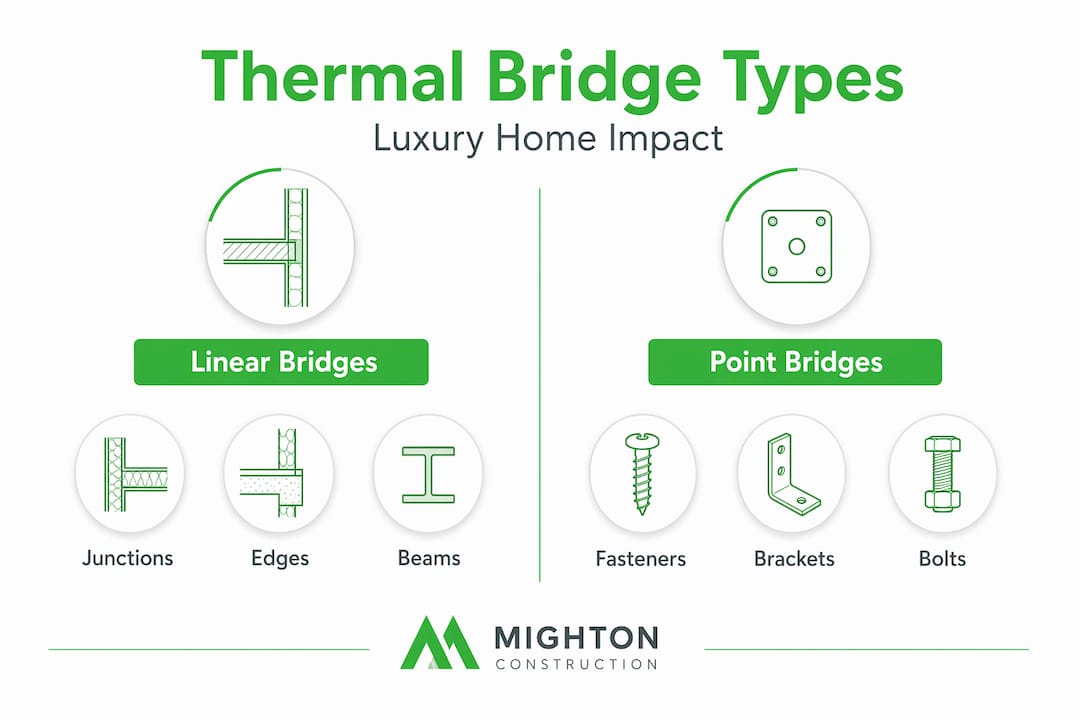
Thermal bridging is often categorised as linear (junction-based) and point (discrete components). Linear bridges are assessed using psi values and non-repeating bridges may not be captured by simple U-value assumptions. That last point is critical. Most builders quote U-values (which measure heat transfer across a flat area of wall), but those numbers can quietly ignore the junctions that matter most.
Bridge type
Typical locations
Quantification method
Linear
Roof-to-wall, slab edges, parapets, window reveals
Psi (ψ) values per metre of junction
Point
Anchor bolts, fixings, structural columns, steel ties
Chi (χ) values per discrete element
Non-repeating
Balconies, corners, roof penetrations
Often missed by standard U-value models
Examples of each bridge type in a luxury custom home:
Linear bridges:
- The junction where a concrete balcony slab meets an insulated exterior wall
- The connection between a roofline parapet and the main roof assembly
- Window and door head, jamb, and sill interfaces
Point bridges:
- Steel anchor bolts securing cladding brackets through insulation
- Structural fixings connecting an exterior deck to an interior floor system
- Metal ties in cavity wall construction
Non-repeating bridges:
- Corners of the building where two walls meet
- Abutments between additions and original structures
- Unique architectural features like cantilevered sections
Getting your designer or builder to consider passive house energy savings principles from the outset is a sound investment, because these principles demand proper junction analysis as standard practice. A thoughtful site analysis will also reveal which orientations and structural choices create the most problematic junctions on your specific lot.
Pro Tip: Don’t rely on U-values alone. Ask your builder about psi values for junctions. These are the numbers that tell you what is actually happening at the edges and connections, not just across the flat wall plane.
How thermal bridging impacts comfort, moisture, and durability
Understanding bridge types is crucial, but comprehending their real-world impacts on comfort and home health is just as important.
“Thermal bridging can degrade comfort and durability by creating colder interior surfaces that increase condensation risk, which in turn can contribute to mould growth and long-term material damage if moisture is persistent.”
The mechanism is straightforward. When the interior surface of your wall, window frame, or floor edge drops below the dew point temperature of the interior air, moisture from that air condenses directly on the surface. In a Georgian Bay home in January, with interior humidity from cooking, bathing, and breathing, that condensation threshold is reached far more easily than most homeowners expect.
Interior surface temperature and condensation risk comparison:
Scenario
Approx. interior surface temp (°C at -20°C outside)
Condensation risk
Well-insulated wall, no bridge
+17 to +19
Very low
Wood stud wall, repeating bridges
+12 to +15
Moderate
Unaddressed balcony slab junction
+5 to +9
High
Steel column through envelope
Below +5
Very high
The consequences compound over time. Preventing condensation is not just about comfort in the short term. Persistent moisture leads to mould colonies forming inside wall assemblies, degraded insulation performance, swollen timber framing, rusting metal components, and in serious cases, structural compromise. A luxury home that cost millions to build can face significant remediation costs within a decade if bridging is not addressed at the design stage.
Symptoms homeowners often notice first:
- Musty or damp smells near exterior walls, especially in winter
- Visible mould or discolouration at corners, window frames, or baseboards
- Damp patches or efflorescence (white salt deposits) on interior surfaces
- Windows that “sweat” excessively even with double or triple glazing
- Unexplained cold zones in rooms that should be uniformly warm
- Warping or separation of finishes near junctions and penetrations
Selecting quality construction materials is important, but materials alone cannot compensate for poor detailing at junctions. A complete envelope insulation strategy must treat the building as a connected system, not a collection of individual components.
How to mitigate thermal bridging in luxury builds and renovations
The effects of bridging can be serious, but with focused strategies, South Georgian Bay homeowners can take control of their luxury build’s comfort and quality.
The core principle here is continuity. Mitigation relies on continuous insulation and detailing to avoid conductive bypasses at junctions, not just adding more insulation thickness. This is a fundamentally different mindset from simply specifying a higher R-value product. The focus shifts from the field of the wall to the edges, corners, penetrations, and connections.
Step-by-step guide for planning thermal bridge mitigation in a custom project:
- Begin with site analysis and design intent. Identify which features of your home (balconies, parapets, large window openings, structural elements) create inherent junction complexity before a single plan is drawn.
- Select materials and systems with continuity in mind. Choose assemblies where insulation can wrap continuously without interruption at junctions. This may influence your structural system choices early on.
- Detail every critical junction explicitly. Parapets, balcony slabs, window reveals, and roof-to-wall connections must each have a detailed, reviewed, and understood drawing showing how insulation and air barrier continuity is maintained.
- Specify and place air barriers correctly. The air barrier and the thermal layer must work together. Gaps or misalignments in the air barrier create additional pathways for heat loss that worsen bridge effects.
- Commission a project-specific thermal bridging calculation. Don’t accept generic assumptions. Request psi values for each key junction and confirm they are factored into the overall energy model.
- Inspect during construction. Detailing on paper is only as good as its execution. Regular inspections at junction stages catch problems before they are buried behind finishes.
There are also excellent modern products and techniques that make this work far more reliable and cost-effective than it was even ten years ago:
- ICF (Insulated Concrete Form) construction: The continuous foam formwork eliminates many traditional framing bridges, delivering exceptional junction performance. Learn more about ICF foundation benefits and the broader benefits of ICF construction for custom homes.
- High-performance fenestration: Triple-glazed windows with thermally broken frames dramatically reduce point and linear bridges at openings.
- Exterior continuous insulation: Rigid insulation boards applied to the outside of the structural frame keep the entire frame warm, eliminating repeating stud bridges.
- Advanced air barrier membranes: Modern self-adhered and liquid-applied membranes can follow complex geometries at junctions, sealing gaps that sheet materials cannot.
- Structural thermal breaks: Specialised products that interrupt steel or concrete connections (such as balcony slab connections) with low-conductivity materials maintain structural integrity while blocking heat flow.
For thermal insulation roof solutions, the same principles apply: continuity at the roof-to-wall junction is where performance is most commonly lost.
Pro Tip: Ask your designer or builder for a project-specific thermal bridging calculation before construction begins. Generic default values in energy models can significantly understate or overstate your actual performance, and the cost of a proper calculation is trivial compared to the long-term value it protects.
The truth most luxury builds miss about thermal bridging
With practical tools for mitigating thermal bridging, it helps to consider what the industry often overlooks and how homeowners can move beyond conventional wisdom.
Here is the uncomfortable reality we see repeatedly in custom home projects across South Georgian Bay: even experienced, well-intentioned builders can underestimate the impact of non-repeating thermal bridges. The field of the wall gets detailed carefully, the insulation product is premium, the R-value looks excellent on paper, but the parapet junction, the cantilevered balcony, or the corner condition receives a generic detail that nobody has stress-tested.
Edge cases matter: linear thermal bridging often concentrates at junctions such as roof-to-wall, windows/doors, and parapets, and can be non-repeating, which may be missed by simplified U-value thinking, so detailing continuity of insulation and air barrier lines is critical.
There is also a quantification problem. Using default junction assumptions can misrepresent the project’s real psi values, so some teams perform project-specific thermal bridging calculations to optimise cost vs performance. We believe every luxury custom home deserves that level of rigour. The cost of a bespoke analysis is measured in hundreds of dollars. The cost of remediating mould damage, re-insulating a poorly detailed parapet, or addressing chronic comfort complaints in a completed luxury home is measured in tens of thousands.
“The most comfortable homes aren’t just well-insulated. They are precisely detailed to eliminate every hidden heat pathway.”
Our view, built from decades of experience on custom projects across this region, is that the clients who push for custom calculations and junction-level detailing consistently end up with homes that outperform their specifications. They are warmer in January, drier in shoulder seasons, and far less likely to face moisture-related issues at year five or year fifteen. That is not a marketing claim. It is what happens when you treat bridging as the engineering problem it truly is, rather than an afterthought.
Sustainable luxury starts with the right construction partner
Homeowners ready to put these strategies into practice need a builder who understands the nuances and delivers sustainable quality.
At Mighton Construction, our approach to every custom build and major renovation in South Georgian Bay starts with exactly the kind of envelope-level thinking this article describes. We don’t default to generic junction details or standard assumptions when your project demands better.

Whether you are planning a waterfront cottage, a year-round luxury home in Blue Mountain or Wasaga Beach, or a major renovation that needs to perform through Georgian Bay winters, our team brings over 30 years of local expertise to every junction, every reveal, and every detail. Our work as a custom cottage builder in Wasaga Beach and as a specialist ICF contractor means we have already solved the bridging challenges that trip up less experienced teams. Reach out to Mighton Construction today to discuss how a properly detailed building envelope can protect your investment and transform your living experience.
Frequently asked questions
Can thermal bridging be completely eliminated in a custom home?
It is nearly impossible to eliminate all thermal bridging, but careful design and detailing can drastically reduce its effects and keep comfort high throughout even the coldest Georgian Bay winters.
Is more insulation always the solution to thermal bridging?
No. Mitigation relies on continuous insulation and detailing to avoid conductive bypasses at junctions, not just adding more insulation thickness. Adding thicker batts between studs does nothing for the heat escaping through the studs themselves.
How can homeowners spot thermal bridging problems in existing homes?
Look for persistent condensation, cold spots near windows or doors, musty smells, and rapid material wear at junctions. These are early warning signs that thermal bridging is degrading comfort and potentially creating moisture problems inside your wall assembly.
What building materials help reduce thermal bridging?
Continuous insulation boards, insulated concrete forms (ICF), triple-glazed windows with thermally broken frames, and advanced air barrier membranes are the most effective tools available to modern custom home builders.
Should I request custom thermal bridging calculations for my build?
Absolutely. Using default junction assumptions can misrepresent the project’s real psi values, meaning your home could underperform without anyone knowing until the cold spots and condensation appear. Project-specific calculations are a small investment that protects a very large one.