
Remodeling project manager: your 2026 renovation guide

TL;DR:
- A remodeling project manager oversees scope, schedule, budget, contractor coordination, and quality to ensure successful home renovations. They serve as the single point of contact, manage all project phases, and utilize tools like budget trackers and clear communication strategies to prevent delays and overruns. Choosing the right project management model depends on project size and complexity, with early involvement crucial for avoiding costly conflicts.
A remodeling project manager is the professional responsible for overseeing and coordinating every aspect of a home renovation to deliver projects on time, within budget, and to client specifications. In the industry, this role is also called a construction project supervisor or residential renovation project lead, depending on the model and scope. The five core pillars of the role are scope planning, scheduling, budget control, contractor coordination, and quality assurance. Without a single accountable point of contact, these responsibilities scatter across trades, designers, and homeowners, and that fragmentation is the root cause of most renovation conflicts. Whether you are planning a kitchen remodel in Collingwood or a full home addition in Wasaga Beach, understanding how a renovation manager operates will directly improve your outcome.
What does a remodeling project manager actually do?
A home renovation manager controls the five pillars that determine whether a project succeeds or fails. Those pillars are scope definition, master scheduling, budget tracking, contractor coordination, and quality control. When one person owns all five, decisions move faster and miscommunication drops sharply.

The role goes well beyond scheduling trades. A skilled remodeling coordinator reads drawings, interprets permit requirements, tracks material lead times, and flags conflicts before they cost money. In South Georgian Bay communities like Wasaga Beach, Collingwood, and Blue Mountain, local permit timelines and seasonal trade availability add layers of complexity that only an experienced supervisor can navigate reliably.
The project manager also serves as the homeowner’s primary communication channel. Every question, concern, and decision flows through one person rather than bouncing between a plumber, an electrician, and a cabinet supplier. That single point of contact is what prevents communication failures from derailing a project.
Pro Tip: Engage your renovation manager before you finalise your design. Catching scope conflicts at the drawing stage costs nothing. Catching them during framing costs thousands.
What phases define effective project management for renovations?
Renovation project management follows four structured phases: planning, bidding and vendor selection, execution and progress monitoring, and closeout. Each phase has defined deliverables and decision points. Skipping or rushing any phase is where projects go sideways.
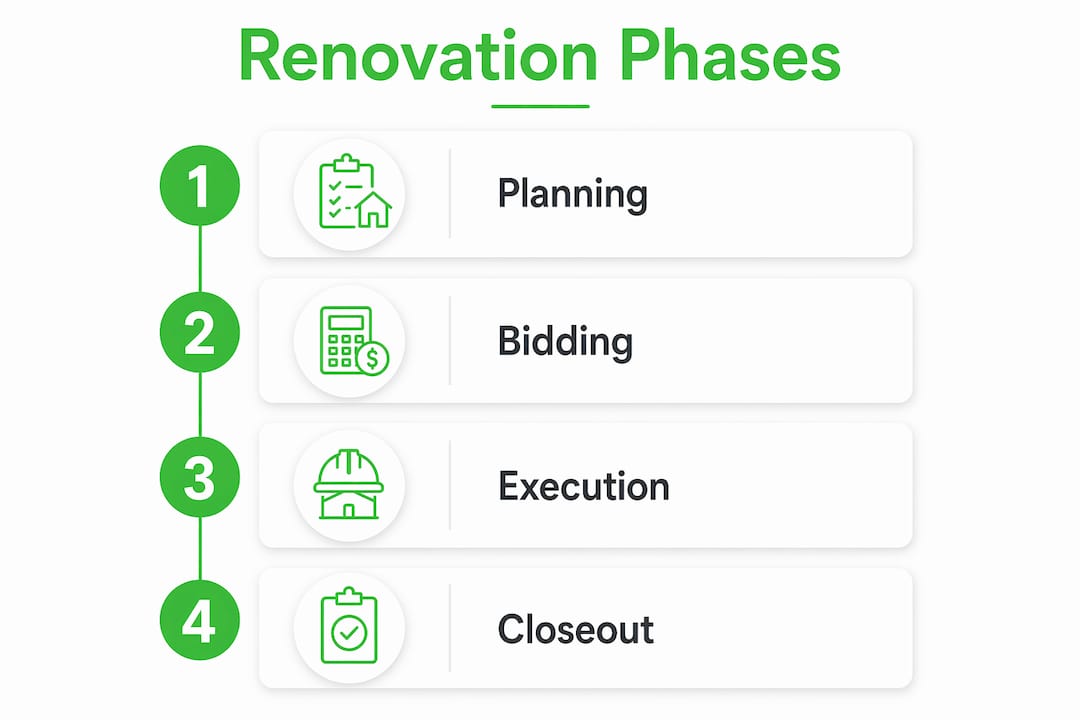
Phase 1: planning
Planning is the most critical phase. The project manager aligns the homeowner’s vision with a realistic budget, secures permits, and builds a master schedule before a single trade is booked. A professional project plan at this stage includes six components:
- Project overview and goals
- Detailed scope of work
- Task schedule with dependencies
- Budget tracker (estimated vs. committed vs. actual)
- Decisions log
- Formal change control process
Getting these six components in place before construction starts is what separates projects that finish on budget from those that do not.
Phase 2: bidding and vendor selection
The manager issues scopes of work to qualified trades and suppliers, collects bids, and evaluates them against the project budget. This phase protects the homeowner from inflated quotes and ensures apples-to-apples comparisons.
Phase 3: execution and progress monitoring
During construction, the supervisor runs weekly site meetings, tracks schedule progress, reviews invoices against the budget tracker, and manages inspections. Key tasks include:
- Confirming trade availability before scheduling each phase
- Logging every decision and change order in writing
- Coordinating material deliveries to avoid site congestion
- Documenting progress with photos for quality and dispute prevention
Phase 4: closeout
Closeout covers final inspections, deficiency walkthroughs, holdback releases, and warranty documentation. A thorough closeout protects the homeowner legally and financially after the trades leave the site.
How does a renovation manager control budgets and schedules?
Budget drift is the most common renovation problem, and it almost always happens gradually. Small, untracked change orders and undocumented material substitutions accumulate until the overrun becomes impossible to ignore. The fix is a budget tracker updated weekly, showing estimated costs, committed costs, and actual costs in three separate columns.
The decisions log works alongside the budget tracker. Every time a homeowner chooses a different tile, upgrades a fixture, or approves a scope addition, the log captures the decision, the cost impact, and the schedule impact. This prevents the ripple effects of undocumented changes from hitting labour scheduling weeks later.
Budget Control Tool
Purpose
Update Frequency
Budget tracker
Tracks estimated vs. committed vs. actual costs
Weekly
Decisions log
Records every scope change and its cost impact
Per decision
Change order form
Formalises scope additions with written approval
Per change
Schedule with dependencies
Shows how one delay affects downstream trades
Weekly
Scheduling control depends on understanding trade dependencies. Plumbing rough-in must complete before insulation. Insulation must pass inspection before drywall. HVAC ductwork must be in place before ceiling framing closes. A construction project supervisor maps these dependencies at the start and monitors them weekly. Knowing precise trade schedules prevents one trade from blocking another and keeps the critical path intact.
Pro Tip: Use the 2–4 weeks before construction starts as a dedicated alignment period. Confirm every trade’s start date, verify material lead times, and lock the schedule before the first worker arrives on site. This window is where most delays are prevented, not fixed.
The Canadian Mortgage and Housing Corporation notes that renovation cost overruns are among the top sources of homeowner financial stress. A weekly budget review meeting, even a 15-minute call, keeps everyone aligned and eliminates surprises.
What type of renovation manager is right for your project?
Project manager titles vary significantly, and the model you choose affects whose interests are prioritised on your project. The three most common models are:
- Owner’s representative: An independent professional hired directly by the homeowner. Their sole obligation is to the homeowner’s budget, timeline, and vision. This model suits large, complex renovations where independent oversight is worth the added cost.
- In-house PM employed by the general contractor: This supervisor manages the GC’s crews and subcontractors. They are skilled at execution but their primary accountability is to the GC’s operations, not exclusively to the homeowner.
- Lead carpenter or project supervisor: Common on mid-size residential projects. This person manages day-to-day site activities and trades but may have limited authority over budget decisions or contract changes.
Choosing the right model depends on project size, complexity, and your comfort level with direct contractor management. For a bathroom remodel in Springwater, a lead carpenter model may be sufficient. For a full home addition or custom build in Blue Mountain, an owner’s rep or an experienced in-house PM from a reputable firm delivers better protection.
When evaluating any candidate, ask for references from projects of similar scope and verify their experience with local permit processes in Simcoe County or South Georgian Bay. Clear role definition and a written responsibility agreement before work starts are non-negotiable. Defining rules of engagement early prevents confusion about who approves what and who communicates with whom.
Understanding why scope planning matters before you hire anyone will help you ask the right questions during the selection process.
What tools and communication strategies do top renovation managers use?
The best renovation managers centralise everything in one place. Scattered emails, verbal approvals, and text-message decisions are where projects lose money and accountability. Cloud-based tools like SiteCapture connect field teams, automate estimates, and provide live progress tracking with photo documentation that all stakeholders can access in real time.
For smaller residential projects, a well-structured Excel-based project plan covers the essentials: scope, schedule, budget tracker, and decisions log in one workbook. The tool matters less than the discipline of using it consistently.
Communication protocols are as important as the tools themselves. Effective project management for renovations establishes clear channels from day one:
- Weekly progress reports: Written summaries sent to the homeowner every Friday, covering schedule status, budget position, and upcoming decisions required.
- Change order approvals: No scope change proceeds without written sign-off from the homeowner. Verbal approvals are not binding and create disputes.
- Trade coordination calls: A brief weekly call with key trades to confirm upcoming schedules, flag material delays, and resolve sequencing conflicts before they hit the site.
- Photo documentation: Site photos taken at each phase milestone protect all parties and provide a clear record of work completed behind walls.
Managing construction change orders through a formal written process is one of the highest-value habits a renovation coordinator can build. It keeps the budget tracker accurate and removes ambiguity about what was approved and when.
Pro Tip: Set a material lead time register at the start of the project. List every major item, its supplier, and its expected delivery date. Review it weekly. Long lead items like custom cabinetry, windows, and specialty tile have derailed more projects than any trade conflict.
For a detailed look at keeping renovation costs under control, the renovation budget tips guide covers practical techniques that align directly with what a strong project manager tracks weekly.
Key takeaways
Effective renovation project management requires a single accountable professional who controls scope, schedule, budget, contractor coordination, and quality from planning through closeout.
Point
Details
Single point of contact
One accountable manager prevents the communication failures that cause most renovation conflicts.
Four-phase structure
Planning, bidding, execution, and closeout each have defined deliverables that keep projects on track.
Weekly budget tracking
Comparing estimated, committed, and actual costs weekly stops budget drift before it becomes a crisis.
PM model selection
Choose between an owner’s rep, GC-employed PM, or lead carpenter based on project size and complexity.
Centralised documentation
A decisions log, change order process, and photo record protect all parties and keep the project accountable.
What i have learned after watching hundreds of renovations
The greatest misconception homeowners carry into a renovation is that a project manager is a glorified messenger. In reality, effective PMs are empowered decision-makers who resolve surprises without stopping the project. They anticipate impacts on the critical path and present solutions, not problems.
What I have seen repeatedly is that the projects with the smoothest outcomes are not the ones with the biggest budgets. They are the ones where the homeowner treated the renovation as a professional construction project from the first meeting. That means written approvals, formal change orders, and a manager with real authority to make calls on site.
The living-on-site reality of residential renovation adds a layer that commercial construction never faces. Stakeholders living through a renovation need a PM who manages their daily experience, not just the schedule. That means sequencing noisy trades thoughtfully, communicating disruptions in advance, and keeping the site safe and clean throughout.
The projects that go wrong almost always share one trait: the PM role was undefined or undervalued at the start. When you invest in strong project management, you are not paying for someone to make phone calls. You are paying for someone to protect your budget, your timeline, and your vision every single day.
For a clear picture of how a well-managed renovation timeline should unfold, the renovation timeline steps guide is worth reviewing before your project kicks off.
— Adam
How Mightonconstruction manages your renovation from start to finish
Mightonconstruction brings over 30 years of project management expertise to every renovation and custom build across South Georgian Bay, including Wasaga Beach, Collingwood, Blue Mountain, Clearview Township, Tiny Township, and Springwater. Every project runs through a structured process: scope definition, permit management, trade coordination, budget tracking, and quality assurance handled by a single experienced team.

Whether you are planning a kitchen remodel, a home addition, or a custom home build, Mightonconstruction delivers transparent communication and premium craftsmanship at every phase. Browse the completed project gallery to see the quality of work that Simcoe County homeowners trust, and reach out to start a conversation about your renovation goals.
FAQ
What does a remodeling project manager do?
A remodeling project manager oversees scope, scheduling, budgeting, contractor coordination, and quality control for a renovation. They serve as the single point of contact between the homeowner, trades, and suppliers throughout the project.
When should i hire a home renovation manager?
Hire a renovation manager before design is finalised. Engaging early allows the manager to align the budget with the scope and catch conflicts before they become costly construction problems.
What is the difference between an owner’s rep and a GC project manager?
An owner’s representative works exclusively for the homeowner and prioritises their budget and vision. A GC-employed project manager is accountable to the general contractor’s operations, which can create different priorities on complex projects.
How do renovation managers prevent budget overruns?
They maintain a weekly budget tracker comparing estimated, committed, and actual costs, and log every change order formally. This prevents small, untracked decisions from accumulating into significant overruns.
What tools do renovation project managers use?
Top managers use cloud-based platforms like SiteCapture for live tracking and photo documentation, combined with structured Excel workbooks for budget tracking, decisions logs, and schedule management. The key is consistent use of whichever system is chosen.