Project feasibility: a homeowner's guide to smart planning


TL;DR:
- Conducting a feasibility study helps homeowners identify potential project risks before investing heavily.
- The TELOS framework assesses technical, economic, legal, organizational, and scheduling factors to guide decisions.
- Early feasibility planning saves costs, prevents delays, and ensures project success in home renovations and builds.
Passion and a healthy budget feel like everything you need to get started on a dream home or major renovation. But many homeowners in South Georgian Bay discover, sometimes painfully and expensively, that enthusiasm alone cannot predict whether a project will actually work. Project feasibility is the disciplined process that answers the critical question before you spend a dollar on drawings or deposits: is this project truly achievable, and under what conditions? This guide unpacks what feasibility means, how to apply it, and why skipping it is one of the costliest mistakes a homeowner can make.
Table of Contents
- Defining project feasibility: What it means for large home projects
- The TELOS framework: Breaking down feasibility for homeowners
- Feasibility for renovations and custom builds: What makes these projects unique
- Budget feasibility: The role of cost estimates and renovation contingency
- Feasibility in action: From high-level screening to go/no-go decision
- Why early feasibility is the best investment for homeowners
- Next steps: Bring your dream home to life with expert feasibility support
- Frequently asked questions
Key Takeaways
| Point | Details |
|---|---|
| Start with feasibility | Test your project’s feasibility before investing in design or construction to prevent costly missteps. |
| Use TELOS for clarity | Assess technical, economic, legal, organisational, and scheduling factors to surface potential roadblocks early. |
| Plan for budget swings | Set realistic contingencies—especially for renovations—since unknowns can add up to 25% to costs. |
| Decide with confidence | A staged feasibility check leads to clear go or no-go decisions and a roadmap for success. |
Defining project feasibility: What it means for large home projects
Now that we’ve highlighted why your dream project needs more than just vision, let’s clarify what project feasibility actually covers.
Project feasibility is not a vague gut check. It is a structured, analytical process designed to test whether your proposed project is realistic before you commit serious money or time. A feasibility study is an analysis of whether a proposed project is practical and likely to succeed before major investments are made, evaluating costs, benefits, risks, and required resources across financial, legal, technical, and scheduling dimensions.
Understanding why feasibility matters is the first step toward protecting your investment. For homeowners planning a custom build or large renovation, this means examining far more than a rough budget number. It means asking whether your site can physically support the design, whether zoning bylaws allow what you want to build, whether your funding model holds up under realistic cost ranges, and whether local trades and materials can realistically meet your timeline.
A strong feasibility process produces something specific and actionable. According to project planning best practices, a feasibility approach should produce an actionable go/no-go recommendation and an early risk-screening roadmap rather than just a definition. That distinction matters enormously. You are not simply gathering information. You are arriving at a clear decision point.
Here is what a solid feasibility review covers for home projects:
- Site and technical constraints: Soil conditions, lot grading, setbacks, and access
- Financial viability: Whether your budget aligns with realistic cost estimates for your scope
- Legal and zoning compliance: Permits, heritage designations, shoreline regulations, and easements
- Operational readiness: Whether you, your designer, and your contractor are aligned and resourced
- Scheduling realism: Whether the project timeline accounts for permit lead times, seasonal windows, and material availability
The home renovation steps involved in any major project are interconnected, and feasibility is the thread that ties them together before they unravel.
“Feasibility is not about killing great ideas. It’s about building great ideas on solid ground.”
The TELOS framework: Breaking down feasibility for homeowners
With the purpose of feasibility clear, let’s look at a proven method to structure your analysis and avoid surprises.
The TELOS framework is one of the most practical tools available for homeowners tackling large projects. TELOS groups feasibility into Technical, Economic/Financial, Legal, Organisational/Operational, and Scheduling feasibility, helping decision-makers ask specific questions in each area. Each dimension uncovers a different category of risk, and missing even one can derail an otherwise well-funded project.
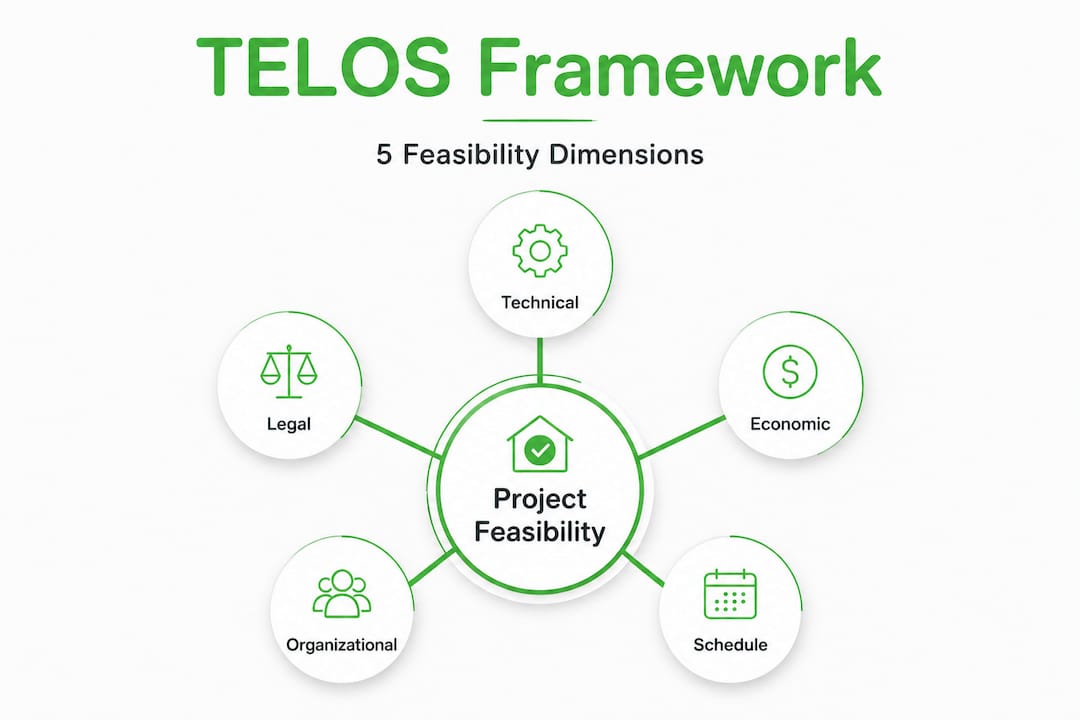
Here is how each TELOS dimension applies to a custom home or major renovation:
| Dimension | Key question for homeowners | Example risk uncovered |
|---|---|---|
| Technical | Can the site and structure support the design? | Poor soil requiring expensive foundation work |
| Economic | Does the budget realistically cover all costs? | Underestimated finishing costs on a luxury build |
| Legal | Are permits and zoning approvals achievable? | Shoreline setback restrictions on a waterfront lot |
| Organisational | Are the right people and processes in place? | No qualified ICF contractor available in the region |
| Scheduling | Can the project be completed in the intended timeframe? | Permit delays pushing construction into winter |
When you work through each dimension systematically, you stop guessing and start planning. Many homeowners who prepare for major renovations discover that one or two TELOS dimensions flag significant issues that would have caused expensive surprises later.
The most commonly skipped dimension is organisational feasibility. Homeowners often assume that once they have a design and a budget, the right team will simply materialise. In South Georgian Bay, where skilled trades are in high demand, confirming contractor availability and capacity is a critical early step, not an afterthought.
Pro Tip: Before engaging a designer or architect, run a quick TELOS checklist on your project. Even a one-page written summary for each dimension will surface the issues that need resolution before you invest in detailed plans.
Feasibility for renovations and custom builds: What makes these projects unique
Now, let’s connect the framework to real-world home projects and highlight what makes a luxury build or major renovation different.
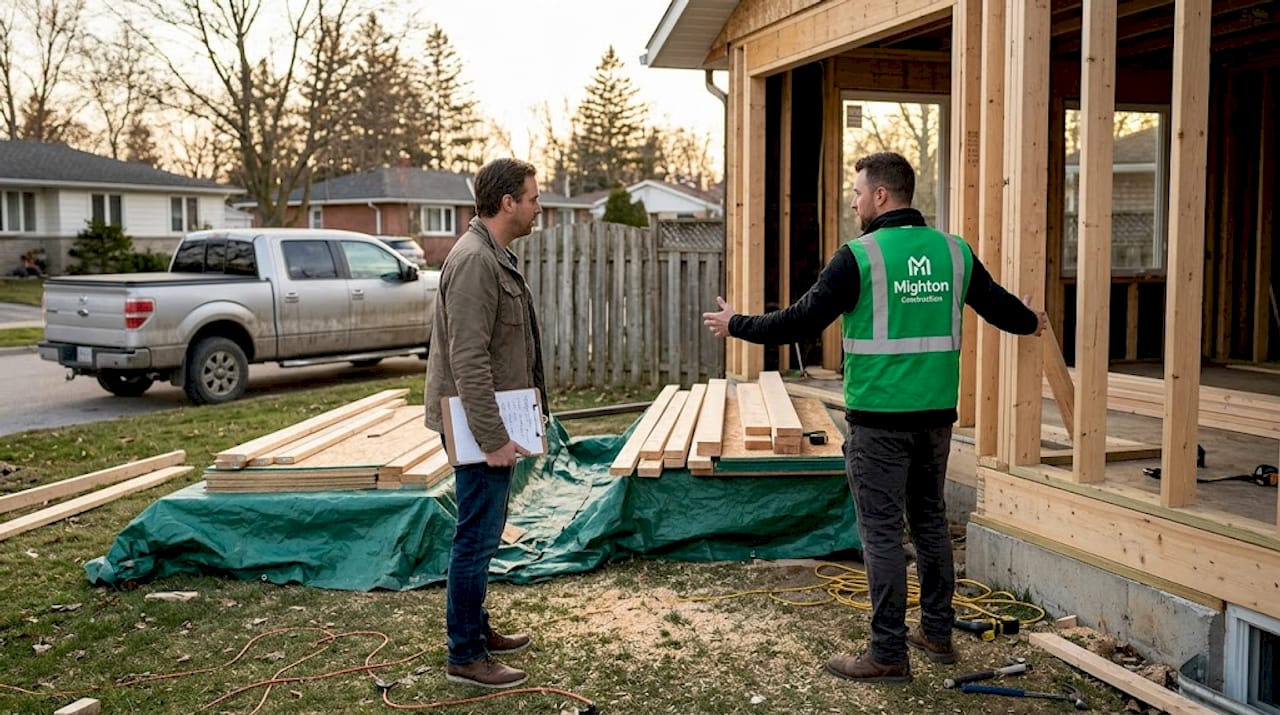
Construction feasibility is distinct from other types of project planning because the physical environment introduces variables that no spreadsheet can fully predict. For construction and renovation, feasibility planning determines whether the design, engineering and site constraints, and financial model can produce a viable build result, typically in a preconstruction phase. This preconstruction feasibility work is where the most valuable discoveries happen.
Custom luxury builds and major renovations in South Georgian Bay carry a specific set of unique considerations that make early feasibility even more important:
- Waterfront and shoreline regulations: Properties along Georgian Bay, Nottawasaga Bay, or inland lakes face provincial and municipal shoreline setback rules, environmental protections, and sometimes Niagara Escarpment Commission requirements. These are non-negotiable and must be verified before any design work begins.
- Seasonal construction windows: Concrete pours, foundation work, and exterior finishing all have weather-sensitive timelines. A project that misses its spring start window may not resume until the following year, adding carrying costs and delays.
- Mature trees and natural features: Large trees, rock outcroppings, and wetland buffers on premium lots can restrict where structures can be placed, requiring engineering solutions that affect both cost and design.
- Heritage and historic designations: Some properties in Collingwood and surrounding communities carry heritage designations that impose design constraints on renovations and additions.
- Material and trade lead times: Premium materials for luxury builds, from engineered hardwood to custom windows, can carry 12 to 20-week lead times. Feasibility must account for procurement timelines alongside construction schedules.
Understanding the custom renovation workflow for projects of this scale helps homeowners see why feasibility is not a one-time checkbox but an ongoing reference point throughout preconstruction.
A practical major renovation checklist will always include site-specific constraint verification as one of its earliest steps, precisely because these constraints have the greatest potential to alter scope, cost, and timeline.
Pro Tip: Write down your top three site or design constraints before your first meeting with a builder. Bring them to the table and ask directly how each one affects feasibility. A builder who engages seriously with those constraints is one you can trust.
Budget feasibility: The role of cost estimates and renovation contingency
No feasibility study is complete without a hard look at costs and what can go unexpectedly wrong. Here’s how budget realism fits in.
Budget feasibility is where many homeowners feel the most confident, and where they are most often surprised. Having a number in mind is not the same as having a feasible budget. Budget feasibility for renovations depends heavily on estimate class and contingency because early-stage estimates are intentionally less precise and must include allowance for unknown existing conditions.
Estimate classes matter because they tell you how much uncertainty is built into a number. A Class 5 estimate, which is the type you get from a ballpark conversation with a contractor, can carry an accuracy range of plus or minus 50%. A Class 3 estimate, developed from preliminary design documents, narrows to roughly plus or minus 20 to 30%. You should not be making firm financial commitments based on a Class 5 estimate, yet many homeowners do exactly that.
Here is what a realistic budget feasibility approach looks like:
- Class 5 (conceptual): Use for initial go/no-go screening only. Do not commit funds.
- Class 4 (schematic): Suitable for preliminary financing conversations. Still requires significant contingency.
- Class 3 (preliminary design): Appropriate for detailed budget planning and lender discussions.
- Contingency for known risks: Budget 5 to 15% above your base estimate for well-documented scopes.
- Contingency for unknown conditions: Budget up to 25% above your base estimate for renovations where existing conditions are not fully visible or documented.
That last point deserves emphasis. Renovations are fundamentally different from new builds because you are working with an existing structure whose hidden conditions are unknown until walls open and floors come up. Knob-and-tube wiring, outdated plumbing, moisture damage, and inadequate insulation are common discoveries that add cost and time to renovation projects.
Even with the best plans, unexpected conditions in renovations can drive cost swings of 25% or more. That is not a failure of planning. It is the nature of working with existing structures, and your budget must account for it.
Renovation budget tips consistently point to contingency planning as the single most important factor separating projects that finish on budget from those that stall or leave homeowners in financial stress. Build the contingency in from day one, not as an afterthought.
Feasibility in action: From high-level screening to go/no-go decision
Bringing the feasibility process full circle, here’s how you can formalise your project decision and next steps without overwhelm.
The feasibility process does not need to be overwhelming. It works best as a staged approach that matches the level of detail to the level of commitment at each phase. Homeowners often need a staged feasibility process: an initial feasibility pass covering high-level constraints and ballpark budget and timeline before committing to full architectural and engineering drawings and detailed permitting packages.
Here is a practical staged process you can follow:
- Stage one: Quick-screen for major blockers. In one to two weeks, check zoning bylaws, confirm lot coverage limits, get a ballpark cost range from a builder, and identify any obvious site constraints. This stage answers whether the project is worth pursuing further.
- Stage two: Preliminary design and detailed feasibility. Engage a designer for schematic drawings. Get a Class 3 estimate. Confirm permit requirements with the municipality. Verify trade availability and material lead times. This stage refines your go/no-go decision with real data.
- Stage three: Go/no-go milestone. Review all feasibility findings and make a formal decision: proceed as planned, revise the scope to address constraints, or pause until conditions change. Document this decision and the reasoning behind it.
- Stage four: Full design and permitting. Only after a clear go decision should you invest in full architectural drawings, engineering reports, and permit applications.
Feasibility studies are designed to identify known issues and potential problems before proceeding, so stakeholders can make a go/no-go decision and outline next steps if proceeding. That structure protects you at every stage.
Following a clear step-by-step renovation process ensures that each stage builds on a solid foundation of verified information rather than assumptions.
Pro Tip: At the end of each feasibility stage, document all known risks and how you plan to address or monitor them as the project advances. This living risk log becomes one of your most valuable project management tools.
Why early feasibility is the best investment for homeowners
Here is a perspective you will not find in most guides on home building or renovation planning.
Most homeowners spend enormous energy on the exciting parts: choosing finishes, browsing floor plans, imagining the view from the deck. That energy is valuable. But the projects that truly succeed, that finish on time, within budget, and exceed expectations, are the ones where the homeowner invested equally in the unglamorous work of early feasibility.
The uncomfortable truth is this: many dream homes fail long before a single shovel touches the ground. They fail because a homeowner fell in love with a design before confirming the site could support it. They fail because a budget was built on a Class 5 estimate and a hope. They fail because permit requirements were assumed rather than verified, and the approval process took 18 months instead of six.
We have seen this pattern repeatedly over more than 30 years of building in South Georgian Bay. The homeowners who arrive at the construction phase with a completed feasibility process are calmer, better prepared, and more decisive. They have already worked through the hard questions. They know their contingency is funded. They know their permits are approvable. They know their contractor has the capacity to deliver.
The homeowners who skip feasibility often arrive at the construction phase carrying unresolved risks that eventually surface as cost overruns, design compromises, or outright project stalls. The money saved by skipping a feasibility study is almost always dwarfed by the cost of the problems it would have caught.
Investing in project management for luxury results starts with feasibility. It is not a cost to minimise. It is the foundation on which every great project is built.
Next steps: Bring your dream home to life with expert feasibility support
Ready to move forward? Here is how to ensure your project starts strong.
At Mighton Construction, we work with homeowners across South Georgian Bay through every phase of the feasibility and build process, from initial site and zoning reviews to full construction management. Our team brings over 30 years of local expertise to the questions that matter most before you commit to a major project.
Whether you are planning a custom cottage builder in Wasaga Beach project on the waterfront or exploring an ICF contractor for custom homes solution for superior energy performance and durability, our team can help you assess feasibility with confidence. We understand the local site conditions, municipal permit processes, and seasonal constraints that shape every successful build in this region. Reach out to Mighton Construction to start the conversation and give your dream home the solid foundation it deserves.
Frequently asked questions
What are the main risks if I skip a feasibility study for my home build or renovation?
You risk major cost overruns, design setbacks, permit delays, or discovering mid-project that your plans are unworkable or non-compliant. Feasibility studies are specifically designed to surface these issues before they become expensive problems.
How early in the planning process should homeowners do a project feasibility check?
Ideally, feasibility should be checked before investing in architectural drawings or making major payments to contractors. A feasibility study is an analysis of whether a project is practical and likely to succeed before major investments are made.
What’s included in a feasibility study for home construction or renovation?
A good feasibility study covers technical, financial, legal, and schedule dimensions, along with an overall risk assessment and a clear recommendation. Feasibility studies evaluate costs, benefits, risks, and all required resources to determine whether a project is worth proceeding with.
How much contingency should I include in my project feasibility budget?
Include 5 to 15% contingency for well-documented scopes, and up to 25% if you are renovating and site conditions are not fully known. Renovation contingency is higher when existing conditions are unknown, and building it in from the start is essential to project success.