Integrated project delivery: Streamlining construction in 2026

TL;DR:
- IPD is a collaborative, single-agreement approach that aligns all project stakeholders from start to finish.
- It significantly reduces costs, delays, and conflicts compared to traditional construction methods.
- Genuine IPD requires full party commitment, early trade involvement, and transparent, shared risk/reward structures.
Most construction projects don’t finish the way they start. Fail on time, budget is the reality for 99.5% of traditional builds, leaving homeowners frustrated and developers absorbing losses they never planned for. If you’ve ever watched your build timeline stretch from months into years, or seen your budget evaporate through change orders and miscommunication, you’re not alone. Integrated project delivery, commonly called IPD, is changing that picture. It’s a structured, collaborative method that brings everyone to the table early, aligns incentives, and builds transparency into the contract itself. This article explains exactly how it works and why it matters for property owners across South Georgian Bay.
Table of Contents
- Understanding integrated project delivery: Core principles and structure
- How the IPD process works: Step-by-step project roadmap
- IPD versus traditional construction: Performance, transparency, and quality
- IPD in South Georgian Bay: Local application and practical outcomes
- Why true IPD changes the game for those who commit
- Discover custom building solutions for South Georgian Bay
- Frequently asked questions
Key Takeaways
| Point | Details |
|---|---|
| Full-team collaboration | IPD unites owners, designers, and builders under one contract for transparent teamwork. |
| Lean techniques and BIM | Digital tools and lean planning minimize waste and errors for smoother construction. |
| Evidence-backed results | IPD delivers faster, more reliable custom builds, with fewer disputes and overruns. |
| Local advantage | IPD suits South Georgian Bay’s custom projects, helping offset local logistics challenges. |
Understanding integrated project delivery: Core principles and structure
IPD isn’t just a buzzword. It’s a fundamentally different way of organising a construction project from the ground up, changing not just who does the work but how they relate to each other and to the outcome.
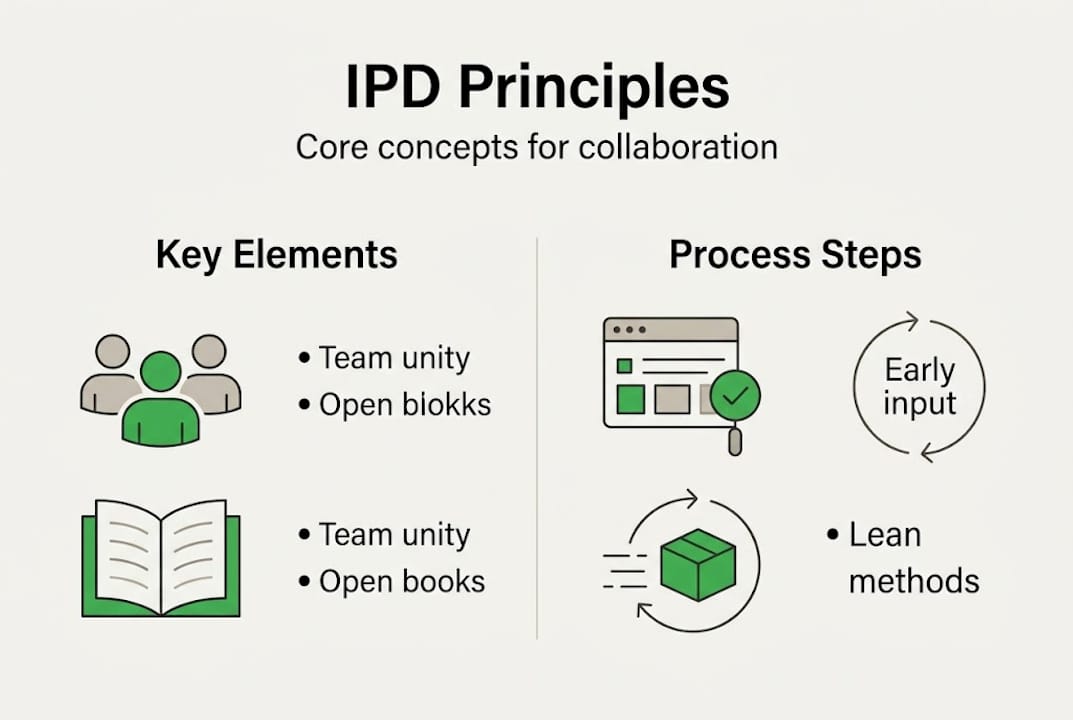
At its core, IPD integrates owners, architects, engineers, contractors, and trades under a single multi-party agreement from start to finish. That single agreement is crucial. In a traditional project, the owner contracts with an architect, then separately with a general contractor, then separately with subtrades. Each party has their own interests, their own risk exposure, and their own incentive to protect themselves rather than collaborate. IPD replaces that fragmented structure with a unified team that shares both the risk and the reward.
The key parties in an IPD project typically include:
- The owner sets vision, goals, and budget parameters and remains actively engaged throughout
- The design team (architect, structural engineer, mechanical/electrical engineers) contributes technical expertise from day one
- The general contractor provides constructability feedback during design, not after it’s finalised
- Key subtrades (mechanical, electrical, specialty) join early to prevent coordination gaps
- Technology specialists support digital workflows and building information modelling (BIM)
The project management structure under IPD relies on several distinctive tools. Key methodologies include multi-party contracts, shared risk/reward pools, open-book accounting, and BIM. Open-book accounting means every party can see where money is going. There’s no hiding costs or inflating margins in secret. The shared risk/reward pool means that if the team delivers under budget, everyone shares the savings. If costs overrun, the team absorbs a portion together before it falls back on the owner.
“The most important shift in IPD is philosophical. It replaces the adversarial ‘protect your contract’ mindset with a ‘best-for-project’ culture where every decision is evaluated against the project’s goals, not individual margins.”
Lean construction practices are woven throughout IPD. Lean, borrowed from manufacturing, focuses on eliminating waste, whether that’s wasted time, wasted material, or wasted effort from rework. BIM adds the digital layer, allowing the full team to work in a shared 3D model where clashes between structural, mechanical, and electrical systems are detected and resolved virtually before construction begins. For a custom home or waterfront cottage in Georgian Bay, that means far fewer surprises once the concrete is poured.
How the IPD process works: Step-by-step project roadmap
With the groundwork set, here’s how the integrated project delivery method takes shape from beginning to end.
IPD process steps follow a logical sequence: the owner selects the team, establishes shared vision, validates costs and schedules, moves into collaborative design, executes integrated construction, and closes out with reward sharing. Each phase builds on the last, and unlike traditional models, the team rarely backs up to resolve issues from a previous phase.
- Owner selects the team. This isn’t a competitive bid process. The owner chooses partners based on qualifications, compatibility, and track record. Price is part of the conversation but not the sole driver. A capable team chosen early is far more valuable than the lowest bidder chosen late.
- Shared vision and goals. The full team, including key trades, gathers to establish project goals: budget targets, quality standards, schedule milestones, and non-negotiables. This shared vision becomes the foundation of every future decision.
- Validation phase. The team pressure-tests the owner’s vision against real numbers. Can the design goals be achieved within budget? What are the actual risks? This phase often surfaces critical issues that would have become costly surprises later.
- Collaborative design with lean and BIM tools. Design is no longer a hand-off from architect to contractor. Everyone contributes simultaneously. BIM models are shared, clashes are identified, and the design evolves based on input from trades who will actually build it.
- Integrated construction using pull planning. Pull planning, a lean scheduling technique, works backward from the completion date, with each trade identifying what they need and when. It eliminates the bottlenecks that pile up in traditional scheduling.
- Project closeout and reward sharing. Once the project is delivered, actual costs are compared against targets. Savings are distributed according to the multi-party agreement. Everyone who helped deliver a successful project is recognised for it.
Consult the project workflow guide for a deeper look at how a custom home moves from concept to completed build.
| IPD phase | Primary participants | Key output |
|---|---|---|
| Team selection | Owner, builder, architect | Signed multi-party agreement |
| Shared vision | Full project team | Goals and success criteria |
| Validation | Engineers, contractors, trades | Verified budget and schedule |
| Collaborative design | Full team using BIM | Coordinated design documents |
| Integrated construction | Contractor, subtrades | Lean-built structure |
| Closeout and reward | All parties | Incentive distribution |
This sequence is intentionally front-loaded with collaboration. The effort spent in early phases pays back many times over during construction, where changes are far more costly.
IPD versus traditional construction: Performance, transparency, and quality
Now, let’s see how IPD measures up against the traditional approaches familiar to most homeowners and builders.
The dominant traditional method is design-bid-build, where the owner hires a designer, receives a completed set of drawings, and then puts the project out to competitive tender. The design-build process offers some improvement over design-bid-build by merging the designer and builder under one contract, but it still lacks the multi-party collaboration that defines true IPD.
Here’s where the performance gap becomes very clear:
| Performance metric | Traditional (design-bid-build) | Integrated project delivery |
|---|---|---|
| On-time delivery | Rarely achieved | Significantly improved |
| Budget adherence | 99.5% miss targets | 17-28% cost reductions typical |
| Change orders | High frequency | Dramatically reduced |
| Rework and conflicts | Common and costly | 80% fewer conflicts |
| Dispute rate | Elevated | Near-zero in true IPD |
| Owner involvement | Reactive and limited | Active and continuous |
IPD’s advantages aren’t marginal. Cost reductions of 17-28%, 30% faster project completion, and 80% fewer coordination conflicts represent real money and real time for South Georgian Bay property owners building custom homes or cottages.
Transparency is another area where the contrast is stark. Traditional contracts often hide markup structures and create information asymmetries where the contractor knows far more than the owner about where money is being spent. Open-book accounting in IPD means the owner can see line-item costs at any point. That kind of visibility also eliminates the most common sources of construction disputes.
Research on lack of reliable builders shows that nearly half of homeowners have been put off renovation projects due to concerns about builder reliability. IPD directly addresses that concern by structuring the entire relationship around accountability and shared outcomes rather than one-sided contracts.
For cost estimation for custom homes, IPD’s validation phase provides a more accurate starting point than a traditional competitive bid, because the people pricing the work are the same people who will execute it.
Pro Tip: IPD is most valuable for complex, high-quality, or large-scale builds where coordination between many trades and disciplines is essential. For a straightforward addition or smaller renovation, a well-managed design-build contract may be more practical.
IPD in South Georgian Bay: Local application and practical outcomes
With the performance comparison clear, let’s discuss IPD’s real-world impact for South Georgian Bay homeowners and developers.
Building in this region presents challenges that make collaborative delivery especially worthwhile. Supply chains for specialty materials (stone, timber, high-performance windows suited to Georgian Bay weather) require longer lead times. Skilled trades are in demand, and scheduling conflicts between trades are common. Seasonal build windows, particularly for waterfront properties, create tight timelines that leave little room for the rework and miscommunication that plague traditional delivery.
IPD’s custom build efficiency is particularly well-suited to complex, high-quality builds, ensuring transparency and efficiency, though it requires experienced teams who genuinely trust the process. A seasoned local team that understands Georgian Bay’s permit environment, supply chain realities, and seasonal factors is critical to making the collaboration actually function.
Here’s what to look for when evaluating a team for an IPD-style project in the region:
- Proven multi-party contract experience. Ask to see examples of previous projects delivered under a true shared risk/reward structure, not just a design-build contract rebranded as IPD.
- Early trade involvement. Your mechanical, electrical, and specialty contractors should be engaged before design is finalised, not after drawings are issued.
- Digital collaboration tools. BIM capability isn’t optional in a genuine IPD project. Confirm the team has real experience using shared models for coordination.
- Local supply chain relationships. A team that already has strong relationships with regional suppliers can anticipate lead times and lock in materials earlier, which matters enormously for waterfront builds or projects with custom finishes.
- A ‘best-for-project’ mindset. This is cultural, not contractual. Probe the team in your first meeting: how do they handle design decisions where one trade’s preference conflicts with another’s?
Success needs early trade input, digital tools, and a genuine ‘best-for-project’ mindset. Failures in IPD-labelled projects are often due to pseudo-IPD arrangements that carry the name without the substance, no genuine risk-sharing, no open-book accounting, and no early trade involvement.
Pro Tip: Ask your prospective builder to show you the actual contract language around risk-sharing and reward pools. If the contract looks like a standard general contract with “IPD” written at the top, that’s a red flag. True IPD contracts are fundamentally different documents.
Explore custom home FAQs to learn more about how collaborative builds are structured from an owner’s perspective. You can also read about subcontractor roles to better understand how trades fit into an integrated project structure.
Why true IPD changes the game for those who commit
Here’s the honest truth that most IPD articles skip: the method only works when every party is genuinely committed. Partial commitment produces something worse than a traditional project, because you get the complexity of IPD without its benefits.
We’ve seen custom builds in Georgian Bay where the framing was exceptional but the electrical and mechanical coordination fell apart because those trades weren’t brought in until design was locked. That’s pseudo-IPD. The challenges include complex contracts and real resistance from parties who aren’t fully committed; it performs best for engaged owners and large or complex projects where the upfront investment in collaboration pays off many times over.
For custom homes and waterfront cottages in this region, that payoff is real. When you’re building a high-spec home near Wasaga Beach or a four-season cottage near Blue Mountain, the coordination demands are significant. Heating systems, ICF foundation details, custom millwork, and complex glazing packages all need to work together seamlessly. That only happens when the trades designing each system can see each other’s work in real time.
The ‘best-for-project’ mindset is the real secret. It means a contractor recommends a slightly more expensive structural approach because it saves the electrical contractor three days of rework. That trade-off never happens in a traditional contract because no one is sharing the savings. In IPD, it happens naturally.
What we’d tell any property owner considering a significant build: ask your builder what custom home construction actually means to them in terms of team integration. The answer will tell you everything.
Discover custom building solutions for South Georgian Bay
If you’re planning a custom home, waterfront cottage, or large-scale renovation in the South Georgian Bay area, the principles behind IPD, transparency, early collaboration, and shared accountability, are exactly what Mighton Construction brings to every project.
With over 30 years of experience building across Wasaga Beach, Collingwood, Blue Mountain, and the surrounding townships, our team understands the regional logistics, seasonal constraints, and quality standards that matter to local property owners. Explore our Wasaga Beach cottage builds and ICF contractor services to see how we apply collaborative, transparent delivery to complex custom projects. Visit our Mighton project gallery to see completed work, then reach out to start a conversation about your vision.
Frequently asked questions
How does integrated project delivery reduce construction delays?
IPD brings all key parties together early, using lean planning and BIM for real-time coordination. Coordination conflicts drop by 80%, and projects are consistently delivered ahead of traditionally managed schedules.
Is IPD suitable for small or less complex home builds?
IPD’s full value emerges in complex, custom projects where many trades and disciplines must coordinate. IPD best for large projects; simpler builds may not justify the additional contract and collaboration overhead.
What makes IPD more transparent than traditional methods?
Open-book accounting, shared risk/reward agreements, and early stakeholder input mean costs, decisions, and progress are visible to all parties. IPD emphasises transparency through multi-party contracts that expose financials and incentivise honesty.
How can I verify if my project is using true IPD?
Check for a genuine multi-party contract, a shared risk/reward pool tied to measurable project targets, and early involvement of key trades well before design is complete. Verify actual multi-party contracts and genuine risk-sharing; anything less is pseudo-IPD in name only.