Home designs in Canada: 2026 guide for homeowners

TL;DR:
- Modern Canadian home designs in 2026 emphasize site-responsive massing, energy performance, and regional climate adaptation. Key styles include modern farmhouse, contemporary bungalow, cottage modern, and ranch revival, all featuring sustainable materials and precise detailing to meet updated codes. Early site analysis and collaborative planning are essential for approval, maximizing performance and aesthetic value while minimizing redesign costs.
Home designs in Canada today integrate modern aesthetics with rigorous energy-performance standards, shaped by regional climates, evolving building codes, and the distinct character of each site. Whether you are planning a custom home in South Georgian Bay, a waterfront cottage near Wasaga Beach, or a modern build in Collingwood, the decisions you make at the design stage determine how your home performs for decades. The best Canadian home architecture in 2026 is defined not just by how a home looks, but by how it responds to its environment, meets updated code requirements, and reflects your lifestyle.
What does modern home design in Canada look like today?
Modern house plans in Canada are defined by a clear set of architectural principles that separate them from the generic suburban builds of the past two decades. Large glazing, clean horizontal lines, and deliberate indoor/outdoor connections are the most recognisable characteristics. These are not purely aesthetic choices. They reflect how Canadians want to live: connected to nature, flooded with natural light, and oriented toward views.
The most compelling Canadian home architecture starts with the site, not the style catalogue. Sun paths, views, and privacy factors shape massing and window placement before a single style decision is made. This approach produces homes that feel genuinely rooted in their location, whether that is a rocky Georgian Bay shoreline, a Blue Mountain ski slope, or a rural Clearview Township property.
Popular architectural styles in 2026 include:
- Modern farmhouse: Board-and-batten or board-formed concrete exteriors, steep gable roofs, and open-plan interiors that blend warmth with clean geometry
- Contemporary bungalow: Single-storey forms with deep overhangs, passive solar orientation, and strong connections to outdoor living spaces
- Cottage modern: Timber accents, natural stone, and large sliding doors that dissolve the boundary between interior and exterior, common in Muskoka and South Georgian Bay
- Ranch revival: Low-profile, sprawling plans suited to flat or gently sloping sites in Springwater and Tiny Township
Material choices are increasingly driven by energy and maintenance performance. White or light-coloured cladding, such as fibre cement or board-and-batten, reduces solar heat gain in south-facing walls. Thermally broken window frames and triple-glazed units are now standard in high-performance builds. These material decisions are no longer optional extras. They are responses to both client expectations and code requirements.
How do 2025 to 2026 Canadian building codes influence home design choices?
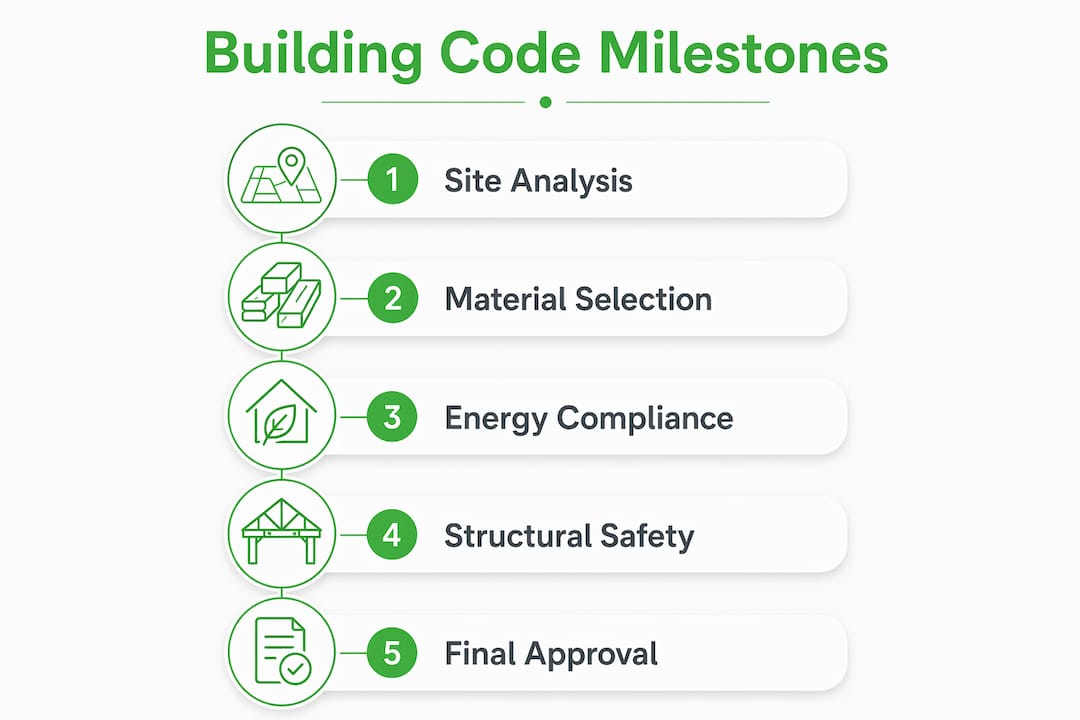
The NECB 2025 and NBCC 2025 are the two most significant regulatory updates shaping Canadian home architecture right now. Together, they raise the bar on energy efficiency, structural safety, and accessibility, and they directly influence what your custom home can and cannot look like.
The NECB 2025 introduces several critical changes for new residential builds:
- Projected climate data for 50 years must now be incorporated into building design, meaning your home is engineered for the climate of 2075, not just today. This encourages resilient design choices from the outset.
- Greenhouse gas reduction targets are now an explicit objective, pushing designers toward electric heating systems, high-performance envelopes, and reduced reliance on fossil fuels.
- Thermal bridging is addressed far more rigorously than in previous editions. Continuous insulation layers, thermally broken cladding attachments, and careful detailing at window and door openings are now required in many compliance paths.
- Airtightness requirements have tightened, meaning your builder must treat the building envelope as a system, not a collection of individual components.
The NBCC 2025 adds structural safety updates and energy performance compliance paths that give builders more flexibility. The energy use intensity (EUI) compliance path is particularly relevant for compact custom homes. Smaller, well-insulated homes inherently use less energy per square metre, and this path formally recognises that efficiency. For homeowners building a modest but high-quality custom home in Wasaga Beach or Springwater, this means your design can qualify for higher energy tiers without meeting every prescriptive requirement individually.
Large glazing, one of the most desired features in modern Canadian homes, requires careful balancing under these codes. Airtightness and thermal bridging rules mean that every window opening must be detailed precisely. Thermally broken frames, warm-edge spacers, and proper air barrier continuity at the rough opening are not optional. They are the difference between a home that performs and one that fails a blower door test.
Pro Tip: Ask your builder to confirm which compliance path they are using before design development begins. Choosing between the prescriptive trade-off path and the EUI path early can save significant redesign costs later, especially if you want large windows or unconventional massing.
For homeowners interested in how energy efficiency shapes luxury builds, the relationship between code compliance and long-term operating costs is direct and measurable.
What are inspiring examples of modern Canadian home designs?
Two recently completed projects illustrate what the best home designs in Canada look like when site analysis, modern aesthetics, and energy performance are treated as a single design problem.
Project
Location
Key design feature
Energy strategy
The Albatross
Québec Laurentians
Cantilevered volumes following steep terrain
Compact massing, high-performance glazing
Timbertop House
Ontario
White board-and-batten cladding, sliding doors
Reflective envelope, low solar heat gain
The Albatross in the Québec Laurentians is a striking example of site-driven massing. The home uses layered volumes following steep terrain with dramatic cantilevers inspired by a bird in flight. Expansive glazing on the valley-facing elevations captures views while terraces on each level create outdoor living spaces that function year-round. The compact, stacked form minimises the building footprint on a challenging slope and reduces heat loss through a tighter surface-to-volume ratio.
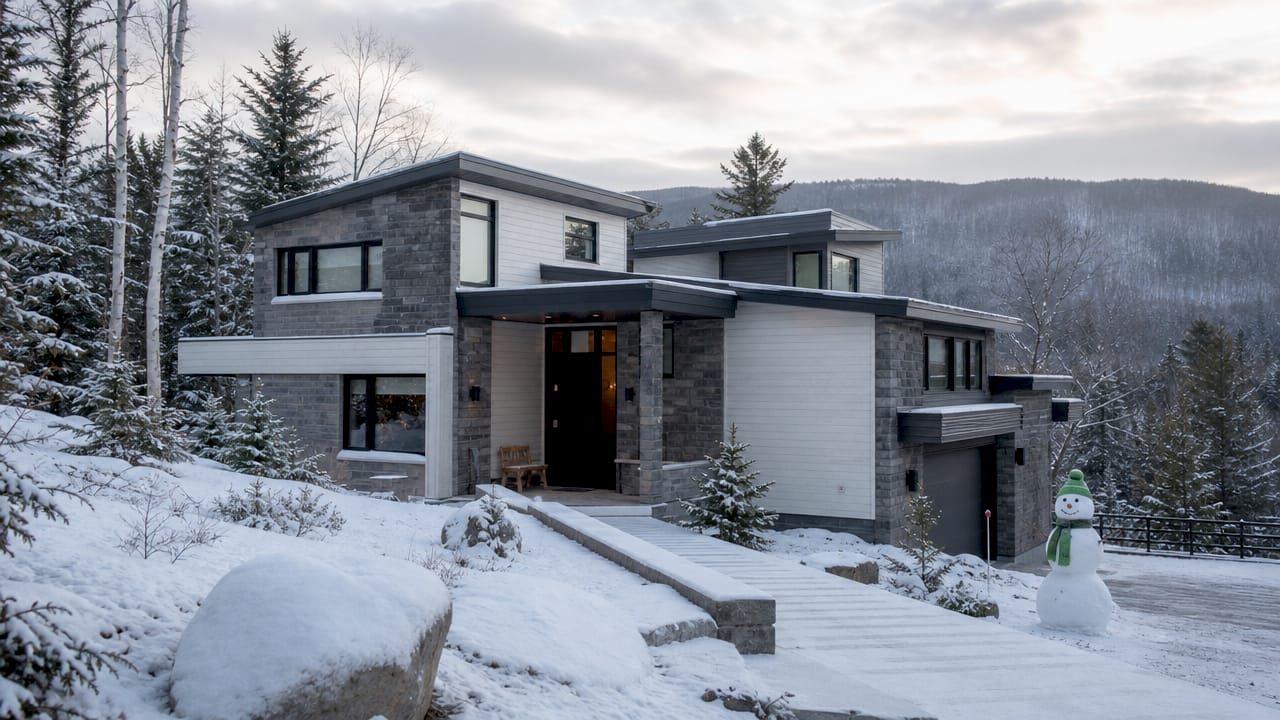
Timbertop House in Ontario, designed by Atelier Kastelic Buffey, takes a different approach. White board-and-batten siding reduces solar heat gain on the building envelope while maximising low-maintenance performance over decades of freeze-thaw cycling. Expansive sliding doors open the main living area directly to outdoor decks, creating the indoor/outdoor connection that defines contemporary cottage living in Ontario. The envelope strategy here is deliberate: light-coloured cladding is not just an aesthetic choice but a passive cooling measure.
The lesson from both projects is consistent. The most admired Canadian residential architecture in 2026 does not start with a style preference. It starts with a site visit, a sun path analysis, and an honest conversation about how the building will perform in a Canadian climate. Homeowners in Collingwood, Blue Mountain, and the broader South Georgian Bay region face the same design challenges as these projects: dramatic topography, strong seasonal sun angles, and the desire for views without sacrificing thermal comfort.
How to plan and get approval for custom home designs in Canada?
Planning permission is required for virtually all new residential builds and major alterations in Canada. Understanding the process before you commit to a design saves time and money. Here is how the approval process works in most Canadian municipalities, including those in Simcoe County:
- Confirm zoning compliance. Before submitting any application, verify that your intended use, building height, setbacks, and lot coverage comply with the local zoning bylaw. In Wasaga Beach, Collingwood, and Clearview Township, zoning rules vary significantly between residential, rural, and waterfront designations.
- Prepare your application package. A complete submission typically includes a site plan showing property boundaries and building placement, architectural drawings (floor plans, elevations, sections), and, for larger or more complex projects, environmental or traffic assessments. Incomplete submissions are the single most common cause of delays.
- Submit and pay the applicable fee. Fees vary by municipality and project scope. Processing takes 8 to 12 weeks on average for straightforward residential applications. Complex projects or those requiring variances take longer.
- Respond to referral agency comments. Your application may be circulated to conservation authorities, utilities, or heritage offices. Responding promptly and completely to their comments keeps your timeline on track.
- Receive your decision. Approvals may come with conditions. If your application is refused, Ontario homeowners can appeal to the Ontario Land Tribunal (formerly LPAT). Understanding your appeal rights before you apply gives you a stronger negotiating position.
Pro Tip: Engage a local builder or design-build firm with direct experience in your municipality before finalising your drawings. Builders who have worked in Wasaga Beach or Tiny Township know which referral agencies are active and what details trigger additional review. This local knowledge can cut weeks from your approval timeline.
Understanding the design-build approval process from the start is one of the most practical steps you can take before breaking ground.
Key takeaways
The most successful home designs in Canada combine site-responsive massing, code-compliant envelope performance, and early coordination between architects, builders, and planners to deliver homes that are both beautiful and durable.
Point
Details
Start with site analysis
Sun paths, views, and topography should shape massing before style decisions are made.
Know your code compliance path
NECB 2025 and NBCC 2025 offer prescriptive and EUI paths; choosing early avoids costly redesigns.
Use inspiring Canadian precedents
Projects like The Albatross and Timbertop House show how aesthetics and performance reinforce each other.
Plan approvals early
Most municipalities require 8 to 12 weeks for processing; incomplete applications are the leading cause of delays.
Integrate HVAC from day one
Early mechanical coordination preserves clean design lines and avoids expensive late-stage changes.
What I have learned building homes in South Georgian Bay
After working with homeowners across Wasaga Beach, Collingwood, and Blue Mountain for over three decades, the pattern I see most often is this: clients arrive with a style in mind and a site they love, but they have not yet connected the two. The homes that turn out best are the ones where we slow down at the very beginning and let the site tell us what the house wants to be.
The updated building codes are not obstacles. They are a framework that pushes every design toward better performance. The early integration of HVAC into architectural design is the single most underrated step in modern custom home construction. I have seen beautiful clean-lined homes compromised at the last minute because a mechanical intake ended up on a prominent façade. That problem is entirely avoidable when the builder and architect work together from the first sketch.
The other thing I tell every client is to treat high-performance design as an investment, not a cost. A home that meets or exceeds current energy tiers will cost less to operate, hold its value better, and qualify for more favourable financing. In a market like South Georgian Bay, where waterfront and recreational properties command premium prices, the performance credentials of your home are part of its value story. Embrace passive house principles where you can. The upfront commitment pays back over the life of the building.
The homeowners who get the most from their custom build are the ones who ask hard questions early, choose a builder with genuine local knowledge, and resist the temptation to start with a floor plan they found online. Your site in Tiny Township or Springwater is not the same as a lot in a Québec ski village. Design for where you actually are.
— Adam
Build your vision with Mighton Construction
Mighton Construction has spent over 30 years building custom homes across South Georgian Bay, from Wasaga Beach and Collingwood to Blue Mountain and Clearview Township. Every project begins with a thorough site analysis and a design-build process that handles approvals, code compliance, and construction under one roof. Whether you are planning a modern waterfront cottage, a high-performance custom home, or a home addition that brings your existing property up to current standards, the team at Mighton Construction brings the local expertise and craftsmanship your project deserves. Browse the completed project gallery to see the range of modern Canadian home designs we have delivered, and contact us to start your consultation.
FAQ
What are the most popular home design styles in Canada right now?
Modern farmhouse, contemporary bungalow, cottage modern, and ranch revival are the leading styles in 2026. Each adapts clean architectural lines to regional climates and site conditions across Canada.
How do the NECB 2025 and NBCC 2025 affect my custom home design?
The NECB 2025 requires projected climate data for 50 years and stricter thermal bridging and airtightness standards. The NBCC 2025 adds energy performance compliance paths, including an energy use intensity option that benefits compact custom homes.
How long does planning approval take for a new home in Canada?
Most residential planning applications take 8 to 12 weeks to process in Canadian municipalities. Complex projects or those requiring variances or referral agency reviews take longer, so submitting a complete application package from the start is critical.
What makes a home design eco-friendly in a Canadian context?
Eco-friendly homes in Canada prioritise airtight envelopes, continuous insulation, triple-glazed windows, and low-carbon heating systems. Compact massing and passive solar orientation reduce energy demand before mechanical systems are even considered.
Do I need an architect to design a custom home in Canada?
Most Canadian provinces require architectural drawings prepared or reviewed by a licensed professional for new residential builds. Working with an architect alongside an experienced local builder, such as Mighton Construction in South Georgian Bay, produces better outcomes at both the design and approval stages.