Green building certification: Guide to sustainable luxury homes

Many luxury homeowners in South Georgian Bay assume that going green means compromising on comfort, style, or resale appeal. That assumption is costing them money. High-performance certified buildings show up to 23% lower operating costs compared to conventional construction. For a custom waterfront home or a major renovation in Collingwood or Wasaga Beach, that difference adds up fast. This guide breaks down what green building certification actually means, which systems matter most for Ontario luxury properties, how the process works in practice, and what real-world results you can expect when you build or renovate with sustainability in mind.
Table of Contents
- What is green building certification?
- Major green certification systems for Canadian homes
- How certification works: Process and criteria explained
- Real-world benefits and what to watch out for
- Making certification work for luxury custom homes and renovations
- Our perspective: What certification really means for your luxury home
- Begin your certified luxury home journey
- Frequently asked questions
Key Takeaways
| Point | Details |
|---|---|
| Certification boosts home value | Green certified homes can sell for up to 10% more and attract eco-focused buyers. |
| Significant energy savings | Certified luxury homes use up to 70% less energy and 50% less water than conventional builds. |
| Process can be complex | Certification requires planning, documentation, and expert support to meet all standards. |
| Ongoing monitoring is key | To guarantee real-world performance, combine certification with active post-occupancy tracking. |
| Rebates help offset costs | Canadian government rebates and grants can reduce the premium of building or renovating sustainably. |
What is green building certification?
Green building certification is not a marketing label a builder slaps on a brochure. It is a structured, third-party verified process that measures how a building performs across several critical categories. Third-party verified rating systems evaluate everything from energy efficiency and water use to indoor air quality, material sourcing, and site impact. An independent body reviews the evidence, scores the project, and awards a certification level based on documented results.
For luxury homeowners in South Georgian Bay, this matters because it removes guesswork. You are not relying on a contractor’s word that your home is energy-efficient. You have a verified score backed by data.
The main evaluation categories across most systems include:
- Energy performance: Heating, cooling, and appliance loads relative to a baseline
- Water efficiency: Indoor fixtures, irrigation, and stormwater management
- Materials and resources: Recycled content, local sourcing, waste diversion
- Indoor environmental quality: Ventilation, air quality, natural light, and acoustics
- Site and location: Ecological impact, connectivity, and land use
Our green building guide for South Georgian Bay covers regional nuances in more depth, but the core principle is consistent: certification gives you an objective, credible measure of your home’s sustainability performance.
“A certified home is not just built to a higher standard. It is proven to perform to one.”
Beyond environmental benefit, certified homes tend to hold their value better, attract more discerning buyers, and deliver measurably healthier living environments. Understanding green building standards is the first step toward making an informed decision about your next project.
Major green certification systems for Canadian homes
Not all certification systems are created equal, and choosing the right one depends on your project type, budget, and goals. Here is a practical comparison of the leading systems relevant to luxury homes and renovations in Ontario.
| System | Best suited for | Levels available | Carbon focus |
|---|---|---|---|
| LEED (Canada) | Custom homes, large renos, commercial | Certified, Silver, Gold, Platinum | Moderate |
| Built Green | Custom homes, production homes | Bronze, Silver, Gold, Platinum | Moderate |
| Zero Carbon Building (ZCB) | New builds, major renos | Standard, Performance | High |
| Green Globes | Commercial, multi-unit | 1 to 4 Globes | Moderate |
| BREEAM | Large commercial, institutional | Pass to Outstanding | Moderate |
LEED, Built Green, and ZCB are the leading certifications in Canada, each with unique criteria, levels, and local relevance. For most luxury custom home clients in South Georgian Bay, LEED Homes or Built Green Platinum are the most recognisable and resale-relevant choices. Both are well understood by Ontario appraisers and real estate professionals.
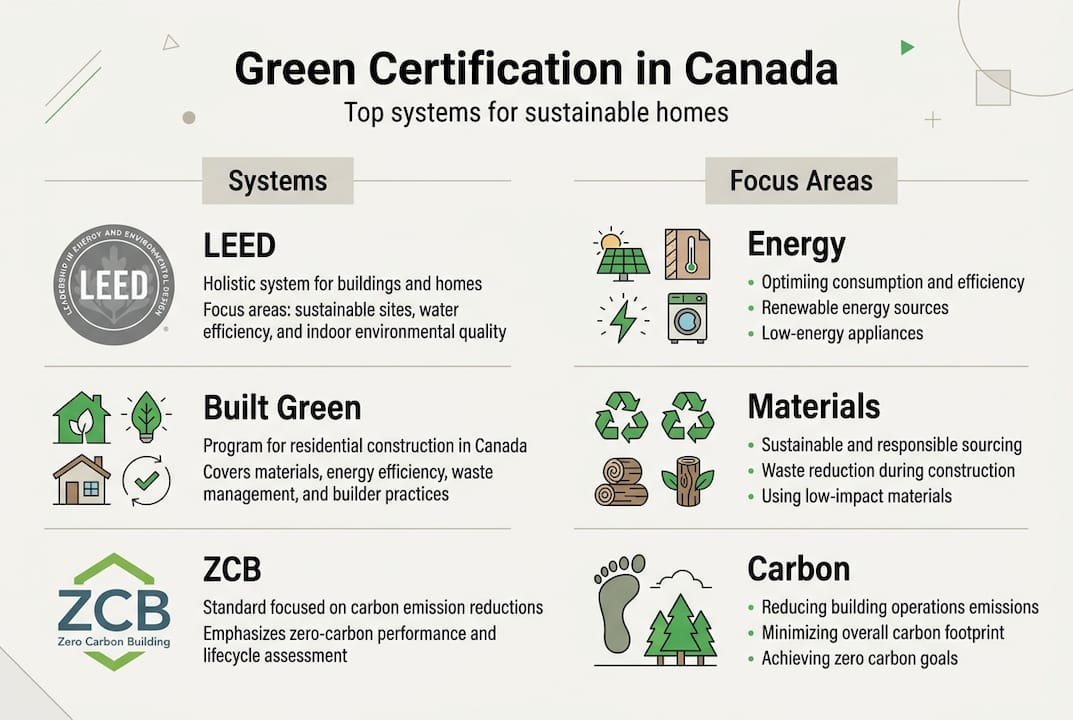
ZCB is worth serious consideration if your priority is carbon neutrality. It focuses specifically on eliminating operational carbon emissions, which aligns well with clients who want a net-zero or near-net-zero home. Review government perspectives on certifications to understand how these systems are evaluated at a policy level.
Key points to keep in mind when comparing systems:
- LEED is internationally recognised and carries strong brand weight in the luxury market
- Built Green is Canadian-developed and highly practical for residential projects
- ZCB is the right choice when carbon reduction is the primary driver
- Green Globes and BREEAM are more relevant for multi-unit or commercial builds
If you are planning a whole home renovation or a significant addition, Built Green’s renovation pathway is particularly well-suited. For clients exploring the full scope of high-end renovation benefits, pairing a renovation with certification can meaningfully increase both comfort and long-term value.
How certification works: Process and criteria explained
The certification process can feel daunting at first, but it follows a logical sequence. Understanding the steps early helps you avoid costly mistakes and missed opportunities.
- Choose your system early. The best time to select a certification path is during the design phase, not after framing begins. Retrofitting for credits you missed is expensive and sometimes impossible.
- Confirm prerequisites. Every system has mandatory baseline requirements. For LEED Homes, these include minimum energy performance thresholds and indoor air quality standards. You cannot buy your way past them with extra points.
- Assign a green rater or consultant. A qualified consultant guides documentation, energy modelling, and third-party inspections. This is not optional for serious projects.
- Accumulate points across categories. Beyond prerequisites, you earn points by exceeding baseline performance in energy, water, materials, and other areas. Higher point totals unlock higher certification levels.
- Third-party verification. An independent verifier reviews your documentation, conducts site inspections, and submits the project to the certifying body.
- Receive your certification. Once approved, your home is officially registered and certified.
Certification involves prerequisites, detailed scoring, and third-party verification at every stage. The process for a custom home typically takes 12 to 24 months from design to certificate, depending on complexity. Costs for certification administration and consulting generally range from $8,000 to $25,000 for a luxury residential project, separate from any construction premiums.
Canadian LEED buildings have saved 6.8 million tonnes of greenhouse gas emissions and 35.2 million equivalent megawatt-hours of energy nationally. That is not a theoretical number. It reflects real buildings performing as designed.
Pro Tip: Engage a certified green building consultant before your architect finalises the design. Decisions made in the first 10% of a project affect 80% of the certification outcome. Review the full certification process steps before your first planning meeting. Also factor certification costs into your custom home financing plan from the start, and ensure your material selection aligns with your target credits.
Real-world benefits and what to watch out for
Green certification delivers measurable results, but it is not a magic guarantee. Knowing both sides helps you set realistic expectations and protect your investment.
The real gains are significant. Certified homes use 30 to 70% less energy, 50% less water, and often command a 10% higher resale value compared to non-certified equivalents. For a $2 million waterfront property in Blue Mountain, a 10% value premium is $200,000. That is a compelling return on a $15,000 certification investment.
| Benefit | Typical range for certified homes |
|---|---|
| Energy savings | 30 to 70% vs. baseline |
| Water savings | Up to 50% |
| Resale value premium | 7 to 10% |
| Operating cost reduction | Up to 23% |
The health and comfort gains are equally real. Better ventilation, lower humidity, and controlled air quality make a certified home noticeably more pleasant to live in year-round, which matters especially in South Georgian Bay’s cold winters.
However, there are genuine limitations to understand. Certified buildings often show 44% higher energy use than predicted because of the gap between design assumptions and how people actually use their homes. Certification is based on modelled performance, not guaranteed operational results.
Pro Tip: Pair your certification with smart IoT energy monitoring and mass timber where the design allows. Real-time data closes the performance gap between what was modelled and what actually happens once you move in. Explore passive house design principles as a complement to formal certification for maximum energy outcomes. Also review limits of green certifications so you can set honest expectations with your builder.
Making certification work for luxury custom homes and renovations
Applying green certification to a luxury project in South Georgian Bay requires a different approach than a standard production home. The stakes are higher, the details are more complex, and the rewards are greater.
Choosing the right system starts with your goals. Luxury projects should prioritise LEED Homes or Built Green for recognition and resale value, while ZCB suits clients with a strong carbon-reduction mandate. Expect a 20 to 40% upfront cost premium on some elements, but check for available rebates before assuming the full cost lands on you.
Key steps for a successful luxury certification project:
- Hire a certified consultant early. Energy modelling and documentation are specialised skills. A good consultant pays for themselves in avoided mistakes and missed credits.
- Integrate certification into your design brief. Do not treat it as an add-on. The most successful certified luxury homes are designed around their sustainability targets from day one.
- Explore rebates and grants. The Canada Greener Homes Grant and various provincial programmes can offset thousands of dollars in upfront costs.
- Plan for documentation time. Certification requires meticulous record-keeping. Build this into your project schedule and budget.
The three most common pitfalls in luxury certification projects are documentation gaps discovered late in construction, delays caused by specialty material lead times, and scope changes that invalidate earned credits. Working with renovation experts who understand both luxury finishes and certification requirements prevents most of these problems. Consistent attention to quality materials is equally critical, since substitutions made during construction can cost you credits you already earned on paper.
Pro Tip: Ask your builder to maintain a live certification tracker throughout construction. Knowing your running point total in real time lets you make informed trade-offs without jeopardising your target level. Review the zero carbon building standard if your project has a strong sustainability mandate.
Our perspective: What certification really means for your luxury home
After working on luxury builds and renovations across South Georgian Bay for over 30 years, we have seen certification used well and used poorly. The honest truth is that a certificate on the wall does not automatically mean a home performs as intended. What matters is what happens after the certificate is issued.
Buyers in the Collingwood and Blue Mountain luxury market are increasingly asking about third-party certifications. That trend is accelerating. LEED Platinum or Built Green Platinum carries genuine weight with sophisticated buyers and their agents. But the clients who get the most value are those who treat certification as the beginning of a performance commitment, not the end of one.
What most articles miss is this: the impact of high-end renovation is amplified when paired with measurable, transparent post-occupancy data. Low utility bills, healthy indoor air, and consistent comfort are what luxury homeowners talk about to their neighbours. A plaque is nice. A $400 monthly hydro bill on a 5,000 square foot home is remarkable. Certification is only the start of true sustainable luxury. Over-engineer the quality, monitor the results, and the home will prove its value every single month.
Begin your certified luxury home journey
Navigating green certification for a luxury custom home or major renovation is genuinely complex, and the decisions you make in the first weeks of planning shape every outcome that follows. Mighton Construction has spent over 30 years building high-performance, premium homes across South Georgian Bay, and we understand both the technical requirements of certification and the uncompromising standards of luxury construction.
Whether you are planning a custom home build in Collingwood, a waterfront cottage in Tiny Township, or a high-performance renovation anywhere in Simcoe County, our team can guide you through the certification process from concept to certificate. We also specialise in ICF construction, which pairs exceptionally well with green certification targets. Contact us today to start the conversation.
Frequently asked questions
What is a green building certification and why should Ontario homeowners care?
Green building certification is a third-party stamp of approval that proves a home meets strict sustainability and health standards, boosting property value and comfort. Ontario homeowners benefit directly through lower operating costs, healthier living environments, and stronger resale appeal.
Which certification is best for a luxury custom home or reno in South Georgian Bay?
LEED Homes and Built Green are widely recognised and best suited for luxury homes or major renovations in Ontario, while ZCB suits advanced low-carbon projects with a strong carbon-reduction mandate.
Do green certified homes cost more, and are there rebates?
Expect up to a 40% premium on some project elements, but Canadian rebates like the Greener Homes Grant can meaningfully offset initial costs and shorten your payback period.
Do certifications guarantee lower bills and better comfort?
Certified homes use 30 to 70% less energy and 50% less water, but ongoing performance depends on quality construction, good occupant habits, and active monitoring systems.
What’s the biggest pitfall to avoid when seeking certification?
Do not treat certification as a checkbox. Performance gaps between design and real use are common, so pair your certification with quality materials, hands-on verification, and post-occupancy energy monitoring.