
Expert strategies to manage luxury home construction
TL;DR:
- Effective construction management in South Georgian Bay minimizes budget overruns and schedule delays for custom homes and renovations. It involves careful planning through core phases, selecting suitable delivery methods, proactive risk management, and rigorous quality control with digital oversight. Building with transparent communication and experienced teams significantly increases the likelihood of project success and high-end results.
Building a custom home or undertaking a major renovation in South Georgian Bay is one of the largest financial commitments most property owners will ever make. The stakes are significant: 85% of construction projects exceed their original budget, and schedule overruns of 20 to 43 percent are considered industry averages. These numbers aren’t meant to alarm you. They exist to underscore why a disciplined, strategic approach to construction management isn’t optional — it’s the single most important decision you’ll make after choosing your builder.
Table of Contents
- Breaking down the phases of construction management
- Choosing the right project delivery method
- Risk and budget: Proactive management strategies
- Quality control and digital tools for oversight
- What most project guides get wrong: The human factor and real client success
- Partner with a team built for high-end construction success
- Frequently asked questions
Key Takeaways
Point
Details
Phases define structure
Break projects into clear pre-construction, construction, and post-construction phases for clarity and efficiency.
Delivery method matters
Choosing the right project delivery method sets the tone for collaboration, control, and outcome certainty.
Proactive risk control
Early risk management planning and transparent reporting can dramatically reduce costly overruns.
Leverage digital tools
Modern platforms simplify oversight, documentation, and remote communication for busy clients.
Success is about people
Team functionality and engaged ownership deliver better results than process alone.
Breaking down the phases of construction management
With an overview of the risks established, let’s look at the construction management process from start to finish.
Every successful custom home or major renovation follows a structured sequence of phases. Understanding what happens in each phase, and what your builder should be doing, puts you in control of your investment. Residential construction management follows three core phases: pre-construction, construction, and post-construction, with a typical total timeline of 10 to 24 months depending on complexity and site conditions.
The three core phases at a glance
Phase
Key activities
Typical duration
Pre-construction
Site analysis, design development, permitting, budgeting
2 to 6 months
Construction
Site prep, foundation, framing, rough-ins, mechanical, finishes
7 to 16 months
Post-construction
Final inspections, deficiency list, occupancy, handover
1 to 2 months
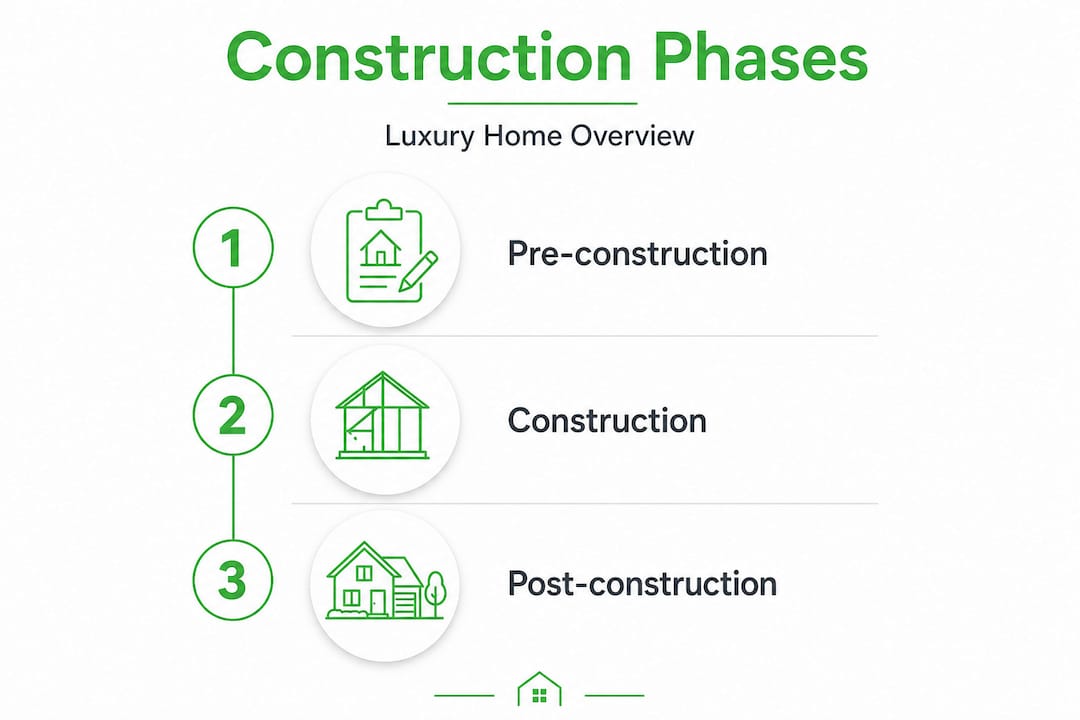
Pre-construction is where the most important decisions are made. Design intent is locked in, budgets are stress-tested, permits are secured, and subcontractor agreements are finalised. Skipping or rushing this phase is where most overruns are born. A detailed custom home project workflow ensures that nothing is left to chance before a single shovel breaks ground.
Construction is the visible phase most clients focus on, but the real management work happens behind the scenes. Scheduling subcontractors in sequence, coordinating material deliveries, managing inspections, and maintaining daily logs are all running simultaneously. Any gap in coordination creates a costly domino effect.
Post-construction is underestimated by most first-time custom home clients. This is when the punch list is generated, meaning a formal record of everything that needs correction or completion before handover. Thorough punch list management protects your warranty rights and ensures your home is exactly what was promised.
A checklist approach for each phase transition reduces errors significantly. Using a thorough custom home checklist at each milestone keeps every trade, designer, and supplier accountable to the same standard.
Statistic: Canadian construction projects average 50% over budget when project management disciplines are not applied systematically from the pre-construction phase onward.
Choosing the right project delivery method
Once you understand the project’s phases, the next step is selecting the structure for managing design and construction responsibilities.
This decision shapes everything: your risk exposure, your level of involvement, how changes are handled, and how well your builder and designer work together. Not all delivery methods are created equal, particularly for high-end luxury builds.
Comparing project delivery methods
Method
Owner involvement
Risk to owner
Speed
Best for
Design-Bid-Build (DBB)
High
High
Slower
Standard residential projects
Design-Build (DB)
Moderate
Lower
Fastest
Luxury custom homes
Construction Manager at Risk (CMAR)
Moderate to high
Shared
Moderate
Complex, large-scale renovations
Agency CM
Very high
Owner retains all
Moderate
Experienced developers
Key methodologies such as Design-Bid-Build, Design-Build, Construction Manager at Risk, and agency CM each serve different project profiles. For high-end custom homes, design-build or two-phase design-build locks design decisions before construction begins, which measurably reduces costly change orders mid-project.
Design-Bid-Build is the most traditional approach. You hire a designer separately, receive a completed design package, and then solicit bids from contractors. The problem is that the contractor has no input on design constructability, so surprises discovered during construction become expensive change orders that fall on you.
Design-Build puts a single entity responsible for both design and construction under one contract. This integrated approach can reduce project timelines by up to 33 percent and creates clear accountability. For a custom home in Collingwood or a waterfront property in Wasaga Beach, this means your designer and builder are communicating daily rather than pointing fingers across separate contracts.
“The difference between a smooth luxury build and a chaotic one often comes down to a single decision made before design even starts: whether your designer and builder are working as a unified team or as two separate businesses protecting their own interests.”
For a real-world scenario, imagine a family commissioning a 4,500-square-foot custom home on the Blue Mountain escarpment. Under a traditional design-bid-build structure, the architect might specify a cantilevered great room without fully accounting for the local frost depth requirements and engineering costs. Under a design-build model, those structural realities are baked into the design from day one. The result is a cleaner budget, faster approvals, and a build that matches the original vision without painful revisions.
Pro Tip: Ask any prospective builder how often they collaborate with their design partners during the pre-construction phase. Daily communication between architect, engineer, and site supervisor is a sign of a mature, integrated team. A well-structured builder understands the role of project managers for luxury homes and incorporates that expertise before permits are even submitted. If you’re still planning a custom home from scratch, this is the most important question you can ask early on.
Risk and budget: Proactive management strategies
After selecting your approach, proactive financial and risk management can make or break your project.
Budget overruns don’t happen because builders are careless. They happen because risks aren’t identified early, contingencies are too thin, and communication between stakeholders breaks down under pressure. The numbers are sobering: construction cost overruns average between 27 and 80 percent industry-wide, and schedule overruns average 20 to 43 percent. Proactive management is your primary defence.
Five essential steps for proactive risk and budget management
-
Develop a Risk Management Plan (RMP) at the outset. A formal RMP identifies every foreseeable risk — site conditions, weather delays, material lead times, subcontractor availability — and assigns a probability and mitigation strategy to each. Effective risk management involves early identification via an RMP, proactive mitigation strategies, stakeholder communication protocols, and tools like CPM scheduling to model task dependencies.
-
Use Critical Path Method (CPM) scheduling. CPM identifies which tasks must be completed on time for the project to finish on schedule. If framing is on the critical path and your framing crew is delayed by a week, you know immediately which downstream trades are affected and can adjust proactively rather than reactively.
-
Build a realistic contingency into your budget. Industry standard for custom residential projects is a contingency of 10 to 15 percent of total construction cost. Anything below 10 percent for a complex custom home is optimistic to the point of being dangerous. Waterfront sites and properties in areas with challenging soil conditions, like parts of Tiny Township or Springwater, may warrant even higher contingencies.
-
Require transparent, regular reporting. Monthly budget-to-actual cost reports, weekly schedule updates, and change order logs should be standard deliverables from your project manager or general contractor. Surprises in construction are almost always avoidable with disciplined reporting.
-
Lock in key material pricing early. Supply chain volatility has made early procurement a critical risk management tool. For finishes like custom cabinetry, architectural millwork, and imported stone, lead times can stretch 16 to 24 weeks. Ordering late puts your schedule at risk and can force expensive substitutions.
Pro Tip: Request a detailed line-item budget from your builder, not just a total number. A builder who can show you exactly where every dollar is allocated, and explain the reasoning behind each number, is a builder who understands luxury custom home planning at a professional level.
Quality control and digital tools for oversight
With risks addressed, the final piece is quality — how to ensure elite results and keep everything on track.
For clients commissioning a luxury home in South Georgian Bay, quality isn’t just about premium finishes. It’s about structural integrity, thermal performance, code compliance, and ensuring that every trade meets the standard documented in your specifications. Quality that isn’t systematically verified isn’t quality at all — it’s a hope.
Quality control in modern construction management involves constructability reviews, value engineering, mock-ups, regular inspections, and digital oversight tools such as Procore and Buildertrend. Each of these plays a specific role in protecting your investment.
Key quality assurance practices for luxury residential projects
-
Constructability reviews involve your project manager, structural engineer, and key subcontractors reviewing design documents before construction begins. This catches conflicts between trades — for example, a structural beam that interferes with a planned HVAC duct — before they become field problems.
-
Material and finish mock-ups are particularly valuable for high-end projects. Before full installation of a custom stone fireplace surround, exterior cladding system, or custom tile pattern, a physical mock-up lets you see and approve the result in real conditions and real light. This step alone prevents enormous dissatisfaction at the end of a project.
-
Milestone inspections should happen at defined points: after rough-in electrical, plumbing, and mechanical; after insulation and vapour barrier; and at key framing milestones. Independent inspections, beyond the minimum municipal requirements, are worth the investment for complex builds.
-
Digital project management platforms give clients real-time access to progress photos, schedules, RFIs (requests for information), and change order logs. For busy professionals or out-of-town owners with a vacation property near Blue Mountain, this transparency is invaluable.
-
Documented handover packages should include all warranties, maintenance manuals, as-built drawings, and inspection records. This documentation protects your investment for decades.
Proper site preparation for custom homes is the foundation — literally and figuratively — upon which all subsequent quality assurance depends. A site that is properly graded, drained, and prepared reduces structural risks that no amount of inspection can fully correct after the fact.
Pro Tip: Ask your builder which digital platform they use to manage projects and whether you’ll have client access. A builder who is confident in their processes welcomes transparency. One who resists is sending you an important signal.
What most project guides get wrong: The human factor and real client success
Technical frameworks are valuable. Phase checklists, delivery method comparisons, and risk registers all serve important functions. But after more than 30 years of building custom homes and major renovations across South Georgian Bay, we’ve observed something that most project management guides don’t acknowledge clearly enough: the single biggest predictor of project success is the quality of the people and the honesty of the communication — not the sophistication of the tools.
Building functional project teams — where experienced project managers lead with transparent reporting and early risk identification — is what actually beats the industry’s dismal overrun statistics. A capable team using a basic spreadsheet will outperform a dysfunctional team using the most advanced project management software available.
What does this mean in practice? It means that when you’re evaluating a builder, the most important questions aren’t about software platforms or phase methodologies. They’re about communication habits. How quickly do they return calls? Do they bring problems to you proactively, or do they wait until there’s no alternative? Do they own their mistakes, or do they deflect? Do they have long-standing relationships with their trade partners, or are they assembling a new crew for every project?
We’ve seen projects with meticulous documentation fail because the team didn’t trust each other enough to raise problems early. And we’ve seen projects with modest paperwork succeed beautifully because everyone at the table was honest, skilled, and genuinely invested in the outcome.
The other factor that most guides overlook is client engagement. The clients who get the best results aren’t the ones who hand over a cheque and disappear. They’re the ones who show up for milestone walkthroughs, ask questions, make decisions promptly, and treat the build team as partners rather than vendors. Your involvement during pre-construction especially — when design decisions are still fluid and inexpensive to change — pays enormous dividends. If you have questions about what that engagement looks like in practice, our custom home process FAQs walk through exactly how we manage that relationship with our clients from first conversation to final handover.
Partner with a team built for high-end construction success
If you want these strategies put to work on your next custom home or renovation, expert local support is available right here in South Georgian Bay.
At Mighton Construction, we’ve spent over 30 years earning a reputation for transparent communication, premium craftsmanship, and results that hold up long after the final inspection. Whether you’re building a custom home in South Georgian Bay, planning one of our signature luxury cottage builds on the waterfront, or undertaking a large-scale renovation, our team manages every phase with the discipline and accountability this guide describes. Browse our recent projects to see the standard we hold ourselves to, then reach out to discuss what your build requires. A well-managed project starts with the right conversation.
Frequently asked questions
How long does a typical custom home project take to complete?
Custom home construction typically takes 10 to 24 months depending on design complexity, site conditions, and local permitting timelines.
What causes most custom construction projects to run over budget?
Poor team coordination, late design changes, and weak risk management are the primary drivers — which is why 85% of projects exceed their original budget.
Which project delivery method is best for luxury custom homes?
Design-build or two-phase design-build methods reduce change orders and timelines by aligning design and construction decisions from the start.
What digital tools can improve construction project management?
Platforms like Procore and Buildertrend streamline communication, scheduling, document management, and quality inspections for residential projects.