Energy efficient home features for luxury custom builds

TL;DR:
- Designing a high-performance luxury home requires a focus on energy-efficient features that enhance comfort, reduce operating costs, and boost resale value. Prioritizing air sealing, superinsulation, and integrated systems ensures maximum efficiency and performance in South Georgian Bay’s climate. Verifiable testing, high-quality envelope upgrades, and renewable systems like solar PV and ground-source heat pumps complete the blueprint for sustainable luxury living.
When you’re designing or renovating a luxury custom home in South Georgian Bay, the decisions you make about energy efficient home features will shape your comfort, your operating costs, and your resale value for decades. This isn’t about swapping in LED bulbs and calling it done. The homes being built today in Wasaga Beach, Collingwood, and Blue Mountain are achieving performance levels that cut utility bills dramatically while delivering the comfort and air quality that premium builds demand. The challenge is knowing which features deliver real, lasting results versus which ones just look good on a spec sheet.
Table of Contents
- Key takeaways
- 1. How to evaluate energy efficient home features for your build
- 2. Superinsulation and advanced air sealing
- 3. High-performance windows, doors, and exterior envelope upgrades
- 4. Mechanical ventilation with heat recovery (MVHR) and smart home energy solutions
- 5. Energy saving appliances and LED lighting
- 6. Renewable energy options and green energy systems
- What I’ve learned after 30 years of high-performance builds
- Build your high-performance home with Mighton Construction
- FAQ
Key takeaways
| Point | Details |
|---|---|
| Air sealing comes first | Seal the building envelope before insulating to maximise every dollar spent on insulation. |
| Integration beats isolation | Single upgrades underperform. Combining insulation, ventilation, and controls delivers compounding savings. |
| Document your performance | Verified testing like blower-door results supports resale premiums and buyer confidence in luxury builds. |
| Envelope upgrades are visible | Windows, doors, and siding are top buyer priorities and directly raise market appeal. |
| Smart controls multiply savings | Smart thermostats and home energy systems amplify the performance of every other feature you install. |
1. How to evaluate energy efficient home features for your build
Not every efficiency upgrade is worth the investment at the luxury level. Before you commit to any feature, weigh it against four criteria.
- Energy savings potential and R-value. Every insulation or cladding choice carries an R-value rating. Higher R-values mean greater resistance to heat flow. For South Georgian Bay’s cold winters, matching insulation type by location to climate-specific targets is what the DOE recommends, and that principle holds firmly in Ontario’s climate zone.
- Integration with the building envelope and systems. A geothermal heat pump in a leaky house performs well below its rated efficiency. Features work in concert, not in isolation. High-performance homes integrate superinsulation, continuous exterior insulation, and triple-pane windows as a system.
- Durability and maintenance requirements. Luxury clients in Clearview Township or Tiny Township don’t want to revisit mechanical systems every few years. Favour features with long service lives and low maintenance profiles.
- Compatibility with luxury design aesthetics. Energy efficiency and architectural beauty are not in conflict. The best builders in Simcoe County prove this on every project.
Pro Tip: Ask your builder to provide projected energy modelling before construction begins. Seeing annual operating cost estimates on paper changes how clients prioritise their feature budgets.
2. Superinsulation and advanced air sealing
This is the single highest-leverage category in the entire list. Get this right and every other feature performs better. Get it wrong and nothing else can compensate.
Air sealing combined with insulation can reduce heating and cooling costs by an average of 15% or more. The sequence matters critically. You seal first, then you insulate. Insulating over air leaks is one of the most common and costly mistakes in residential construction, and it happens on luxury builds too.
For walls, attics, and crawlspaces, the right insulation type depends on the assembly:
- Spray foam at rim joists and around penetrations creates an air barrier while adding R-value simultaneously
- Rigid mineral wool or EPS board on the exterior provides continuous insulation that eliminates thermal bridging through studs
- Blown cellulose or dense-pack fibreglass fills cavities without leaving voids that would compromise thermal performance
- ICF construction for foundations and walls delivers both structure and insulation in a single assembly. Mighton Construction’s ICF contractor services are purpose-built for clients who want this level of performance from the ground up.
Attic insulation deserves particular attention. Whole-home insulation combined with air sealing can save 15 to 25% on energy bills, with attic work consistently delivering the highest return per dollar spent. Pair that with careful sealing of every electrical penetration, plumbing stack, and light fixture before the insulation goes in.
Passive House certified buildings achieve airtightness levels proven by blower-door testing and require stringent airtightness with balanced ventilation achieving at least 75% heat recovery efficiency. While not every luxury home pursues formal certification, treating these standards as targets sets a clear benchmark.
Thermal bridging deserves more attention than it gets in conventional builds. Every wood stud, metal connector, and concrete tie creates a thermal short-circuit that bypasses your insulation entirely. Continuous exterior insulation breaks this bridge and keeps the entire wall assembly performing as designed.
3. High-performance windows, doors, and exterior envelope upgrades
Windows and doors are the most visible energy efficient home features to prospective buyers. 37% of REALTORS® consider windows, doors, and siding very important for energy efficiency in home sales. That visibility matters when you’re selling a luxury waterfront cottage in Wasaga Beach or a custom home on Blue Mountain.
| Feature | Standard option | High-performance option |
|---|---|---|
| Window glazing | Double-pane, no coating | Triple-pane, low-e coating, argon fill |
| Door construction | Hollow-core steel | Fibreglass with polyurethane foam core |
| Exterior insulation | None (stud cavity only) | Continuous rigid mineral wool or EPS board |
| Air sealing at frames | Basic caulking | Gaskets, tapes, and spray foam detailing |
Triple-pane windows with low-emissivity coatings and argon or krypton gas fills reduce heat loss through the glass by roughly 30% compared to standard double-pane units. In a home with extensive glazing facing Georgian Bay, that difference is significant across a heating season. Explore window selections and styles that balance performance with architectural intent.
For doors, fibreglass units with dense polyurethane foam cores outperform steel doors in thermal resistance and eliminate the condensation problems that plague metal doors in Ontario winters. Triple weather-stripping and magnetic seals at the threshold round out the assembly.
Pro Tip: Specify that all window and door rough openings receive spray foam detailing and flashing tape before frames are set. This one step prevents the majority of air infiltration that undermines envelope performance.
Exterior cladding choices affect thermal performance too. James Hardie fibre cement siding over a continuous insulation layer creates a durable, low-maintenance assembly that resists the freeze-thaw cycling common across Springwater and Collingwood. Read more about building envelope strategies tailored to South Georgian Bay conditions.
4. Mechanical ventilation with heat recovery (MVHR) and smart home energy solutions
Here’s the thing about airtight buildings that surprises most homeowners: you need to bring fresh air in deliberately because the building no longer does it accidentally. That’s exactly what a mechanical ventilation with heat recovery system does.
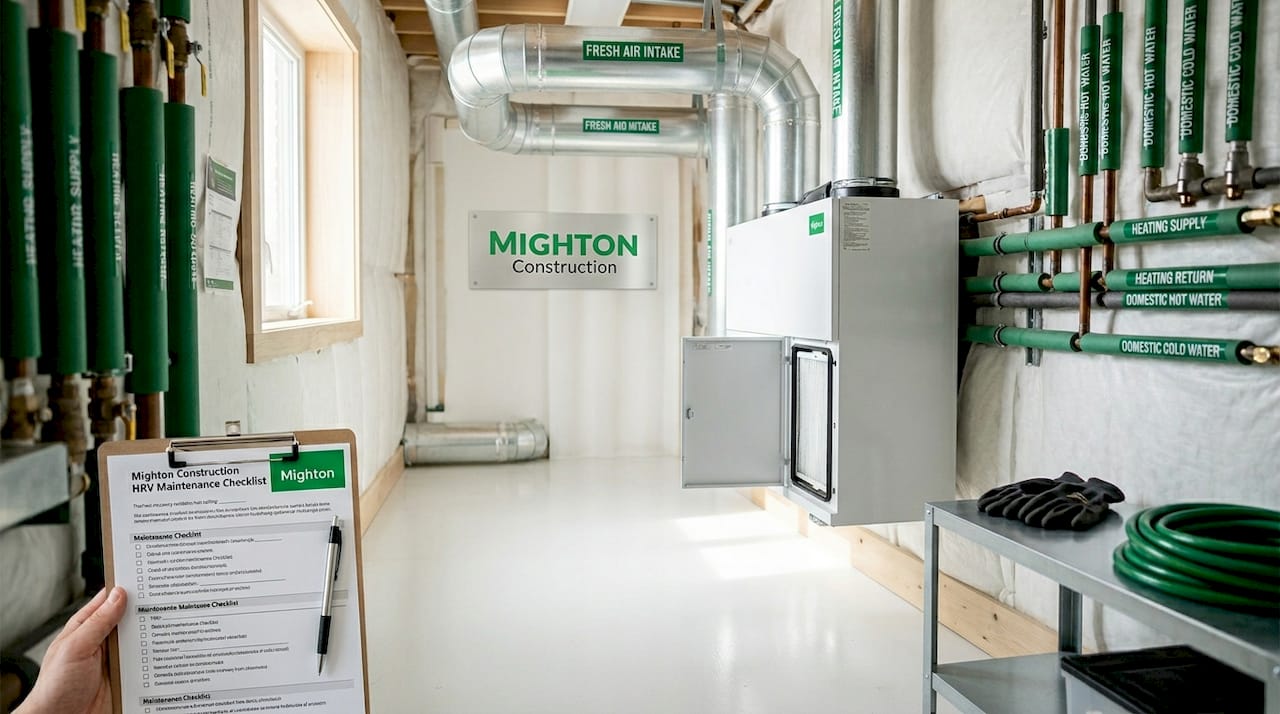
An MVHR unit draws stale air out of bathrooms, kitchens, and utility spaces while simultaneously pulling fresh air in from outside. The two airstreams pass through a heat exchanger without mixing. Heat recovery ventilation systems typically operate between 75% and 90% efficiency, meaning most of the heat in the outgoing air gets transferred to the incoming cold air. In a Collingwood winter, that’s a substantial fuel saving every single day.
The catch is that MVHR performance depends entirely on the envelope. Airtightness verification with blower-door testing must be coordinated with mechanical ventilation systems during construction. A leaky building dilutes the air exchanges the MVHR is controlling, driving down its real-world efficiency and increasing running costs.
Smart home energy solutions compound the savings that your mechanical systems deliver:
- Smart thermostats save homeowners an average of 8% on utility bills by adjusting settings based on occupancy and location data
- Whole-home energy monitors show you real-time consumption by circuit, making it easy to identify inefficiencies after move-in
- Automated shading systems work with your building management software to use solar gain in winter and block it in summer
- Demand-control ventilation adjusts fresh air delivery based on actual occupancy, reducing energy use in rooms that are empty
For vacation properties and cottages around Wasaga Beach and Tiny Township, remote access through smart home platforms means you’re not heating or cooling an empty property between visits.
5. Energy saving appliances and LED lighting
Appliances and lighting account for a meaningful share of a home’s operating costs, and the gap between standard and high-efficiency options has widened considerably in recent years.
- Select ENERGY STAR-rated appliances throughout. Refrigerators, dishwashers, washers, and dryers carrying the ENERGY STAR designation use 10 to 50% less energy than conventional models. In a luxury kitchen renovation in Springwater or Clearview Township, specifying these units adds little to project cost and reduces operating expenses for the life of the home.
- Specify LED lighting in every fixture. LED technology has matured to the point where colour rendering, dimming performance, and fixture design options meet luxury residential standards without compromise. Average energy use per fixture drops by roughly 75% compared to incandescent bulbs.
- Design for daylighting. Positioning living spaces, clerestory windows, and light wells to maximise natural illumination reduces the hours your lighting system runs each day. This is a design decision, not a product purchase, and it costs nothing extra when planned from the start.
- Choose low-embodied-carbon materials. Reclaimed wood, locally sourced stone, and materials certified to FSC or similar standards reduce the carbon footprint built into the structure itself. These choices support sustainable home design goals without sacrificing the aesthetic quality that luxury clients expect.
Pro Tip: For luxury kitchen renovations, specify induction cooktops alongside your ENERGY STAR-rated appliances. Induction cooking transfers up to 90% of energy directly to the pot versus roughly 40% for gas, and it eliminates combustion byproducts that degrade indoor air quality.
6. Renewable energy options and green energy systems
Renewable energy systems work best when layered onto a high-performance envelope. Adding solar panels to a poorly insulated home is like filling a leaking bucket. Get the envelope right first, then size your renewable systems against a much lower baseline load.
Solar photovoltaic (PV) systems are the most common entry point for residential renewable energy in South Georgian Bay. South-facing roof planes on custom homes in Blue Mountain and Collingwood can generate meaningful portions of annual electricity demand. Net metering arrangements with Hydro One allow excess generation to offset consumption at other times.
Ground-source heat pumps (commonly called geothermal systems) extract heat from the ground year-round. Ontario’s soil temperatures remain stable well below the frost line, making these systems highly effective in Simcoe County’s climate. Coefficient of performance ratings of 3 to 4 are typical, meaning you get three to four units of heat for every unit of electricity consumed.
Solar thermal collectors for domestic hot water pre-heat supply water before it reaches your conventional or heat-pump water heater. In a large custom home with high hot water demand, this addition can offset a substantial fraction of water heating energy annually.
The combination of a tight envelope, a ground-source heat pump, and a rooftop solar PV array brings many custom homes in this region close to net-zero operating performance. That is no longer an aspirational target reserved for experimental builds. It is achievable today with proven technology and experienced builders.
What I’ve learned after 30 years of high-performance builds
I’ve watched the industry’s relationship with energy efficiency shift from a compliance checkbox to a genuine design priority, and that shift has changed what separates good builders from exceptional ones.
The biggest mistake I see in high-performance building is treating efficiency features as a shopping list rather than an integrated system. A client installs a premium heat pump but skips proper air sealing. Another invests in triple-pane windows but leaves the attic under-insulated. Neither home performs as promised, and both clients walk away sceptical about the value of efficiency investments.
What actually works is sequencing. Seal the envelope. Insulate thoroughly. Then size your mechanical systems against that real load, not an assumed one. Then layer in renewables. Every dollar spent in this order multiplies. Every dollar spent out of this order is partially wasted.
Documented performance matters more than most clients realise at the time of construction. Buyers who see verified blower-door results, energy modelling reports, and utility records pay a measurable premium and close with more confidence. The builders who document everything build better reputations and command better prices.
My honest advice: don’t evaluate a luxury builder on their feature list. Evaluate them on their process, their sequencing discipline, and whether they verify their own work with third-party testing.
— Adam
Build your high-performance home with Mighton Construction
Mighton Construction brings over 30 years of experience building and renovating luxury custom homes across South Georgian Bay, including Wasaga Beach, Collingwood, Blue Mountain, Clearview Township, Tiny Township, and Springwater. We design every project as an integrated system, not a collection of individual upgrades, which is why our clients consistently achieve the comfort, savings, and resale performance they were promised.

From custom home construction with full ICF foundations and triple-pane envelope assemblies to kitchen renovations and bathroom upgrades that incorporate ENERGY STAR appliances and efficient fixtures, we manage every detail from design through to finishing. Browse our project gallery to see how energy efficient home features look when they’re executed at the luxury level. Contact Mighton Construction today to discuss your custom build or renovation in South Georgian Bay.
FAQ
What are the most impactful energy efficient home features?
Superinsulation, advanced air sealing, and mechanical ventilation with heat recovery deliver the largest combined impact. These three features, properly integrated and verified through blower-door testing, form the foundation of every high-performance home.
How much can air sealing and insulation reduce energy bills?
Air sealing combined with insulation can reduce heating and cooling costs by 15% or more, with whole-home programmes achieving 15 to 25% savings when attic work and penetration sealing are included.
Do energy efficient features increase resale value in luxury homes?
Yes. Visible envelope upgrades like triple-pane windows and quality siding are among the top priorities for buyers. Documented energy savings supported by verified testing data correlate with stronger resale prices and faster sales in the luxury segment.
What is an MVHR system and do I need one?
Mechanical ventilation with heat recovery is a system that exchanges stale indoor air for fresh outdoor air while recovering up to 90% of the heat in the outgoing stream. Any home built to a high airtightness standard requires one to maintain healthy indoor air quality.
Is renewable energy worth adding to a luxury custom home?
Renewable energy options like solar PV and ground-source heat pumps are most cost-effective when installed on a well-sealed, well-insulated home. In Ontario’s climate, a ground-source heat pump paired with rooftop solar can bring a custom home very close to net-zero operating performance.