Designing energy efficient homes: a builder's guide


TL;DR:
- Designing energy efficient homes involves integrating a high-performance building envelope and passive solar strategies to minimize energy demand before adding renewables. Properly sealing and insulating the envelope, carefully selecting windows, and applying passive solar design principles significantly improve overall efficiency and comfort. Mechanical systems should be right-sized through early energy modelling and verified during construction to ensure optimal performance.
Designing energy efficient homes is the practice of integrating a high-performance building envelope, passive solar strategies, and efficient mechanical systems into a single coordinated system that minimises energy demand before renewables are ever introduced. The industry standard term for this approach is high-performance building design, a framework used by the U.S. Department of Energy, Canada’s Passive House community, and the National Green Building Standard (NGBS). For homeowners and builders in South Georgian Bay, Collingwood, and Wasaga Beach, where winters are long and heating costs are significant, getting this right from the design stage is the single most impactful decision you will make. This guide walks through every layer of that system, from insulation and orientation to heat pumps and solar panels.
What are the key components of an energy efficient home envelope?
The building envelope is the foundation of every efficient home design. It includes your walls, roof, foundation, windows, and doors. Every gap, thermal bridge, or under-insulated assembly in that envelope translates directly into higher energy bills and reduced comfort.
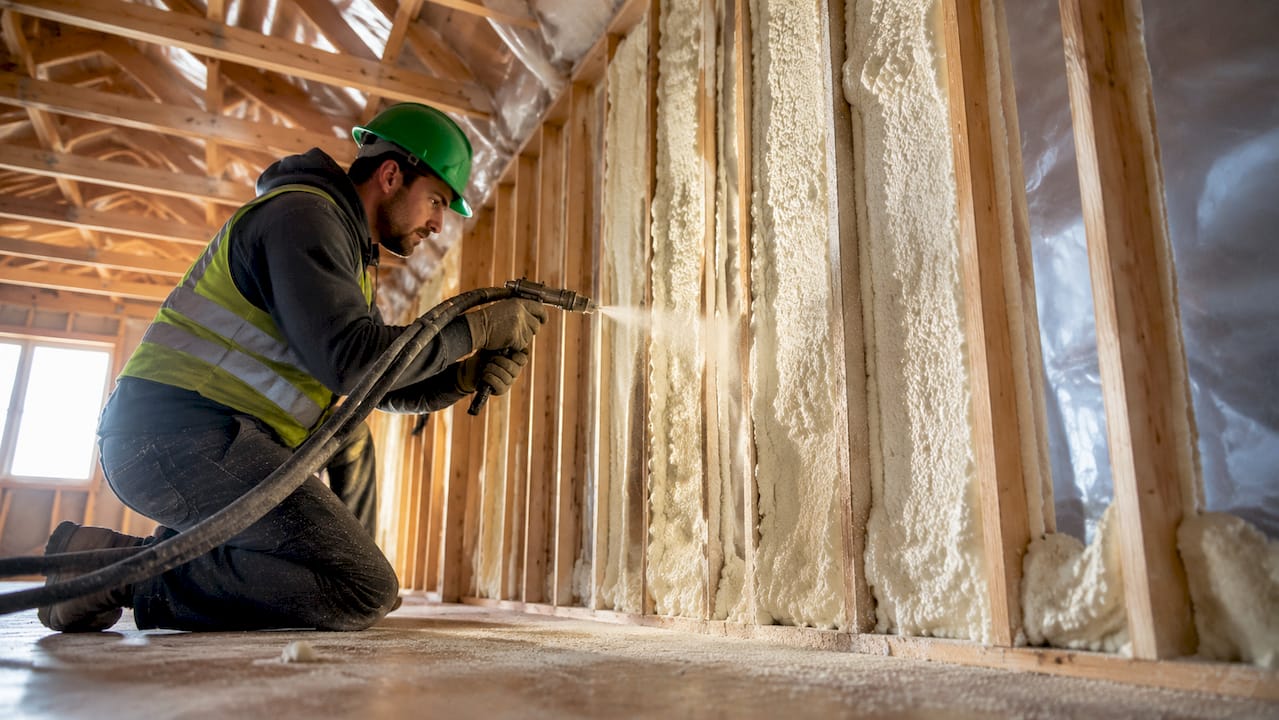
High-performance insulation is the starting point. Closed-cell spray foam delivers both air sealing and insulation in a single application, making it ideal for rim joists, cathedral ceilings, and other complex assemblies. Blown fibreglass or cellulose works well in open wall cavities and attics where cost efficiency matters. Beazer Homes’ documented high-performance build used a combination of closed-cell spray foam and blown fibreglass, achieving 1.09 ACH50 air leakage. That number means the home loses less than one full volume of air per hour under pressure testing. Most standard Ontario builds land between 3 and 5 ACH50.
Air sealing is equally critical and is often undervalued. Every penetration for wiring, plumbing, and HVAC must be sealed with acoustical sealant, spray foam, or gaskets before drywall goes up. Blower door testing confirms the result. Without testing, you are guessing.
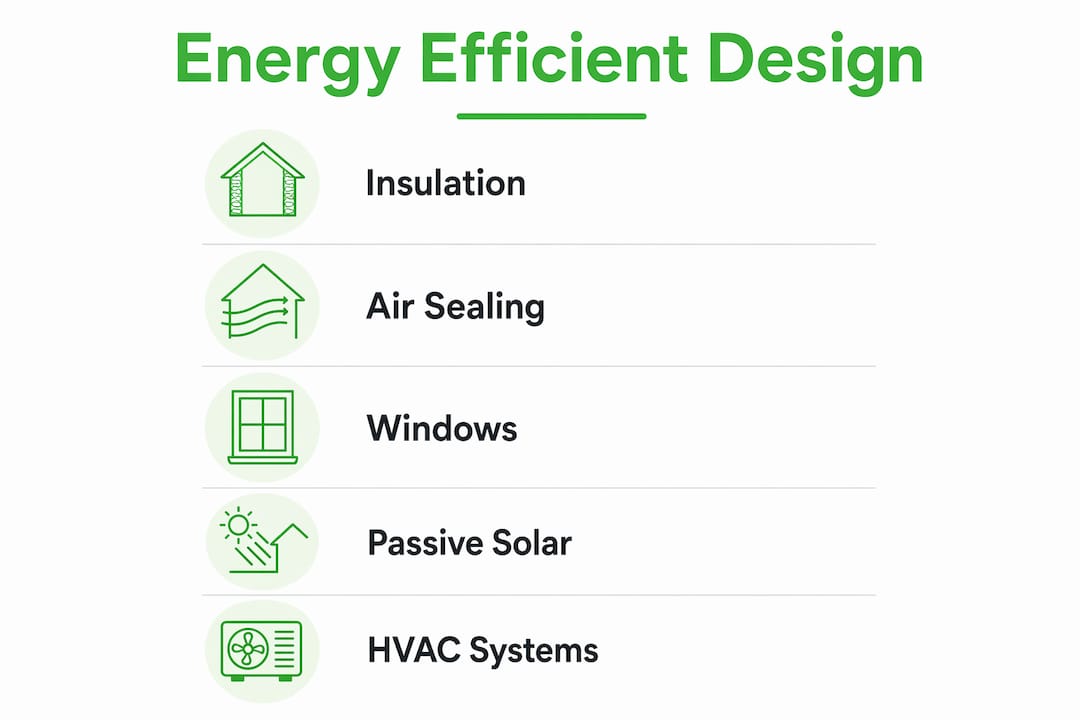
Windows deserve careful specification. Double-pane units with low-e coatings, U-values at or below 1.4 W/m²K, and appropriate solar heat gain coefficients (SHGC) for your orientation are the minimum standard for Canadian climates. South-facing windows benefit from a higher SHGC to capture winter solar gains. North-facing windows should prioritise low U-values above all else.
Pro Tip: Thermal bridging through structural studs can reduce effective wall R-value by 20 to 30 percent. Adding a continuous layer of rigid mineral wool or XPS insulation on the exterior of the framing eliminates that loss without changing your interior layout.
For a deeper look at envelope strategies for luxury homes in South Georgian Bay, Mighton Construction’s detailed guide covers insulation sequencing, airtight detailing, and thermal bridging prevention specific to this region.
How does passive solar design improve energy efficiency in Canadian homes?
Passive solar home design uses the sun’s energy for heating and natural light without mechanical systems. In Canadian climates like Simcoe County and Blue Mountain, a well-oriented home can meaningfully reduce heating loads through the coldest months of the year.
The DOE’s ultra-efficient home design framework recommends using local climate data and site conditions to maximise passive solar gains in winter while preventing overheating in summer. The sequence below reflects how experienced builders approach this in practice:
- Orient the long axis east to west. This positions the largest wall surface to face south, maximising winter sun exposure and minimising east and west heat gain in summer.
- Size south-facing glazing carefully. A glazing-to-floor-area ratio of roughly 7 to 12 percent on the south face captures useful solar heat without causing overheating. Oversizing this ratio is one of the most common design errors in passive solar homes.
- Design roof overhangs to the sun’s angle. A properly calculated overhang shades south windows at the summer solstice but allows full winter sun penetration. This is geometry, not guesswork.
- Use thermal mass on interior surfaces. Concrete floors, tile, and masonry walls absorb solar heat during the day and release it at night, smoothing out temperature swings.
- Plan for natural ventilation. Cross-ventilation through operable windows on opposite walls, combined with the stack effect through a stairwell or clerestory, can eliminate the need for mechanical cooling on most spring and fall days in South Georgian Bay.
The 2025 NGBS awards credits for passive cooling design and exterior shading using vegetation, overhangs, and architectural solutions. These credits reflect real, measurable reductions in mechanical load. For more on passive solar strategies for Canadian homes, including window orientation and ventilation design, Mighton Construction’s passive house guide covers the specifics of our regional climate zones.
Which HVAC and renewable energy systems work best with efficient home designs?
Once the envelope is tight and the passive strategies are in place, mechanical system selection becomes straightforward. The goal is to right-size equipment to the actual reduced load, not to the load a leaky, poorly insulated home would have.
| System | Best application | Key performance metric |
|---|---|---|
| Air-source heat pump | Most Canadian climates with a backup | HSPF2 rating above 8.0 |
| Ground-source heat pump | Cold climates with stable ground temps | COP above 3.5 in heating mode |
| Energy recovery ventilator (ERV) | All airtight homes | Sensible recovery efficiency above 75% |
| Heat pump water heater | Conditioned mechanical rooms | COP above 3.0 |
| Solar photovoltaic (PV) | South-facing roofs with minimal shading | System output matched to annual load |
The Beazer Homes case study is instructive. Their high-performance home used a central heat pump with HSPF2 8.1 and SEER2 16.7, paired with a 10 kW solar PV array and 27 kWh of battery storage. The heat pump water heater operated at a COP of 3.45. These numbers are achievable in Ontario with current equipment from manufacturers like Mitsubishi, Bosch, and Carrier.
Ventilation deserves special attention in airtight homes. Ultra-tight homes cannot rely on drafts for fresh air. An ERV or heat recovery ventilator (HRV) delivers continuous filtered airflow while recovering 70 to 80 percent of the heat from outgoing stale air. This keeps indoor air quality high without wasting the energy you spent conditioning that air.
Early collaboration between energy modellers and mechanical engineers during schematic design is what separates a well-performing home from one that looks good on paper but underperforms in practice. System sizing must align with the modelled envelope performance, not with a rule-of-thumb calculation.
Pro Tip: Never size a heat pump to the old furnace capacity. A properly insulated and sealed home in Wasaga Beach or Clearview Township may need 40 to 60 percent less heating capacity than the previous equipment suggests. Oversized equipment short-cycles, wears out faster, and dehumidifies poorly.
For a full breakdown of HVAC and renewable energy options for custom builds, including smart thermostat integration and solar battery storage, Mighton Construction’s guide to energy efficient home features covers current best practices.
What sustainable materials and construction methods support green building?
Sustainable house plans go beyond insulation R-values. The materials you specify and the methods your builder uses affect the long-term durability, carbon footprint, and life-cycle cost of the home.
- Engineered wood products such as LVL beams, I-joists, and cross-laminated timber (CLT) use wood fibre more efficiently than dimensional lumber, reducing waste and improving structural consistency.
- Insulated concrete form (ICF) construction delivers continuous insulation on both sides of a concrete wall, exceptional airtightness, and superior thermal mass. ICF is particularly well-suited to the freeze-thaw cycles common in Springwater and Tiny Township.
- Regional and recycled content materials reduce transportation emissions and often perform better in local climate conditions. Ontario-manufactured brick, locally sourced stone, and recycled-content drywall are all available through regional suppliers.
- Prefabricated wall panels and roof trusses built in a controlled factory environment reduce on-site waste, improve dimensional accuracy, and speed up the construction schedule. Tighter tolerances also make air sealing easier.
- Durable exterior cladding such as James Hardie fibre cement reduces long-term maintenance costs and resists the moisture and freeze-thaw damage common in South Georgian Bay waterfront properties.
The 2025 NGBS certification framework rewards points across six areas including energy efficiency, water efficiency, and resource efficiency. Choosing materials that contribute to multiple categories simultaneously, such as ICF, which scores on both energy and durability, is the most cost-effective path to certification. For a detailed look at eco-friendly materials for luxury builds, Mighton Construction’s materials guide covers sourcing, performance, and cost comparisons.
What verification practices confirm your home performs as designed?
A well-designed home that is poorly built will not perform as expected. Verification during construction is what closes the gap between design intent and real-world results.
- Conduct blower door testing at rough-in. Testing before drywall allows you to find and fix air leakage while walls are still open. Testing only at final inspection means expensive remediation if targets are missed.
- Inspect the air barrier at every trade junction. The points where framing meets foundation, where windows meet rough openings, and where electrical boxes penetrate vapour barriers are the most common failure points.
- Verify insulation installation quality. ENERGY STAR certification requires quality installation checks that go beyond R-value specifications, including grading of insulation contact with framing and identification of voids or compressions.
- Commission mechanical systems after installation. Confirm that ERV or HRV airflows match design specifications, that heat pump refrigerant charge is correct, and that duct leakage is within acceptable limits.
- Monitor post-occupancy energy use. Smart thermostats from Ecobee or Nest, combined with a whole-home energy monitor such as Emporia or Sense, give you real data to compare against the energy model.
“Builders must focus on continuous verification of the air barrier and thermal details during construction, using blower door and duct leakage testing to ensure design performance.” ENERGY STAR certification requirements 2026
Third-party certification through ENERGY STAR, the NGBS, or Passive House adds an independent layer of quality assurance that protects both the builder’s reputation and the homeowner’s investment.
Key takeaways
Designing energy efficient homes requires reducing energy demand through the building envelope and passive strategies first, then selecting mechanical systems and renewables sized to that reduced load.
| Point | Details |
|---|---|
| Envelope performance comes first | Prioritise insulation, air sealing, and thermal bridging prevention before selecting mechanical systems. |
| Passive solar orientation matters | Orient the long axis east to west and size south glazing to 7 to 12 percent of floor area for optimal solar gain. |
| Right-size mechanical systems | Use energy modelling to size heat pumps and ERVs to the actual reduced load, not to old equipment capacity. |
| Verify during construction | Blower door testing at rough-in and ENERGY STAR quality checks prevent costly post-construction remediation. |
| Sustainable materials compound benefits | ICF, engineered wood, and regional materials improve energy performance, durability, and NGBS certification scores simultaneously. |
What 30 years of building in South Georgian Bay has taught me about energy efficiency
The most common mistake I see is treating energy efficiency as a checklist rather than a system. A builder installs R-22 batts in the walls, specifies a high-efficiency furnace, and calls it done. But if the air barrier has 40 penetrations that were never sealed, and the windows face north because the lot was oriented for the view, the furnace is working twice as hard as it needs to.
The homes that genuinely perform, the ones where clients call us two winters later to say their heating bills are half what they expected, are the ones where the envelope, orientation, and mechanical systems were designed together from day one. That means bringing an energy modeller into the conversation at schematic design, not after the floor plan is locked. It means specifying blower door testing at rough-in as a contract requirement, not an optional extra.
In Collingwood and Blue Mountain, where we see serious cold snaps and significant wind exposure, the difference between a 2 ACH50 home and a 1 ACH50 home is not just numbers. It is the difference between a home that feels tight and comfortable at minus 25 and one that has cold spots, drafts, and a heat pump that runs constantly. Clients who have lived in both know immediately which one they are in.
The technology has never been better. Cold-climate heat pumps, triple-pane windows, and spray foam insulation are all accessible at reasonable cost in Ontario right now. The limiting factor is almost always the design process, specifically whether the builder and the design team are working from the same performance targets from the start.
— Adam
Build your energy efficient custom home with Mighton Construction
Mighton Construction has been building high-performance custom homes across South Georgian Bay, including Wasaga Beach, Collingwood, Clearview Township, and Springwater, for over 30 years. Our team integrates passive solar design, advanced insulation systems, and right-sized mechanical systems from the first design meeting, not as afterthoughts.

Whether you are planning a new custom home, a waterfront cottage, or an ICF-built home that stands up to Ontario winters, we bring the craftsmanship and technical knowledge to deliver real performance. Browse our completed custom home projects to see how we approach energy efficient architecture in practice, or contact us to start your consultation today.
FAQ
What does designing energy efficient homes actually involve?
Designing energy efficient homes means integrating a high-performance building envelope, passive solar orientation, and right-sized mechanical systems into a single coordinated design. The goal is to reduce energy demand first, then meet the remaining load with efficient equipment and renewables.
What is the best insulation for an energy efficient home in Canada?
Closed-cell spray foam delivers the highest R-value per inch and doubles as an air barrier, making it ideal for rim joists and complex assemblies. Blown fibreglass or cellulose works well in open wall cavities and attics where cost efficiency is a priority.
Do I need an ERV or HRV in an airtight home?
Yes. Ultra-tight homes cannot rely on drafts for fresh air, so an ERV or HRV is required to deliver continuous filtered ventilation while recovering heat from outgoing air.
What certifications should I look for in an energy efficient home?
ENERGY STAR, the National Green Building Standard (NGBS), and Passive House are the three most recognised certifications in Canada. Each requires third-party verification of both design specifications and construction quality.
How early should energy modelling happen in the design process?
Energy modelling and mechanical integration should begin at schematic design, before the floor plan is finalised. Early modelling allows the design team to align envelope assumptions with HVAC sizing and avoid costly changes later.