Building envelope essentials for luxury homes in South Georgian Bay

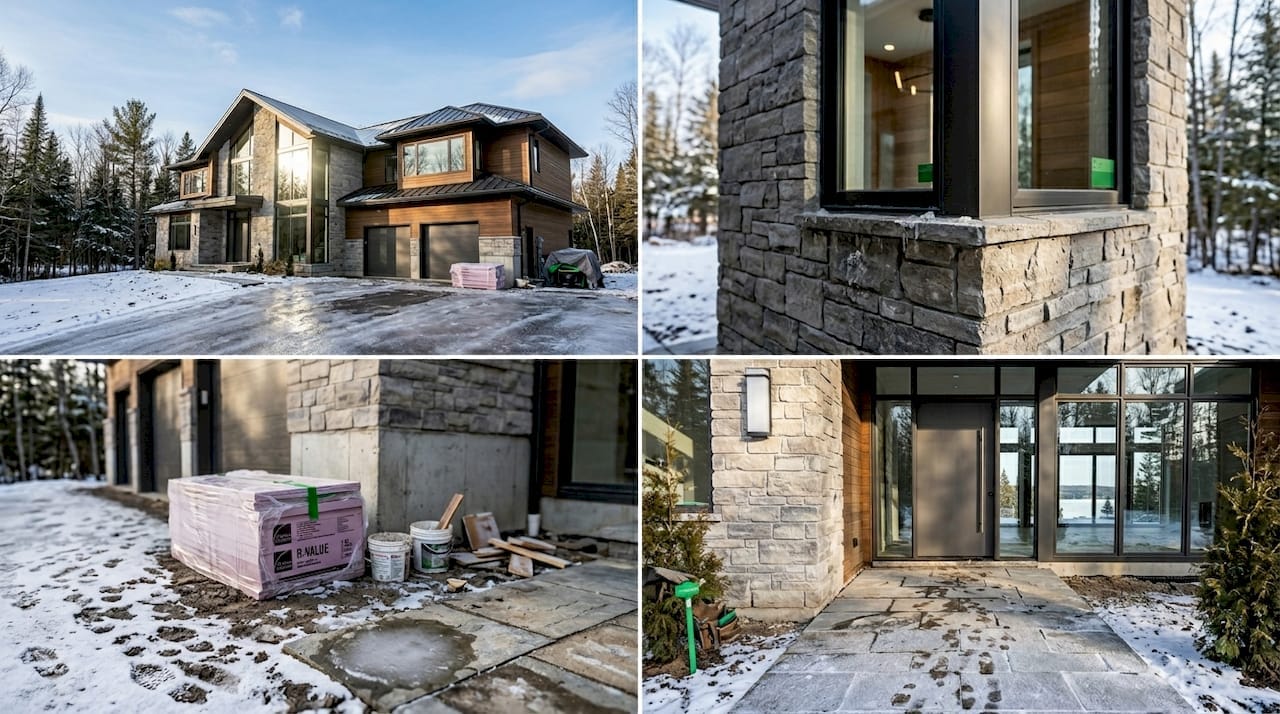
Most homeowners picture the building envelope as simply walls and a roof. The reality is far more layered. The building envelope is the complete physical boundary separating your conditioned interior from the outdoor environment, and it governs every aspect of comfort, energy use, and long-term durability in your home. For custom luxury builds and high-end renovations across South Georgian Bay, getting the envelope right is the single most important decision you will make. This article breaks down what the building envelope is, its key components, the best system types, and what performance standards truly matter in our climate.
Table of Contents
- What is a building envelope?
- Key components of a high-performance envelope
- Types of building envelope systems: Pros and cons
- Building envelope performance: What really matters
- Climate matters: South Georgian Bay building envelope essentials
- Common pitfalls and expert solutions for custom home envelopes
- How building envelopes add value to luxury properties
- Bringing your high-performance building envelope to life
- Frequently asked questions
Key Takeaways
| Point | Details |
|---|---|
| Envelope definition | The building envelope separates inside from outside, including walls, roof, and foundation. |
| Luxury home essentials | Continuous insulation, airtightness, and smart moisture control are vital for luxury South Georgian Bay homes. |
| Climate adaptation | Canada’s harsh climate demands high R-values and moisture control for lasting comfort and durability. |
| Performance matters | Top-tier envelopes reduce energy use, increase comfort, and boost home value. |
| Expert solutions | Professional guidance prevents common problems and ensures optimal building envelope performance. |
What is a building envelope?
The building envelope is every element that stands between your living space and the outside world. Think of it as your home’s protective shell. It controls what gets in and what stays out, from heat and cold to moisture and air.
The primary functions of a well-designed envelope include:
- Air control: Preventing unwanted air movement in and out
- Water control: Shedding rain and blocking ground moisture
- Vapour control: Managing humidity to prevent condensation inside walls
- Heat control: Slowing the transfer of warmth between inside and outside
- Structural support: Carrying loads and resisting wind and snow
Every one of these functions must work together. A gap in any one of them creates problems that ripple through the entire home. Choosing quality materials in construction from the start is what separates a truly durable luxury home from one that looks impressive but underperforms over time.
Key components of a high-performance envelope
A high-performance envelope is not a single product. It is a carefully assembled system of components, each with a specific job.
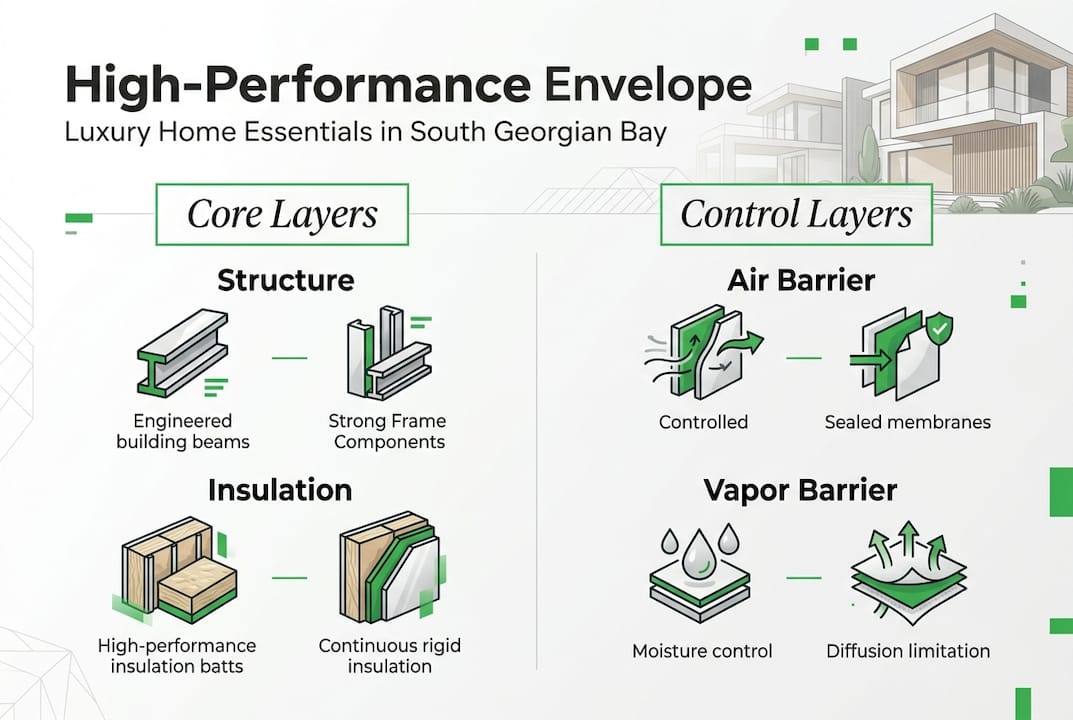
| Component | Primary role | Luxury home priority |
|---|---|---|
| Roof assembly | Top weather barrier, drainage | High R-value, ice dam prevention |
| Exterior walls | Insulation, structural, air/vapour | Continuous insulation layers |
| Windows and doors | Openings, light, ventilation | Triple-glazed, thermally broken frames |
| Foundation | Structural base, moisture block | ICF or waterproofed concrete |
| Insulation | Thermal resistance throughout | Spray foam, rigid board, or mineral wool |
| Air and vapour barriers | Airtightness and moisture control | Continuous, taped, and detailed |
The key components each serve a distinct function, but they only perform at their best when they are integrated as a system. A premium roof assembly means little if the wall-to-roof junction leaks air. Triple-glazed windows lose their advantage if the rough opening is poorly sealed.
For foundations in South Georgian Bay, ICF construction (Insulated Concrete Form) delivers exceptional thermal mass and moisture resistance, making it a top choice for luxury builds in our climate. Our team at Mighton Construction has built complete envelope solutions that treat every junction and transition as a critical detail, not an afterthought.
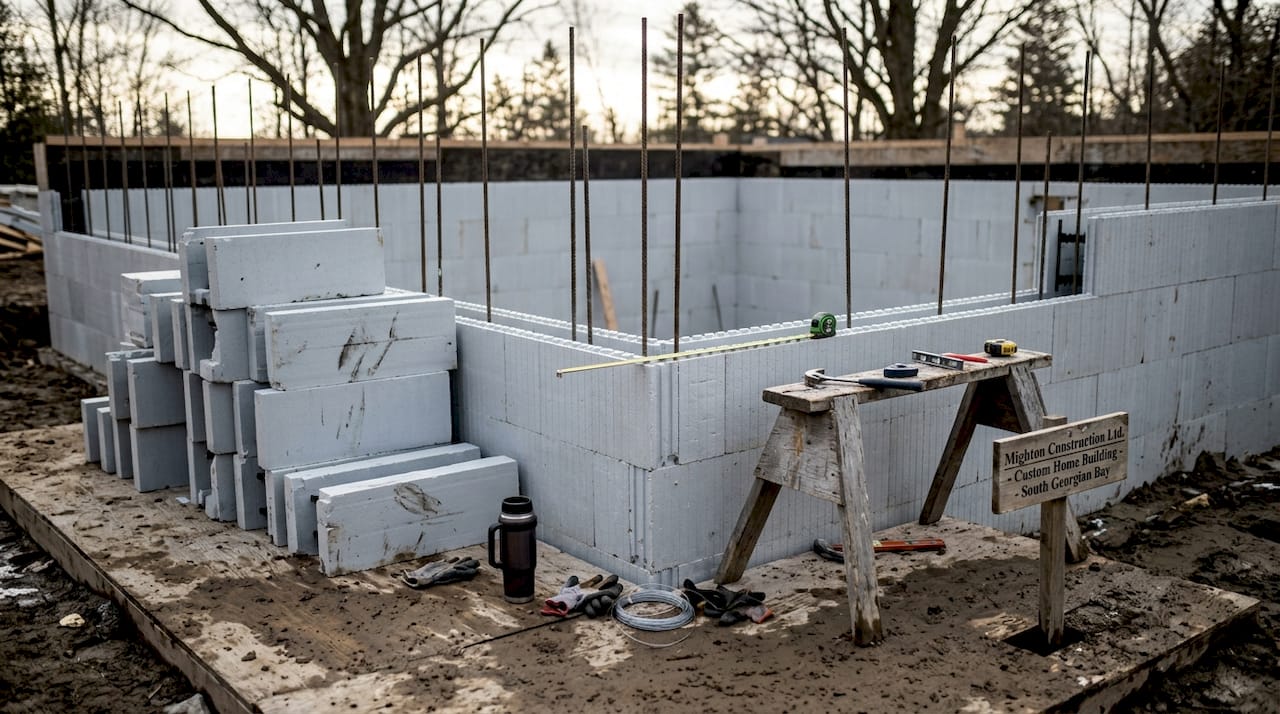
Pro Tip: Pay close attention to the transitions between components, where the wall meets the roof, where the foundation meets the wall. These junctions are where most envelope failures begin.
Types of building envelope systems: Pros and cons
Not all envelopes are built the same way. The system types range from basic single-layer assemblies to sophisticated double-skin facades, each with trade-offs in cost, performance, and complexity.
| System type | How it works | Best for |
|---|---|---|
| Single envelope | All control layers in one assembly | Budget builds, mild climates |
| Double-skin | Outer facade plus ventilated cavity | Luxury homes, high moisture zones |
| Pressure-balanced | Equalises pressure to stop water entry | Exposed coastal or lakefront sites |
| Double-barrier | Primary plus secondary water barrier | High-risk or complex geometries |
| Mass wall (ICF) | Thermal mass absorbs and releases heat | Cold climates, energy performance |
| Lightweight (wood frame) | Cavity insulation, faster build | Common residential, lower cost |
For luxury custom homes in South Georgian Bay, the double-skin approach and ICF mass wall systems stand out. A double-skin envelope creates a ventilated cavity that allows moisture to escape, dramatically reducing the risk of rot and mould. Systems-based envelope design treats every layer as part of a coordinated whole rather than isolated products stacked together.
ICF walls offer continuous insulation with no thermal bridging through studs, and the ICF foundation benefits extend well beyond the basement, providing a stable, airtight base for the entire assembly above.
Key advantages of high-performance envelope systems for luxury builds:
- Superior airtightness reduces heating and cooling loads significantly
- Ventilated rainscreen cladding protects the primary water barrier
- Thermal mass in ICF walls moderates indoor temperature swings
- Double-barrier systems provide redundancy against water intrusion
Building envelope performance: What really matters
Performance comes down to three measurable factors: thermal resistance (R-value), airtightness, and moisture management. For luxury homes in South Georgian Bay, the benchmarks are demanding.
For high-performance luxury homes, the targets are:
- Walls: Continuous exterior insulation (R-8 or better) plus cavity fill (spray foam at R-14 or better), for a total wall assembly of R-25 to R-40 or higher
- Roofs: R-60 minimum for cold climate performance
- Airtightness: Less than 1 to 3 ACH50 (air changes per hour at 50 Pascals of pressure)
- Windows: Triple-glazed with thermally broken frames, U-value of 0.20 or lower
Stat to know: Tight envelopes can deliver HERS energy savings of $3,600 per year and allow HVAC systems to be sized 40 to 50% smaller than in a standard build.
Airtightness is often the most underestimated factor. A Passive House energy efficiency standard targets around 0.6 CFM per square foot at 50 Pascals. Even homes that fall short of that standard but achieve under 2 ACH50 see dramatic reductions in drafts, noise, and energy bills. What defines a high-end home standard today is increasingly tied to these measurable performance outcomes, not just finishes and fixtures.
Pro Tip: Ask your builder for a blower door test result at project completion. This single number tells you exactly how airtight your envelope is and whether it meets the performance targets you paid for.
Climate matters: South Georgian Bay building envelope essentials
South Georgian Bay sits in Climate Zone 7, one of Canada’s most demanding building environments. Winters bring extreme cold, heavy snow loads, and persistent wind. Summers swing to heat and humidity. The envelope must handle both extremes without fail.
For cold climate Zone 7 construction, best practices include:
- Placing at least 45% of the total wall R-value on the exterior side of the structure to control condensation within the wall assembly
- Targeting R-40 or higher for walls, achievable with double-stud framing without exterior rigid insulation
- Using permeable wall designs that allow drying toward the exterior
- Installing ventilated rainscreen cladding to drain and dry the cladding layer
- Specifying smart vapour retarders that adjust permeability with seasonal humidity changes
“Permeable wall assemblies that can dry to the exterior are the most forgiving in cold climates, where inward vapour drive in summer can trap moisture in walls designed only for winter conditions.”
Details like covered entryways are not just aesthetic choices. They protect the envelope at its most vulnerable transition points, where doors and windows meet the wall assembly. For waterfront and cottage properties, year-round home comfort depends on an envelope that performs in every season. The resilient exteriors best practices from Green Building Canada reinforce that local climate knowledge is non-negotiable in envelope design.
Common pitfalls and expert solutions for custom home envelopes
Even well-intentioned builds fall short when these common mistakes go unaddressed. Recognising them early saves significant cost and frustration.
- Thermal bridging through studs. Wood studs conduct heat far better than insulation. Thermal bridging via studs can reduce the effective R-value of a wall assembly by 20 to 50%. Continuous exterior insulation breaks this bridge.
- Skipping hygrothermal modelling. For complex assemblies like unvented attics or double walls, hygrothermal modelling is essential to predict where condensation will form and whether the assembly can dry safely.
- Incomplete air barrier continuity. The air barrier must be continuous across all six sides of the building. A single gap at a rim joist or window rough opening undermines the entire system.
- Ignoring wind pressure at corners. Wind pressures are significantly higher at building corners, and envelope detailing must account for this, particularly at exposed lakefront or hilltop sites.
- Choosing finishes before performance. Selecting cladding or roofing materials before the control layer strategy is finalised leads to costly redesigns or compromised performance.
The Perfect Wall concept, placing all control layers on the exterior of the structure, solves most of these problems by keeping the structure warm, dry, and protected. Working with quality construction materials and an experienced ICF contractor ensures these details are handled correctly from the start.
Pro Tip: Request that your design team run hygrothermal modelling on any non-standard wall or roof assembly before construction begins. It costs a fraction of what a mould remediation project will.
How building envelopes add value to luxury properties
A best-in-class building envelope is not just a technical achievement. It is a financial one. The returns show up in multiple ways over the life of your home.
- Lower energy bills: Air leakage accounts for 25% of heat loss in a typical home. A tight envelope eliminates most of that waste.
- Smaller HVAC systems: Tight envelopes allow HVAC sizing reductions of 40 to 50%, cutting equipment costs and mechanical room footprint.
- Higher resale value: Energy performance is increasingly a premium feature that buyers pay for, particularly in the luxury segment.
- Better indoor air quality: A controlled envelope means ventilation is intentional, not accidental. Fresh air comes through a heat recovery ventilator, not through gaps in the wall.
- Long-term durability: Moisture-managed assemblies resist rot, mould, and structural degradation for decades longer than standard builds.
- Reduced carbon footprint: A smaller heating and cooling load means less energy consumed year after year.
For luxury properties in South Georgian Bay, the luxury home value case for a high-performance envelope is straightforward. You spend more upfront on insulation, air sealing, and premium windows, and you recover it through lower operating costs, reduced maintenance, and stronger resale.
Bringing your high-performance building envelope to life
Understanding the building envelope is one thing. Executing it at the level your luxury home deserves is another entirely.

At Mighton Construction, we have spent over 30 years building and renovating homes across South Georgian Bay, from Wasaga Beach and Collingwood to Blue Mountain and beyond. As your custom home builder, we bring deep local knowledge of Zone 7 climate demands, proven ICF and high-performance framing expertise, and a commitment to envelope details that most builders overlook. Browse our luxury home gallery to see how these principles translate into finished homes, or explore our recent projects for inspiration. When you are ready to start planning your build or renovation, our team is here to guide you through every decision.
Frequently asked questions
Why is the building envelope so important for luxury homes?
A high-quality building envelope controls air, water, vapour, and heat while providing structural support, making it the foundation of comfort, efficiency, and durability in any luxury home.
How does climate in South Georgian Bay affect envelope design?
Zone 7 cold temperatures and moisture require 45% exterior R-value placement, R-40 or higher walls, and expert vapour control to prevent condensation and mould.
What materials are best for a high-performance envelope?
Continuous exterior insulation such as Rockwool or EPS rigid board, combined with spray foam cavity fill and smart vapour retarders, delivers the best results for luxury homes in cold climates.
How do building envelopes boost home value?
Tight envelopes cut HVAC sizing by 40 to 50%, reduce energy bills, improve indoor air quality, and increase resale appeal for luxury properties.