
Bathroom renovation advice for Canadian homeowners 2026
TL;DR:
- Bathroom renovations involve updating fixtures without altering layouts, while remodels change structure or plumbing. Proper budgeting, waterproofing, ventilation, and permits ensure long-term durability and safety in bathroom projects. Homeowners should plan carefully, allocate contingency funds, and engage licensed professionals for compliance and quality assurance.
Bathroom renovation advice is defined as expert guidance on updating, redesigning, or rebuilding a bathroom to improve function, style, and long-term value. Whether you own a cottage near Wasaga Beach, a family home in Collingwood, or a property in Springwater, a well-planned bathroom project delivers measurable returns. The best way to remodel a bathroom starts with one decision: are you renovating or remodelling? That single distinction shapes your budget, your timeline, your permit requirements, and every trade you hire. This guide gives you the framework to plan confidently and spend wisely.
How do bathroom renovations differ from remodels and why does it matter?
Bathroom renovation updates finishes and fixtures without changing the room’s layout, while a remodel changes the structure or plumbing configuration. Replacing your tile, vanity, lighting, or mirror is a renovation. Moving a toilet, expanding a shower, or relocating a sink crosses into remodel territory. That distinction matters because it determines cost, complexity, and whether you need a building permit.
Feature
Renovation
Remodel
Layout changes
No
Yes
Plumbing moves
No
Often
Permit required
Rarely
Usually
Typical timeline
1–3 weeks
4–10 weeks
Cost range (2026)
$3,000–$10,000
$10,000–$40,000+
Renovations suit homeowners who want a fresh look without disrupting daily life. Remodels suit those whose bathroom no longer functions well, perhaps because the layout is awkward, the shower is too small, or accessibility is a concern. Homeowners in South Georgian Bay who are updating a waterfront cottage for resale often find a targeted renovation delivers strong return without the disruption of a full remodel.
The permit question is where many homeowners get tripped up. Cosmetic work rarely requires a permit in Simcoe County, but any work touching structural walls, electrical panels, or drain lines typically does. Pulling the correct permits protects your home insurance coverage and your resale value. Working with a licensed contractor who knows local building codes in Clearview Township or Tiny Township removes that uncertainty entirely.
What are the key budgeting strategies for bathroom renovations?
Mid-range bathroom remodels cost approximately $10,000 to $25,000 in 2026, with labour and materials representing the largest share of that spend. A standard 50 to 60 square foot bathroom averages $15,000 to $20,000 nationally. Canadian homeowners in premium markets like Blue Mountain or Collingwood should budget at the higher end of any range, given regional labour rates and material shipping costs.
Budgeting by category prevents the most common planning mistake: underestimating costs and making expensive mid-project changes. Think in three tiers:
- Cosmetic refresh (paint, fixtures, hardware, lighting): $3,000 to $8,000, timeline of one to two weeks.
- Partial update (new tile, vanity, shower surround, no layout changes): $8,000 to $18,000, timeline of two to four weeks.
- Full gut remodel (new layout, plumbing moves, full waterproofing, custom tile): $20,000 to $50,000+, timeline of six to ten weeks.
Experts recommend contingency funds of 10% to 20% of the total project budget for bathroom renovations, with 15% to 20% being the common range when water damage risk is present. That means a $20,000 renovation should carry a $3,000 to $4,000 contingency reserve. Older homes in Springwater or Wasaga Beach frequently hide rotted subfloor or corroded supply lines behind existing tile. Without a contingency fund, those discoveries stall your project and force rushed decisions.
The biggest cost drivers in any bathroom project are labour, plumbing relocation, waterproofing, and electrical upgrades. Materials like porcelain tile and solid-surface vanity tops are visible and exciting to choose, but they rarely represent the largest line item. Spend generously on waterproofing membranes and quality fixtures, and save on decorative accessories you can swap out later.
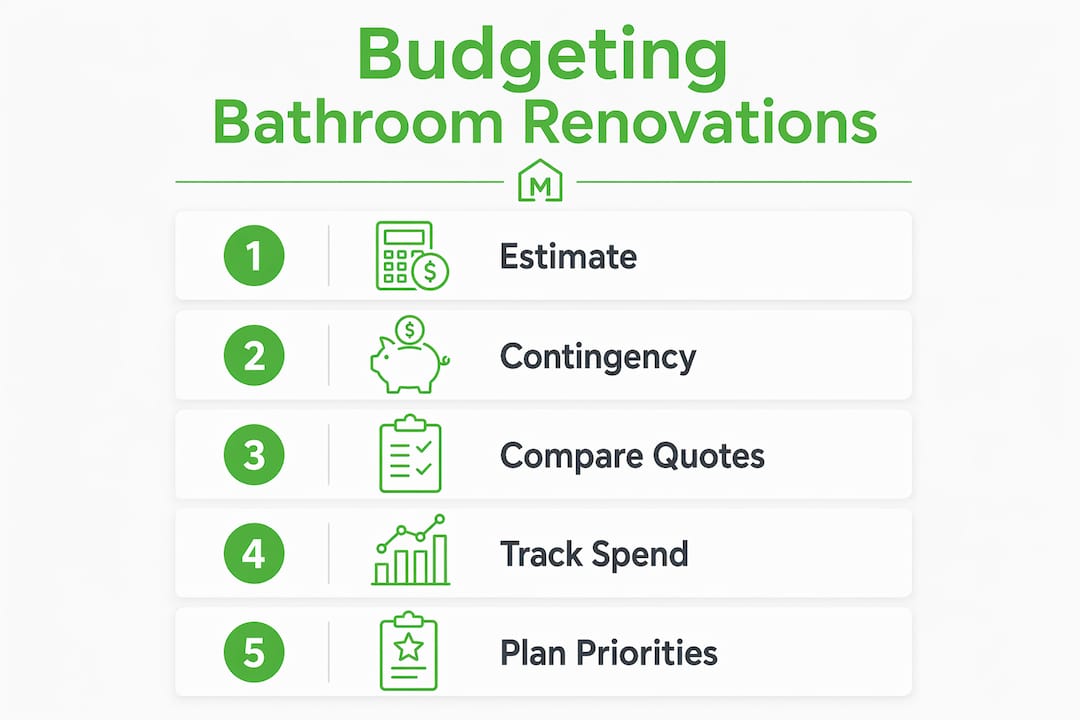
Pro Tip: Get three itemised quotes before committing to any contractor. Ask each quote to separate labour from materials so you can compare apples to apples. A quote that bundles everything together makes it impossible to identify where costs differ.
For more detail on managing renovation spend, the home renovation budget tips guide from Mighton Construction covers contingency planning and trade sequencing in depth.
Which design priorities make a bathroom renovation last?
The best bathroom remodel advice centres on one principle: plan your wet and dry zones before you select a single tile. Wet zones include the shower, tub, and toilet area. Dry zones cover the vanity, storage, and entry area. Keeping plumbing fixtures grouped in the wet zone reduces pipe runs, lowers labour costs, and simplifies waterproofing.
Waterproofing is the single most consequential investment in any bathroom renovation. The professional standard is a 24-hour flood test after shower pan installation, where the pan is filled with water and inspected repeatedly for seepage around the perimeter and drain. Skipping this test is the most expensive shortcut a homeowner can take. A failed shower pan discovered two years after completion means tearing out tile, subfloor, and potentially ceiling material in the room below.
Lighting deserves far more attention than most bathroom renovation tips provide. A single overhead fixture creates flat, unflattering light and deep shadows around the vanity mirror. Layered lighting uses three sources: ambient (overhead), task (flanking the mirror at face height), and accent (toe-kick or niche lighting). Brands like Kichler and Progress Lighting offer bathroom-rated fixtures across all three categories that meet Canadian electrical standards.
Key design elements that separate a durable renovation from a short-lived one:
- Grout selection: Epoxy grout in shower areas resists staining and moisture penetration far better than standard cement grout.
- Tile format: Large-format tiles (600mm x 600mm and above) reduce grout lines and are easier to clean, but require a perfectly level substrate.
- Vanity height: Comfort-height vanities at 90cm suit most adults and are a low-cost accessibility upgrade.
- Storage: Recessed niches in shower walls and medicine cabinets with integrated lighting add function without consuming floor space, which matters most when renovating a small bathroom.
Pro Tip: When renovating a small bathroom, use large-format light-coloured tile on the floor and walls to make the space read as larger. Avoid busy patterns or dark grout, which visually shrink the room.
The luxury bathroom renovation workflow article on the Mighton Construction site walks through the full design-to-finish sequence for premium projects.
What are the technical safety codes every bathroom renovation must meet?
Electrical and ventilation codes are non-negotiable in any bathroom renovation, and they are the area where DIY projects most commonly fail inspection. GFCI protection is required for all bathroom receptacles under NEC 210.8(A)(1), and dedicated 20-amp circuits are the standard for bathroom wiring. GFCI breakers cost approximately $40 to $80 each. That is a small price relative to the fire and electrocution risk of an unprotected circuit in a wet environment.
Technical requirement
Standard
Why it matters
GFCI protection
NEC 210.8(A)(1), all receptacles
Prevents electrocution near water
Circuit amperage
Dedicated 20A circuit
Handles hair dryers and heaters safely
Wiring gauge
12 AWG minimum on 20A breakers
Code compliance and fire prevention
Exhaust fan airflow
Removes moisture before mould forms
Fan certification
HVI-listed, exterior-vented
Confirms rated performance
Mechanical ventilation is required in any bathroom without an operable window, and even when a window exists, a fan is the better long-term solution. The IRC 2024 standard sets minimum airflow at 50 CFM intermittent or 20 CFM continuous, with the fan exhausting directly to the exterior. Fans that vent into attic spaces are a code violation and a direct cause of structural rot. For guidance on proper installation standards, ventilation installation experts can clarify what exterior-vented systems require in your specific build type.
Ventilation failures cause moisture problems leading to mould, rot, and costly repairs. This is one of the most common red flags seen in bathroom renovations gone wrong across Canada. A quality exhaust fan from Panasonic or Broan, properly sized and vented, costs $150 to $400 installed. Remediation of mould damage caused by an undersized or improperly vented fan can cost $5,000 or more.
Permits and inspections exist to catch these issues before they become expensive problems. In Simcoe County and across Ontario, electrical work in a bathroom renovation requires a licensed electrician and an ESA inspection. Plumbing work touching drain lines or supply pipes requires a licensed plumber and a municipal inspection. These are not optional steps. They are the mechanism that protects your home’s value and your family’s safety.
Key takeaways
Successful bathroom renovation advice comes down to four decisions: know whether you are renovating or remodelling, budget with a 15% to 20% contingency, invest in waterproofing and ventilation first, and pull every required permit.
Point
Details
Renovation vs. remodel
Renovation updates finishes; remodel changes layout or plumbing. Choose based on function and budget.
Contingency budgeting
Reserve 15%–20% of total budget for hidden water damage or structural surprises.
Waterproofing first
A 24-hour shower pan flood test is the professional standard. Never skip it.
Ventilation codes
Minimum 50 CFM exhaust fan, HVI-listed, vented to exterior. Required by IRC 2024.
Permits protect value
Electrical and plumbing inspections in Ontario are mandatory and protect resale value.
What I have learned after 30 years of bathroom renovations in South Georgian Bay
After three decades of building and renovating bathrooms across Wasaga Beach, Collingwood, and the Blue Mountain area, the pattern I see most often is this: homeowners spend weeks choosing tile and almost no time thinking about what goes behind it. The tile is what you see. The waterproofing membrane, the exhaust fan, and the subfloor condition are what determine whether that tile is still looking good in fifteen years.
The second mistake I see constantly is under-budgeting and then cutting corners when surprises appear. Every bathroom renovation I have ever managed has revealed something unexpected once the walls opened up. Corroded copper supply lines. Rotted OSB subfloor from a slow shower leak. Knob-and-tube wiring that nobody knew was there. A 15% contingency is not pessimism. It is experience.
My honest advice on timelines: standard remodels run three to six weeks, and complex projects extend to ten weeks or more. Homeowners who plan for six weeks and finish in four are happy. Homeowners who plan for two weeks and finish in six are frustrated, even when the result is excellent. Set realistic expectations with your contractor at the start, get a written schedule, and build in buffer time around trade inspections.
The homeowners I see get the best results are the ones who treat their contractor as a partner, not just a vendor. They ask questions. They show up for key inspections. They understand that a premium bathroom renovation in Simcoe County is a significant investment, and they protect it by staying engaged throughout the process.
— Adam
Plan your bathroom renovation with Mighton Construction
Mighton Construction has delivered premium bathroom renovations across South Georgian Bay for over 30 years, serving homeowners in Wasaga Beach, Collingwood, Blue Mountain, and throughout Simcoe County. Every project is managed from initial design through final inspection, with transparent communication and meticulous attention to waterproofing, electrical compliance, and finish quality.

Whether you are refreshing a guest bath or gutting a primary suite, the team at Mighton Construction brings the trades, the experience, and the local code knowledge your project requires. Browse completed projects in the renovation gallery or connect directly with the bathroom renovation experts at Mighton Construction to discuss your project and get a detailed quote.
FAQ
What is the difference between a bathroom renovation and a remodel?
A renovation updates finishes and fixtures without changing the layout, while a remodel changes the room’s structure or plumbing configuration. Replacing tile and a vanity is a renovation; moving a toilet or expanding a shower is a remodel.
How much does a bathroom renovation cost in Canada in 2026?
Mid-range bathroom remodels cost approximately $10,000 to $25,000 in 2026, with a typical 50 to 60 square foot bathroom averaging $15,000 to $20,000. Cosmetic refreshes start around $3,000, while full gut remodels in premium markets can exceed $50,000.
How long does a bathroom renovation take?
Cosmetic refreshes take one to two weeks, standard remodels run three to six weeks, and complex projects with plumbing moves or custom work extend to six to ten weeks. Trade scheduling and material lead times are the most common causes of delays.
Do I need a permit for a bathroom renovation in Ontario?
Cosmetic work rarely requires a permit, but any electrical, plumbing, or structural work does. In Ontario, electrical work requires a licensed electrician and an ESA inspection. Plumbing work touching drain lines requires a licensed plumber and a municipal inspection.
What is the most important technical requirement in a bathroom renovation?
GFCI protection on all receptacles and a properly vented exhaust fan are the two most critical code requirements. The IRC 2024 standard requires a minimum of 50 CFM of airflow exhausted directly to the exterior to prevent moisture damage and mould.